The Value Proposition Canvas Model: A Practical 2026 Guide
Roughly 43% of startups collapse because they build something the market does not need. That single figure explains why so many teams reach for a structured method to test their offer before committing budget. The value proposition canvas model exists precisely for that reason, giving you a disciplined way to connect what you build to what customers actually value. Before you refine your messaging, it helps to define a Strong value proposition grounded in real customer evidence.
The stakes are measurable. According to youStartups data, most startup failures tied to poor product-market fit are preventable when you validate demand before scaling spend. A visual framework turns vague assumptions into testable statements, so your product decisions rest on evidence rather than optimism.
What the value proposition canvas model actually is
The framework is a tool used to analyze, evaluate, and adjust the value of a product or service so it aligns with customer requirements. Alexander Osterwalder, together with Yves Pigneur and Alan Smith, created it to help companies design, test, and build propositions that match customer needs and jobs-to-be-done. In practical terms, it is an extension that zooms into two blocks of the broader Business Model Canvas: customer segments and value propositions.
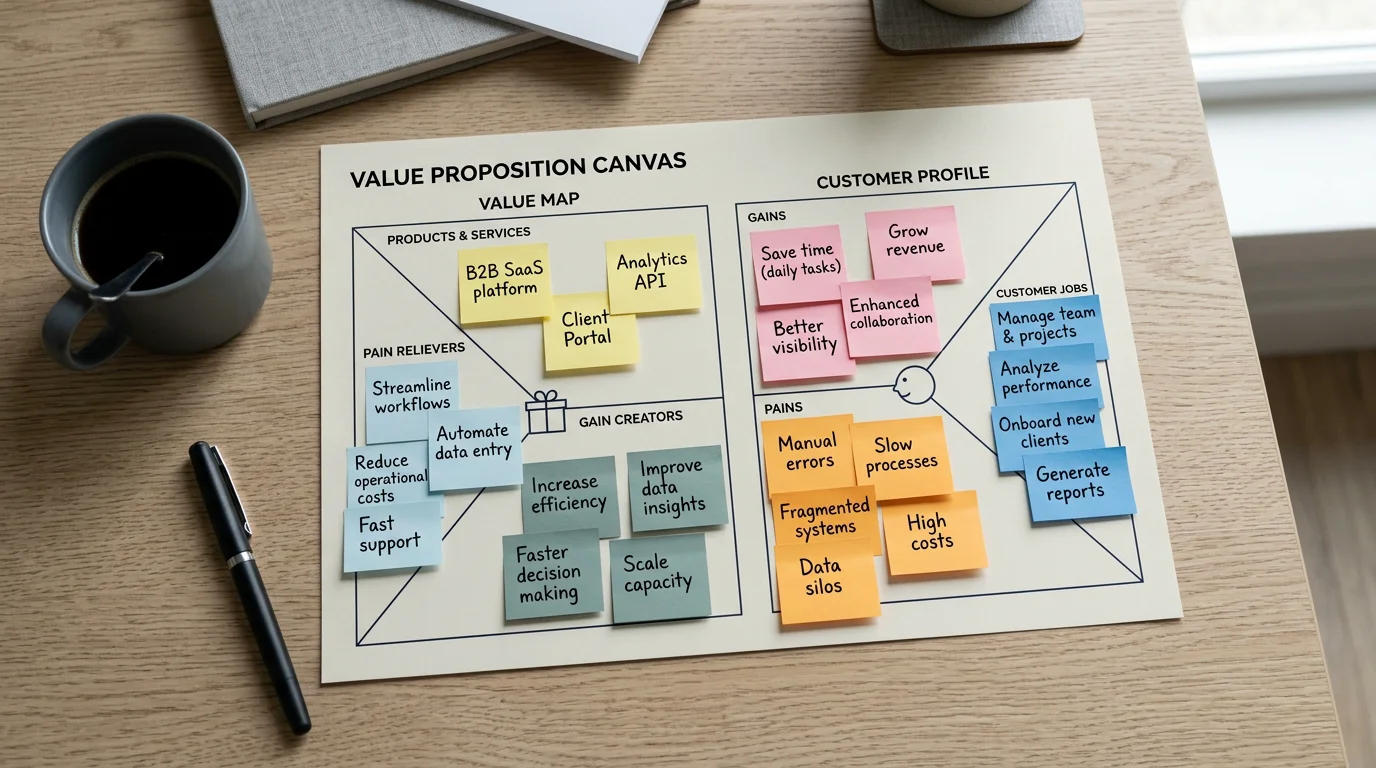
The canvas is split into two halves that must mirror each other. On the right sits the customer profile, describing the people you serve. On the left sits the value map, describing your offer. When the left half addresses the most important elements of the right half, you have reached what practitioners call fit. If you are building a broader model around this exercise, our Startup Business Canvas places the value proposition inside its full commercial context.
The customer profile: jobs, pains, and gains
Start with the people, not the product. The customer profile records your assumptions about who you serve, then tests them against reality. Its purpose is not to design an ideal customer but to understand real ones, and it contains three components.
- Customer jobs are the functional, social, and emotional tasks people try to complete, the problems they solve, and the needs they satisfy.
- Pains are the negative experiences, emotions, and risks encountered before, during, and after getting a job done.
- Gains are the outcomes and benefits customers want, including results that would genuinely delight them.
Create a separate profile for each customer segment, because every segment carries distinct jobs, pains, and gains. Once listed, rank each item by importance to the customer. This ranking matters: it tells you which frustrations and desires deserve your attention and which are merely nice to address.
The value map: products, pain relievers, and gain creators
The value map mirrors the profile. It consists of your products and services, the pains they relieve, and the gains they create. A common mistake is trying to answer every job at once. A business should address the most important jobs, pains, and gains well; attempting to cover all of them usually means doing all of them poorly.
Pain relievers describe exactly how your offer alleviates specific customer frustrations, while gain creators describe how it produces the outcomes people want. Honesty is essential here. Not every pain can be fully relieved, and claiming otherwise weakens the exercise. When you are ready to test different configurations of your offer, our guide to Business Model Prototyping shows how to iterate before you commit resources.
How to achieve fit and product-market fit
Identifying your proposition on paper is only the first stage. Fit is reached when the products and services in your value map address the most significant pains and gains in the customer profile. You then validate what matters to customers, gather their feedback, and refine continually.
The link to survival is direct. Startups that reach product-market fit grow substantially faster than those still searching for their core value, and structured validation is what shortens that search. A widely used checkpoint is the Sean Ellis test, which MVP research summarizes as a signal of fit when at least 40% of users would be very disappointed to lose the product. Treat the canvas as a living document, revisited whenever new segments or propositions surface.

Where the value proposition canvas fits among other tools
The canvas is one instrument in a wider strategy toolkit. It is deliberately narrow, going deep on two blocks rather than describing an entire business. Understanding its boundaries helps you choose the right tool for the moment.
| Tool | Primary focus | Best used when |
|---|---|---|
| Value proposition canvas | Fit between customer jobs, pains, gains and your offer | Refining or launching a specific offering |
| Business Model Canvas | The whole business, across nine building blocks | Mapping how the entire company creates value |
| Deckadence strategy frameworks | Board-ready analysis with structured storytelling and visuals | Presenting the proposition to decision-makers |
The canvas answers whether your offer matches customer needs. It does not, by itself, communicate that answer persuasively to a board. That translation, from analysis to a decision-ready narrative, is where a dedicated presentation system earns its place. According to CB Insights figures, a meaningful share of startups still close because their offer never fit market needs, which underscores why the diagnostic and its clear communication both matter.
Common mistakes to avoid
Even a proven framework fails when applied carelessly. A few recurring errors dilute its value.
- Mixing several segments into one profile, which blurs the distinct jobs, pains, and gains you must serve.
- Confusing gains with the inverse of pains; a gain is more than the simple removal of a frustration.
- Overloading the value map instead of concentrating on the most important priorities.
- Skipping validation and treating assumptions as facts, the single habit most likely to produce a product nobody wants.
Avoiding these traps keeps the exercise grounded in evidence and prevents the false confidence that a tidy diagram can create.
Turning the canvas into confident decisions
Used well, the value proposition canvas model converts guesswork into a testable map of customer jobs, pains, and gains matched to your offer. Build one profile per segment, rank ruthlessly, and validate with real customers before you scale. The framework is not a one-time diagram but a living tool that sharpens fit over time. Its true payoff arrives when the clarity you gain reaches the people who decide, expressed as a narrative they can act on quickly.
Take action with Deckadence
You have mapped the fit between what customers need and what you deliver. The next challenge is presenting that insight so leaders and boards grasp it in seconds and move to a decision. Analysis only creates momentum when it is communicated with clarity and structure.
We combine proven strategy frameworks, structured storytelling, and board-level visuals to help you turn a completed canvas into a persuasive case. Explore our Value Proposition Canvas template, built for PowerPoint, Keynote, and Figma, to translate your customer insight into a slide system that aligns stakeholders and accelerates decisions.
Frequently Asked Questions
Who created the value proposition canvas?
Alexander Osterwalder developed it alongside Yves Pigneur and Alan Smith. It was popularized through the book Value Proposition Design and is applied in organizations and start-ups worldwide.
How does it differ from the Business Model Canvas?
The value proposition canvas zooms into two blocks of the Business Model Canvas: customer segments and value propositions. It examines them in far greater detail so you can define stronger, more targeted customer value propositions.
How many canvases should I create?
Create one canvas for each distinct customer segment, because each has its own jobs, pains, and gains. A single blended profile hides differences that matter and weakens the fit you are trying to achieve.
Can it help me reach product-market fit?
Yes. By matching your pain relievers and gain creators to ranked customer needs, the canvas guides you toward fit. Pair it with customer feedback and validation checkpoints, and revisit it whenever new segments emerge.
How do I present a completed canvas to decision-makers?
Translate the analysis into a clear, structured narrative supported by board-ready visuals. Our template and slide systems help you convert customer insight into a persuasive deck that aligns stakeholders and speeds up decisions.