Nearly three-quarters of consumers now name value for money as the leading attribute when they weigh a product or service. That single figure explains why a strong value proposition has become the difference between a business that converts and one that is overlooked. Before you can earn attention, you must state, in plain language, why someone should choose you. To structure that thinking from the very start, our Value Proposition Canvas Template gives you a repeatable place to begin.
According to PwC research, value for money leads the attributes buyers consider, ahead of cost and ease of use. Yet many teams still confuse a value proposition with a slogan. It is not a tagline; it is a promise built on customer needs, competitive difference, and evidence. Get it right and you shorten sales cycles, align stakeholders, and move people to act with confidence.
What Makes a Value Proposition Truly Strong
A value proposition is a statement that clearly conveys the unique benefits you deliver and why you deliver them better than anyone else. It answers a single question in the buyer's mind: what is in it for me? The strongest versions do not describe features. They connect an offering to a problem the customer genuinely wants to solve.
Context matters, because competition keeps intensifying. In its 2026 outlook, ApplyBoard observes that the contest to attract audiences has rarely been more demanding, which raises the bar for any compelling promise. When many alternatives look similar, clarity wins. A value proposition that is specific, credible, and easy to repeat is far harder for a competitor to copy.
Strong statements also share a discipline: they focus on a few high-impact needs rather than trying to serve everyone. They align with how customers measure success, and they outperform rivals substantially on at least one dimension that people actually care about.
The Core Components of a Compelling Value Proposition
Behind every persuasive statement sits a repeatable structure. You do not need creative inspiration so much as a checklist of elements that, together, make the promise believable.
- Relevance: the offer speaks directly to a defined audience and the problem it wants solved.
- Quantified value: the benefit is measurable, such as time saved or cost reduced, not vague claims of "high quality".
- Differentiation: it states what you provide that competitors cannot or do not.
- Proof points: data, testimonials, or results that reduce perceived risk.
These components rarely stand alone. A value proposition is embedded in a wider business model, and a weak model undermines even the sharpest wording. If you want to see how the promise connects to revenue, customers, and delivery, our Business Model Overview shows where a value proposition sits inside the bigger picture.
Mapping Customer Jobs, Pains, and Gains
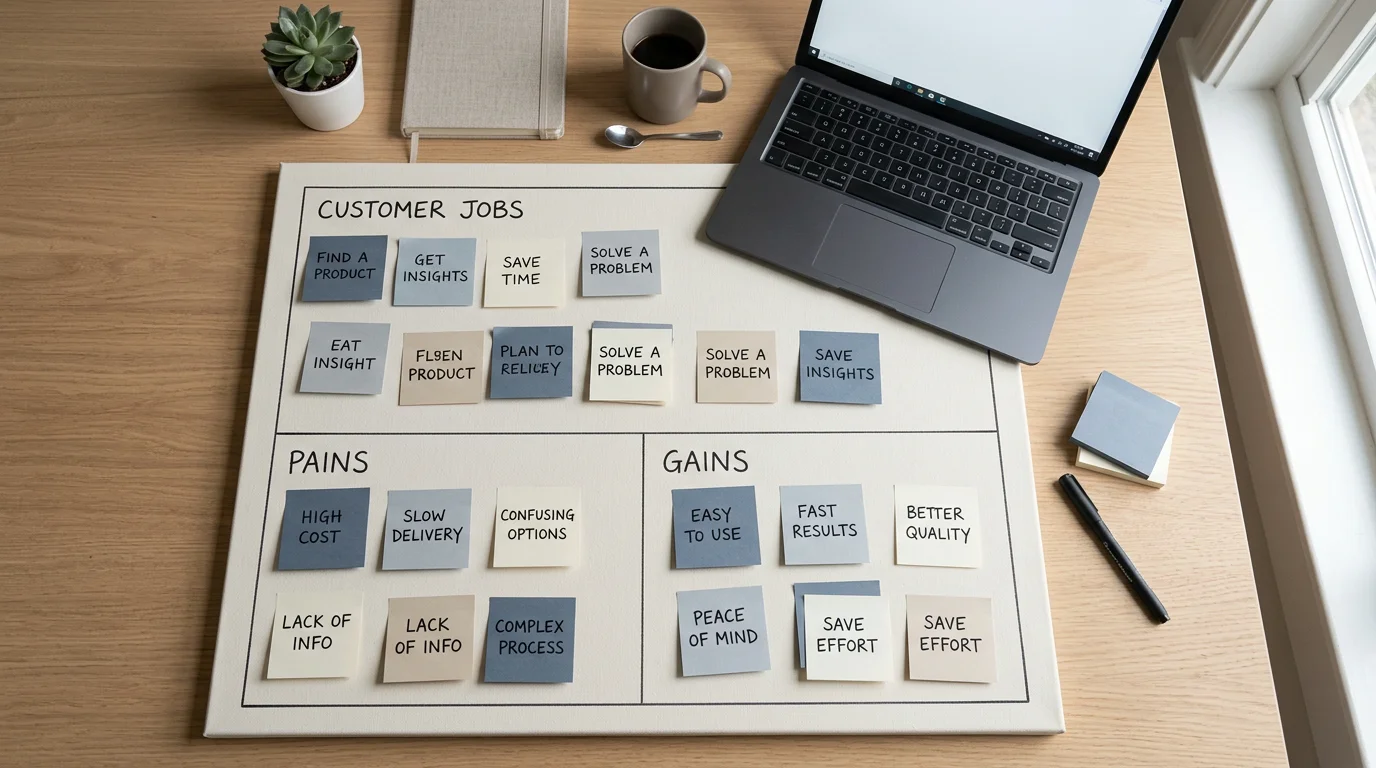
The most reliable way to design a promise is to start with the customer, not the product. The jobs to be done approach, popularized by the late Harvard professor Clayton Christensen, argues that people "hire" a product to make progress on a task. Understand that task and the value writes itself.
Work through three questions before drafting anything. First, what functional, social, and emotional jobs is your customer trying to complete? Second, what pain points stand in the way, such as wasted time, high cost, or unreliable alternatives? Third, what gains would delight them, from measurable savings to greater status or peace of mind?
Rank each item by intensity and frequency. A pain that is severe and constant deserves more attention than one that is mild and rare. This ranking prevents a common failure: spreading a message across too many benefits until none of them land. Focus on the few that carry the most weight and clarify your path toward product-market fit.
How to Write a Value Proposition Step by Step
Once you understand the customer, drafting becomes a structured task rather than a guessing game. A simple sequence keeps the work honest and testable.
- Define the target customer. Name the specific segment and their motivations, not a generic "everyone".
- Pinpoint the primary pain. Identify the single problem that matters most to that segment.
- Describe your solution. Explain how your offering removes that pain in plain terms.
- Highlight the benefit. Lead with the outcome the customer values, quantified where possible.
- State the difference. Make clear what sets you apart from the obvious alternatives.
- Provide proof. Add evidence that the claim is credible.
Steve Blank's formula offers a useful skeleton: we help a defined customer achieve an outcome by doing something specific. Draft several versions, then test them with people unfamiliar with your business. If confusion appears, revise. A value proposition is refined through iteration, not perfected in one sitting.
From Statement to Persuasive Delivery

A well-worded promise still fails if it is delivered poorly. This is where many teams lose deals. Reporting a Forrester finding, Prospeo notes that only about 15 percent of sales conversations add enough value to justify the buyer's time. The wording may be sound, but the delivery communicates nothing.
The remedy is to treat your value proposition as a system you run across every conversation, supported by clear board-ready visuals rather than dense text. People retain and act on what they can see. If you want to understand why structured, visual delivery persuades, our Why Visuals Work explanation covers the underlying evidence.
Practically, this means turning your statement into a short narrative: the customer's problem, the stakes of inaction, your solution, and the proof. Consistency reinforces the message, so the same promise should appear on your website, in your decks, and in every stakeholder discussion.
Common Mistakes That Weaken the Promise
Even experienced teams undermine strong ideas with avoidable errors. Watch for these recurring traps.
- Being too vague. "Best in class" tells the buyer nothing they can verify.
- Listing too many benefits. Crowding the message dilutes the one point that matters.
- Describing features, not outcomes. Buyers care about results, not specifications.
- Skipping proof. Claims without evidence invite doubt and delay.
- Never testing. A statement that is never validated is merely a guess.
The biggest threat is rarely a rival; it is inaction. Many qualified opportunities stall simply because the buyer chooses the status quo. A precise, evidenced value proposition directly counters that inertia by making the cost of doing nothing visible.
Turning Clarity Into Decisions
Building a compelling value proposition is less about clever phrasing and more about disciplined thinking. Start with the customer's jobs, pains, and gains. Focus on the few benefits that carry the most weight, quantify them, and back them with proof. Then deliver the message with clarity and consistency so it survives contact with busy decision-makers. When the reasoning is sound and the presentation is clean, the promise does the persuading for you, and decisions follow more quickly.
Take action with Deckadence
Once your value proposition is clear, the challenge shifts to communicating it in a way that commands the room. Complex ideas stall when they arrive as walls of text, and even the sharpest strategy loses momentum without a structure that decision-makers can follow at a glance.
We combine proven strategy frameworks, structured storytelling, and board-level design to help you turn analysis into persuasive presentations. Explore our consulting-grade slide systems and strategy frameworks to prepare board-ready decks in PowerPoint, Keynote, and Figma that make your thinking show as clearly as it reads.
Frequently Asked Questions
What is the difference between a value proposition and a slogan?
A slogan is a memorable phrase built for recall, while a value proposition is a reasoned promise built on customer needs, differentiation, and proof. A slogan may support the proposition, but it cannot replace it. The proposition must stand up to scrutiny, not just sound appealing.
How long should a value proposition be?
Aim for one or two sentences that a stranger can understand immediately. The goal is clarity, not brevity for its own sake. If the reader cannot restate your promise after reading it once, it is too complicated.
How do I know if my value proposition is strong enough?
Test it with people unfamiliar with your business and watch for confusion or hesitation. A strong version is specific, credible, and difficult for a competitor to copy. If feedback reveals doubt, refine the wording and the proof behind it.
Which frameworks help me build a value proposition?
The jobs to be done approach and the value proposition canvas are widely used starting points, and they pair well with broader tools such as SWOT or the Business Model Canvas. Our framework library and templates give you structured, board-ready versions of these methods. They keep the analysis rigorous while remaining easy to present.
How often should I revisit my value proposition?
Markets and customer needs evolve, so treat the proposition as a living statement rather than a one-time exercise. Review it whenever your audience, competition, or offering shifts meaningfully. Regular testing keeps the promise aligned with what buyers actually value.