Roughly one in three failed startups collapse for a single reason: nobody wanted what they built. This is not a design flaw or a funding problem. It is a value problem. A value proposition canvas template exists to prevent exactly that outcome, forcing you to describe customer reality before describing your solution. To move faster from a blank page to a defensible offer, our strategy framework library gives you a structured starting point.
The tool is deceptively simple, yet the stakes are high. According to figures cited from CB Insights research, 35% of startups fail due to a lack of market need. A canvas will not guarantee demand, but it makes weak assumptions visible early, when they are still cheap to fix rather than expensive to unwind.
What a value proposition canvas template actually is
The value proposition canvas is a framework developed by Alexander Osterwalder to align what you offer with what customers genuinely want. It sits alongside the Business Model Canvas and zooms into one relationship: the fit between a customer segment and the value you promise them.
A template turns that theory into a repeatable working surface. Instead of debating positioning in abstract terms, your team fills in defined boxes, compares both sides, and reaches agreement grounded in evidence. The value proposition itself is best understood as a plain answer to a hard question: why should this specific audience care about what you offer, right now?
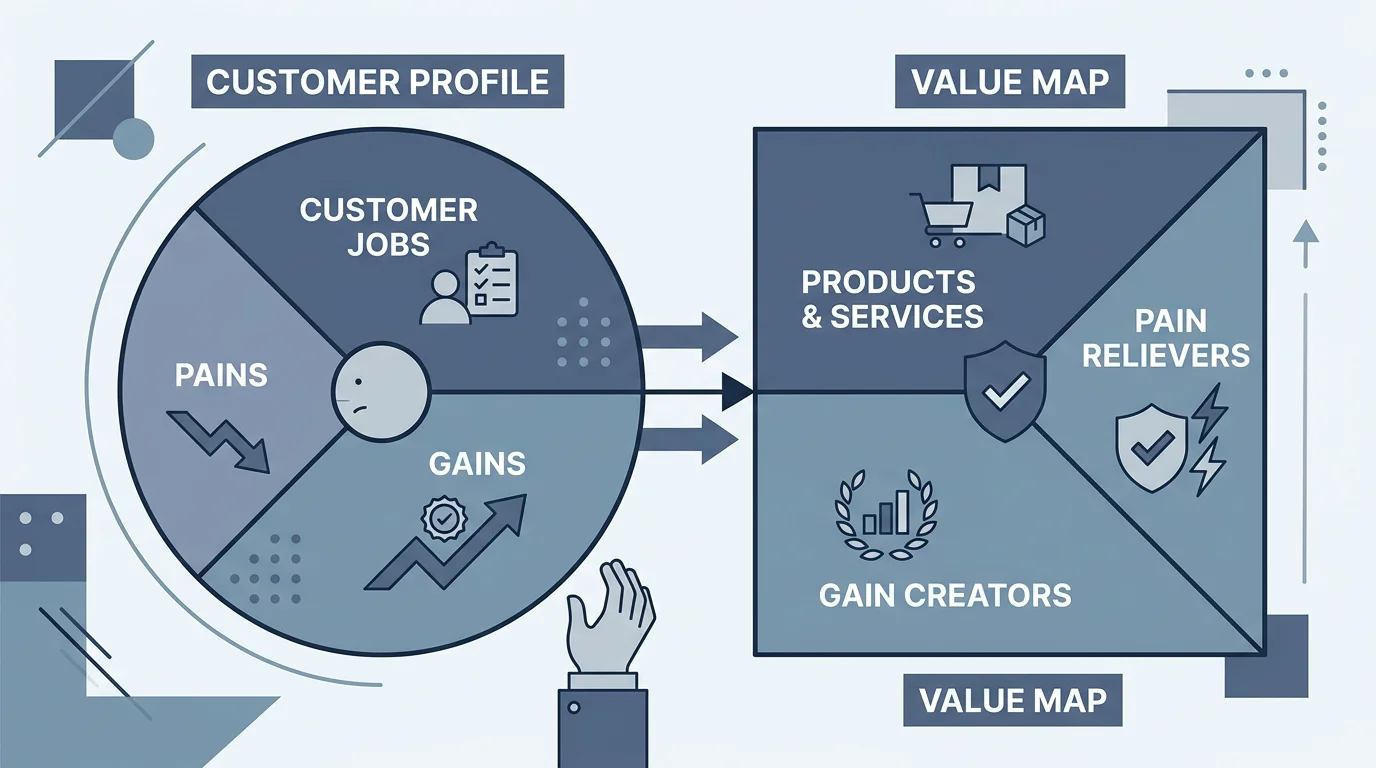
The two sides: customer profile and value map
Every template splits into two halves that must mirror each other. On the right sits the customer profile, describing the people you serve. On the left sits the value map, describing how your offer responds to them.
The customer profile contains three elements:
- Customer jobs: the tasks, problems, or needs your audience is trying to accomplish, functional, social, and emotional.
- Pains: the frustrations, risks, and obstacles they face while trying to get those jobs done.
- Gains: the outcomes and benefits they hope for, from concrete savings to reputational wins.
The value map answers each of those in turn:
- Products and services: the concrete offering your value proposition is built on.
- Pain relievers: how your offer removes or reduces specific customer pains.
- Gain creators: how your offer produces the outcomes customers actively want.
Fit occurs when your pain relievers and gain creators address the pains and gains that customers rank as most important. Alignment on trivial pains does not count.
How to build your canvas step by step
Where should you begin? Not with your product. Start on the customer side, because a template completed from the offer inward simply reprints your existing assumptions.
- Define one segment. A single canvas serves a single customer profile. If you address several segments, build several canvases.
- Map jobs, pains, and gains using real inputs: interviews, support tickets, sales call notes, and survey verbatims rather than internal guesses.
- Rank ruthlessly. Mark which jobs are critical and which pains are severe. Priority is what makes a canvas useful.
- Fill the value map only after the profile is complete, connecting each pain reliever and gain creator to a ranked item.
- Check the fit line by line, then test the resulting statement with actual customers.
That final test matters more than internal consensus. As reported by Entrepreneur, the Sean Ellis test holds that if 40% of your customers would be "very disappointed" to lose access to your product, you have a strong signal of fit. Your canvas is a hypothesis until behavior confirms it.
Why value alignment decides survival
The canvas earns its place because misaligned value is not a cosmetic issue; it is a leading cause of failure and forced change. When founders realize their promise does not land, they rarely quit outright. They pivot.
The pattern is visible in the data. Drawing on the Startup Genome Report, one 2026 founders' guide notes that value proposition changes account for 28% of all startup pivots, second only to customer segment shifts at 38%. Both categories describe exactly what the canvas is built to interrogate: who you serve and what you promise them.
A completed template does not remove the risk of a pivot, but it relocates the moment of discovery. A cheap correction on a canvas is preferable to an expensive correction after a launch. To connect this thinking to execution timelines, our business roadmap template for results helps you sequence the tests that validate or retire each assumption.
From analysis tool to persuasive presentation
Here is the step most teams skip. A canvas that stays inside a workshop file changes nothing. Its conclusions have to reach the people who approve budgets, headcount, and roadmaps, and those people rarely read raw canvases.
This is where the framework becomes a communication problem, not only an analytical one. A ranked pain, a matched pain reliever, and a proof point can be translated into a single, defensible slide. Visual clarity is not decoration here; it is what allows a decision-maker to grasp the fit in seconds. Our explanation of why visuals work for persuasive slides covers the mechanics behind that speed of comprehension.
The efficiency argument reinforces the point. In 2026, as one product-market fit guide observes, a healthy startup should aim for a lifetime-value to acquisition-cost ratio of three times or higher. A value proposition that a board understands and funds is the input that makes that ratio achievable, because clarity shortens sales cycles and reduces wasted spend.

Choosing the right format for your canvas
Templates come in several formats, and the right choice depends on what you intend to do next. A downloadable document is fine for a private draft. A slide system is better when the output must persuade an audience.
| Format | Editable | Board-ready design | Bundled strategy frameworks |
|---|---|---|---|
| Free document (DOCX) template | Yes | Limited | No |
| Spreadsheet or whiteboard | Yes | Limited | No |
| Our strategy slide systems (Deckadence) | Yes | Yes | Yes |
Free document templates are a reasonable place to sketch a first draft, and they remove any barrier to entry. Their limitation is the handoff: a plain document rarely survives the transition to a decision meeting without heavy reformatting. When the canvas must become part of an executive narrative, our McKinsey-style PowerPoint presentation tips show how to carry the analysis into a structured, board-ready story rather than rebuilding it from scratch.
Turning the canvas into a decision
A value proposition canvas is only as valuable as the action it triggers. Build it from the customer side, rank pains and gains honestly, and treat the completed template as a hypothesis to test rather than a conclusion to defend. Then close the loop that most teams leave open: translate the fit you have identified into a clear, evidence-backed slide that a decision-maker can approve without a second reading. The framework diagnoses your value; the presentation is how that value gets funded.
Take action with Deckadence
You have mapped the jobs, pains, and gains, and you have found genuine fit. The remaining challenge is making that clarity land with the executives and investors who decide what moves forward, under real time pressure and scrutiny.
We build consulting-grade slide systems and strategy frameworks with board-ready design for PowerPoint, Keynote, and Figma. From the value proposition canvas to SWOT, PESTEL, and the Business Model Canvas, our board-ready strategy slide systems help you turn structured thinking into presentations that align stakeholders and accelerate decisions. Start with a framework that shows your reasoning as clearly as it reads.
Frequently Asked Questions
What is the difference between a value proposition canvas and a Business Model Canvas?
The Business Model Canvas describes your entire business across nine building blocks. The value proposition canvas zooms into two of those blocks, the customer segment and the value proposition, to examine their fit in detail. They are complementary rather than competing tools.
How many canvases should I create?
You should build one canvas per distinct customer segment. Combining several audiences on a single template blurs the priorities and produces a value proposition that fits no one precisely. Separate canvases keep each profile sharp and testable.
Do I need to fill in the customer profile or the value map first?
Always begin with the customer profile. Completing the value map first tends to reprint your existing assumptions rather than surface real needs. Starting on the customer side keeps your offer accountable to evidence.
How do I know my value proposition is validated?
A canvas is a hypothesis until customer behavior confirms it. Test your statement through interviews, landing-page experiments, and retention data. A common benchmark holds that fit is strong when a significant share of users would be very disappointed to lose access to your product.
Can a value proposition canvas be used in a board presentation?
Yes, and doing so is often where it delivers the most value. The ranked pains and matched relievers translate naturally into clear, persuasive slides. Our board-ready slide systems help you carry that analysis into an executive narrative without rebuilding it.