The Startup Business Canvas: A Practical 2026 Founder Guide
Most ventures do not fail because the code was bad. They fail because the model was never tested. A single sheet can expose that risk early, and the startup canvas for business modelling exists precisely for that purpose. If you want the wider context first, our business model overview frames how the pieces fit together before you begin sketching.
The stakes are concrete. According to CB Insights research, poor product-market fit sat behind 43% of failures among 431 venture-backed companies that shut down since 2023. A canvas will not guarantee fit, yet it forces you to confront the question before you spend a year building the wrong thing.
What a Startup Business Canvas Really Maps
At its core, a startup business canvas condenses an entire venture onto one page. Instead of paragraphs, you answer focused questions in each cell. The result is a shared picture that a founding team can read in seconds.
The tool was formalised by Alexander Osterwalder, whose nine building blocks describe a firm's value proposition, infrastructure, customers, and finances on a single visual chart. It is designed to help you describe, challenge, and pivot a model rather than defend a fixed plan. That flexibility is why it became a standard artefact in accelerators and boardrooms alike.
Why Founders Reach for the Canvas Before the Business Plan
Consider the sequence a new team faces. A traditional plan can run to forty pages, yet investors rarely read them cover to cover. A canvas, by contrast, is lightweight and iterative, which suits a market that shifts monthly.
The failure data reinforces the case. CB Insights found that "ran out of capital" appeared in 70% of shutdowns, but it was usually the final symptom rather than the root cause. Bad timing and unsustainable unit economics trailed at 29% and 19% respectively. A canvas surfaces those weak points, because cost structure and revenue streams sit next to one another where any imbalance is visible.
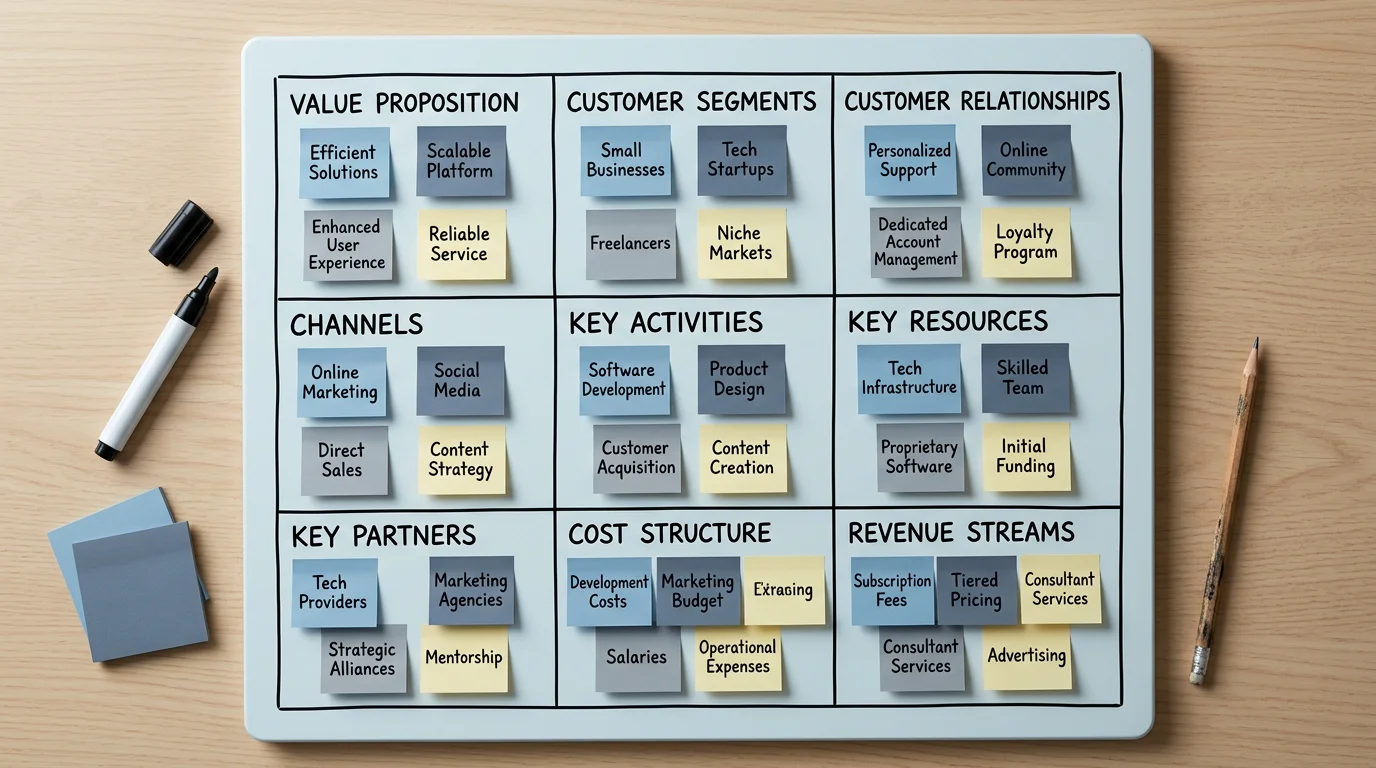
The Nine Building Blocks, Explained
Each block answers one strategic question. Read together, they explain how the venture earns more than it spends while serving a real need.
- Customer segments: the specific groups you intend to serve, from a niche audience to a multi-sided platform.
- Value propositions: the bundle of products and services that solves a customer problem better than the alternatives.
- Channels: how you reach and deliver value to those customers, whether through owned or partner routes.
- Customer relationships: how you acquire, retain, and grow each segment.
- Revenue streams: the pricing logic, such as subscription, licensing, or asset sale.
- Key resources: the human, financial, physical, and intellectual assets you cannot operate without.
- Key activities: the critical work that delivers the value proposition.
- Key partnerships: the suppliers and alliances that reduce risk or extend reach.
- Cost structure: the major expenses, split between fixed and variable, cost-driven and value-driven.
When you translate this thinking into a deck for investors, structure matters as much as content. Our startup pitch proposal template helps you carry each block into a persuasive board-level narrative.
Canvas Versus Lean Canvas: Choosing Your Format
The classic canvas is not the only option. Ash Maurya's Lean Canvas adapts the same grid for early idea validation, swapping some blocks for problem, solution, and unfair advantage. The choice depends on your stage and audience.
| Format | Primary focus | Best suited for | Output |
|---|---|---|---|
| Business Model Canvas | Whole model, partners and resources | Established or scaling ventures | One-page operating map |
| Lean Canvas | Problem, solution, early risk | Pre-launch idea validation | Assumption test sheet |
| Our strategy framework library (Deckadence) | Framework plus board-ready visuals for PowerPoint, Keynote, and Figma | Founders presenting strategy to decision-makers | Investor-ready slide system |
A canvas captures the thinking. A polished slide system is what actually moves a room of stakeholders, which is where our template library extends the raw framework.
Filling In Your Canvas: A Step-by-Step Approach
Start with customer segments and the value proposition, because everything else depends on that fit. Then work outward to channels, relationships, and revenue before pricing the cost side. Treat every cell as a hypothesis, not a fact.
Ambition helps here. As of March 2026, recent venture data counted 1,345 unicorns worldwide with a combined valuation of 6.4 trillion dollars, most of them clustered in AI, industrial, and health sectors. A clear canvas will not put you in that group, but it keeps your assumptions honest as you scale. Once the model stabilises, a sequenced plan keeps execution on track, and our business roadmap template for startups turns the canvas into dated milestones. Teams that prefer to sketch collaboratively can also map ideas in real time inside our Block Workspace.

Common Mistakes and How the Canvas Evolves in 2026
The canvas has known limits. Critics note that it is static, capturing a snapshot rather than the interaction between components over time. It also risks isolating the firm from its wider industry and stakeholder environment. Treat it as a living draft, revisited every time evidence arrives.
The method is also adapting to new tooling. In June 2026, according to an industry report, Maurya launched an AI-assisted successor that stress-tests canvas assumptions across several dimensions, arguing that AI has collapsed the cost of building while the cost of building the wrong thing stayed the same. The lesson holds: automation speeds execution, but disciplined validation still decides who survives.
Turning a One-Page Map Into Momentum
A well-built startup canvas is not paperwork; it is a decision instrument. Fill each block honestly, test the riskiest assumptions first, and revisit the sheet whenever the market answers back. Keep the customer problem at the centre, watch the balance between cost and revenue, and let evidence, not optimism, drive every revision. Done well, that single page shortens the distance between an idea and a validated, fundable model.
Take action with Deckadence
You have mapped the model. The next task is to make that thinking land with the people who fund and approve it. Investors and boards respond to clarity, and a rough grid rarely survives contact with a skeptical audience.
We combine consulting-grade strategy frameworks with board-ready design for PowerPoint, Keynote, and Figma, so your reasoning shows as clearly as it reads. To sharpen the heart of your model, explore our Value Proposition Canvas template and translate customer insight into a structured, persuasive presentation.
Frequently Asked Questions
What is a startup business canvas in simple terms?
It is a one-page visual template that summarises how a company creates, delivers, and captures value. You answer a short question in each of nine linked blocks. The result is a shared, testable snapshot of the whole business.
How is a canvas different from a full business plan?
A business plan is a long written document, while a canvas is a single visual map built for speed and iteration. The plan explains and defends; the canvas explores and tests. Many founders draft the canvas first, then expand the parts that need detail.
Should I use the Business Model Canvas or the Lean Canvas?
Use the Lean Canvas when you are validating an early idea and its risks. Choose the classic Business Model Canvas when partners, resources, and operations matter for a scaling venture. The two share the same one-page logic, so switching later is straightforward.
How often should I update my canvas?
Treat it as a living document rather than a finished artefact. Revisit it whenever customer feedback, pricing tests, or market shifts contradict an assumption. In practice, active early-stage teams may revise it every few weeks.
Can a canvas help me pitch to investors?
Yes, because it clarifies the model before you build the narrative around it. The canvas gives you the logic, and a structured deck communicates it persuasively. Our template library helps you carry each block into board-ready slides that decision-makers can follow quickly.