Roughly nine in ten startups never reach maturity, and the reason is often not a broken product but a broken model for making money. Testing how you will earn, deliver, and sustain value deserves as much rigor as testing features. Before you commit a budget to a full launch, our Startup Business Canvas gives you a structured surface to sketch and pressure-test those choices. The discipline of prototyping a business model turns abstract strategy into small, testable experiments.
The stakes are concrete. According to U.S. Bureau of Labor Statistics data, approximately 20% of new businesses fail within the first year and nearly 50% within five years. Many of those closures trace back to models that were never validated with customers. Prototyping addresses that gap directly.
What business model prototyping actually means
Consider a familiar pattern. A team perfects a product, then bolts on a revenue model at the last moment and hopes it holds. The results are frequently disappointing. Business model prototyping reverses that order by treating the model as the thing to be tested, not an afterthought.
In practice, you build lightweight representations of how the whole venture works: how customers discover you, why they pay, what it costs to serve them, and which partners you depend on. These representations can be a landing page, a role play, a sales brochure, a simple simulation, or a one-page canvas. Each one exists to validate a specific hypothesis, not to look finished. If you are still clarifying the fundamentals, our guide on What Is a Business Model establishes the vocabulary you will test.

Why you should prototype the model, not only the product
Changes to a business model, even without changing the product, can reshape an entire industry. The classic razor-and-blades pricing of Gillette was later disrupted again by subscription challengers such as Dollar Shave Club. Spotify and Netflix altered distribution and introduced recurring revenue where others sold single units. The lesson is that where value is captured matters as much as what is built.
The data reinforces the point. The most cited cause of failure is building something nobody needs. According to Founders Forum research, 42% of startups fail because there is no real market need for the product. That is a business model problem disguised as a product problem, and it is exactly what early experiments are designed to surface.
The three lenses: desirability, viability, feasibility
What has to be true for this venture to work? Answering that question systematically is the core of good prototyping. A widely used approach applies three lenses that must eventually work in harmony.
- Desirability: Do people actually want this? Is the value proposition clear and compelling to a defined customer?
- Viability: Can this become a sustainable business? What are the costs, and how will revenue exceed them over time?
- Feasibility: Can you realistically build and deliver it with the resources and technology available?
Start by listing every assumption tied to these lenses, then prioritize. Which assumptions are foundational, which depend on others, and which can you test immediately? To sharpen the desirability question specifically, our Value Proposition Canvas Template helps you map customer jobs, pains, and gains against what you offer.
Frameworks and tools that make prototyping tangible
The Business Model Canvas, created by Alexander Osterwalder and Yves Pigneur, remains a common starting point because it synthesizes an entire model onto a single page. It lowers the barrier to discussing and mocking up how a venture fits together. Overlaying an innovation lens, such as the Ten Types of Innovation, pushes you to consider profit model, channel, network, and customer engagement, not only product performance.
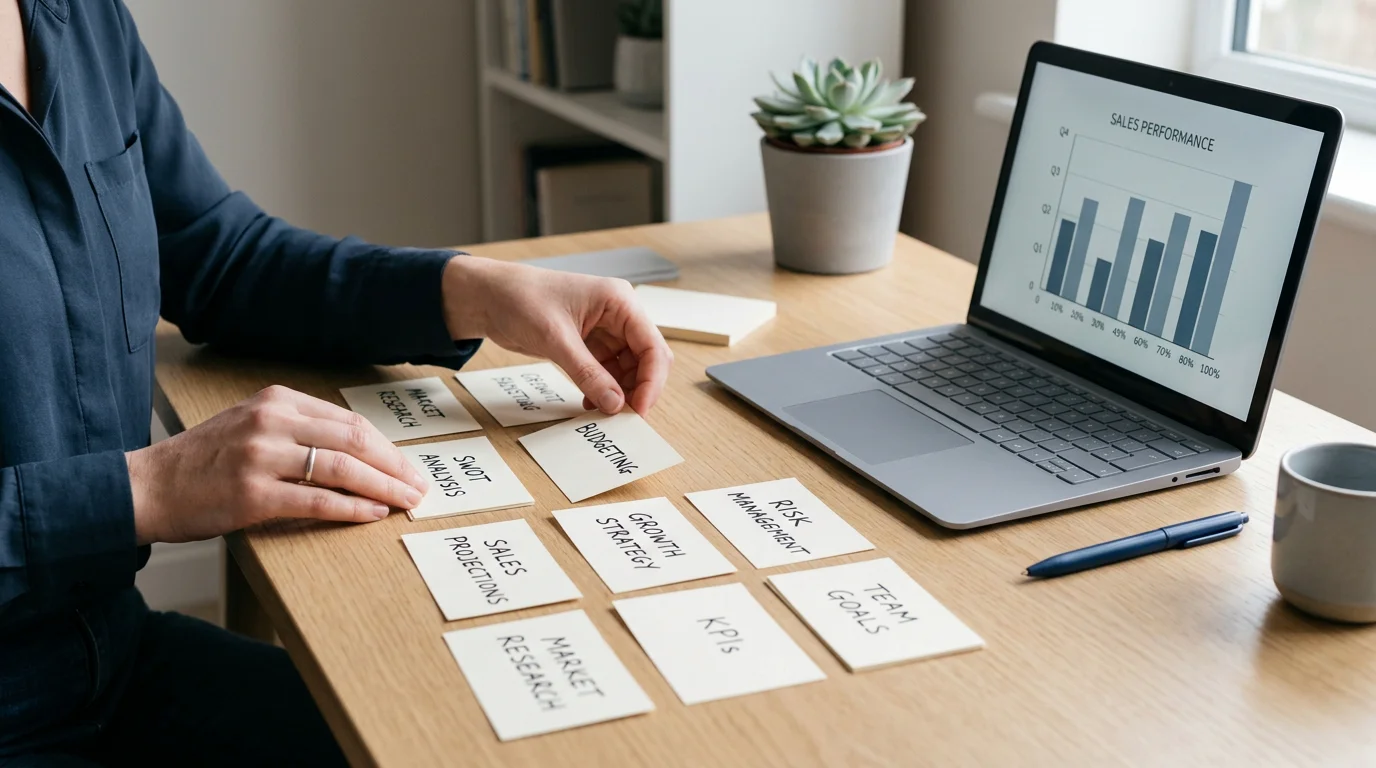
Beyond the canvas, useful prototype formats vary by purpose. A "lemonade stand" prototype, where you sell to real customers in a temporary setup, tests pricing and value directly. A landing page tests demand and channel conversion. A quantitative simulation explores unit economics in a risk-free environment. Each format trades fidelity for speed, and the right choice depends on the question you most need answered. Define the purpose first, then pick the tool.
A step-by-step approach to running your experiments
Prototyping succeeds when it is disciplined rather than decorative. The following sequence keeps experiments honest and fast.
- Define the purpose: State the one hypothesis this prototype exists to test. Without a clear purpose, building is wasted effort.
- Set the attributes: Decide the scope, resolution, and lifetime the prototype needs. Build only enough to answer the question.
- Build to learn, not to scale: Prototyping and engineering differ in goal. You are building to learn quickly, so make deliberate trade-offs on polish.
- Measure the right data: Building is only half the work. Decide in advance what evidence will confirm or refute the hypothesis.
- Iterate: Do not build only one version. Explore several models and test which arrangement actually holds with customers.
To sequence these experiments across a quarter or a funding cycle, our Business Roadmap Template helps you connect each validated assumption to the next milestone.
Common pitfalls that undermine business model prototypes
Teams tend to build too much. A prototype is a brutally honest representation of an idea, and the temptation is to add detail that hides weaknesses rather than exposes them. Restraint is a feature, not a compromise. Another frequent error is scaling before the core model is proven.
The evidence is stark here. Analysis reported by CB Insights via industry compilations reviewed 483 startup post-mortems and found that "no market need" led at 42%, ahead of "running out of cash" at 29%, together accounting for 71% of cited shutdowns. Premature scaling and unvalidated demand are precisely the failures early prototyping is meant to prevent. Sector context matters too: according to Bureau of Labor Statistics data compiled by GrowthList, construction and retail startups face failure rates near 53%, a reminder that model assumptions differ sharply by industry.
Turning experiments into confident decisions
The value of prototyping a business model is not the prototype itself but the decisions it unlocks. By defining each assumption, testing desirability, viability, and feasibility with small experiments, and measuring real evidence, you replace expensive guesswork with fast, cheap learning. Build several versions, keep them lean, and let customer response guide which model deserves your capital. The teams that prototype early and often think more precisely and commit with far greater confidence.
Take action with Deckadence
Once your experiments point to a model that holds, you still have to convince a board, investors, or executive stakeholders. That is where clear structure and persuasive visuals turn validated learning into approved decisions.
We provide consulting-grade strategy frameworks and board-ready slide systems built for PowerPoint, Keynote, and Figma, combining proven methods such as the Business Model Canvas with structured storytelling and refined design. Explore our strategy frameworks and board-ready slide systems to present your tested model with clarity and move decision-makers to act.
Frequently Asked Questions
How is business model prototyping different from product prototyping?
Product prototyping tests whether a solution works and appeals to users. Business model prototyping tests the wider system of how you create, deliver, and capture value, including channels, pricing, costs, and partnerships. Both matter, but validating the model prevents building a great product with no sustainable way to earn from it.
What is a "lemonade stand" prototype?
It is a small, live experiment where you sell to real prospective customers in a temporary, low-cost setup. It lets you observe genuine reactions to pricing and value, ask follow-up questions, and gather immediate feedback. This direct evidence is often more revealing than an online test alone.
Which framework should I start with?
The Business Model Canvas is a practical starting point because it captures an entire model on one page and is easy to discuss. Pairing it with a value proposition tool sharpens the desirability question. Our Value Proposition Canvas Template and Startup Business Canvas give you structured surfaces to begin.
How long does business model prototyping take?
Simple prototypes such as a landing page or a role play can be built and tested within days. More advanced experiments, including working demonstrators or detailed simulations, may span several weeks or multiple iterations. The purpose and required fidelity determine the timeline, so define the question before you build.
How do I know when a business model is validated?
A model is closer to validation when your riskiest assumptions across desirability, viability, and feasibility are supported by real customer evidence rather than opinion. Look for consistent signals, such as willingness to pay or repeatable conversion, before scaling. Treat each experiment as one data point and keep iterating until the pattern is clear.