Why do so many promising ventures still collapse despite talented teams and real funding? Very often, the answer is a weak or untested business model rather than a weak product. The business model canvas addresses this risk directly by forcing you to describe, on a single page, how your organisation creates and captures value. If you are shaping a new venture, you may also find it useful to pair the framework with our Startup Business Canvas for early-stage planning.
Introduced by Alexander Osterwalder and Yves Pigneur, this one-page tool has become a shared language for entrepreneurs, consultants, and executives worldwide. It turns abstract strategy into something visible, discussable, and testable. In 2026, when speed of iteration matters more than lengthy documentation, that clarity is a genuine competitive advantage.
What a Business Model Canvas Actually Is
At its core, a business model canvas is a strategic management template used to develop new models and document existing ones. It presents a firm on one chart, covering its value proposition, infrastructure, customers, and finances so that trade-offs become visible. Rather than writing dozens of pages, you sketch the whole logic of a company in a way that any stakeholder can grasp at a glance.
The framework grew out of Osterwalder's doctoral research on business model ontology and was popularised through the book Business Model Generation. It is distributed under a Creative Commons licence, which is one reason it has spread so widely across startups and established organisations. If you are still clarifying the underlying concept, our guide on what a business model is offers a helpful foundation before you populate the canvas itself.
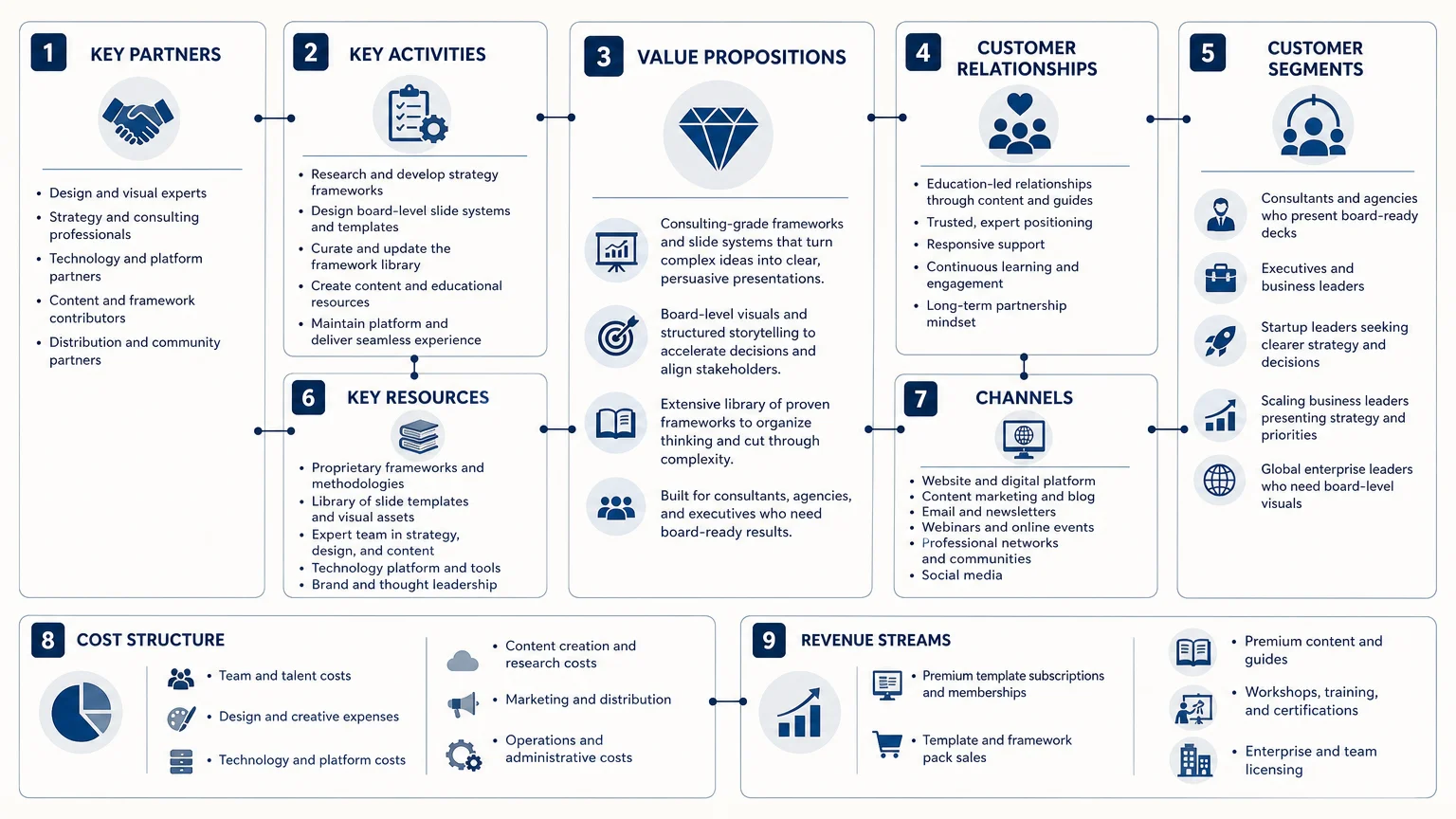
The Nine Building Blocks Explained
The canvas organises a business into nine interconnected components. Together they answer who you serve, what you offer, how you deliver it, and how the money moves. Understanding each block, and how it connects to the others, is what separates a thoughtful model from a simple list.
- Customer segments: the distinct groups you intend to serve, from mass markets to tightly defined niches.
- Value propositions: the products and services that solve a problem or satisfy a need for each segment.
- Channels: how you reach customers to sell and to deliver value, whether through owned, partner, or blended paths.
- Customer relationships: the type of relationship you build, from personal assistance to self-service and communities.
- Revenue streams: how the business earns income, such as asset sales, usage fees, or subscriptions.
- Key resources: the human, financial, physical, and intellectual assets required to operate.
- Key activities: the most important actions needed to execute the value proposition.
- Key partnerships: the suppliers and alliances that reduce risk and let you focus on your core.
- Cost structure: the major costs incurred, and whether the model is cost-driven or value-driven.
The value proposition sits at the heart of the framework, acting as a guiding star for every other block. When you refine it, our Value Proposition Canvas Model can help you connect customer jobs, pains, and gains to what you actually offer.
Why the Canvas Matters for Modern Ventures
The stakes behind a clear business model are high. According to CB Insights research analysing 431 venture-backed companies that shut down since 2023, running out of capital appears in 70% of failures, yet it is usually the final symptom rather than the root cause. The deeper drivers were poor product-market fit at 43%, bad timing at 29%, and unsustainable unit economics at 19%.
A canvas will not guarantee success, but it makes these failure modes visible early. When your revenue streams do not cover your cost structure, or your value proposition does not match a real segment, the gaps appear on the page before they drain your runway. Academic work reinforces the pattern: a study of failure factors identified product-market misfit, lack of capital, competition, and a flawed business model among the most decisive causes.
How to Fill Out Your Canvas Step by Step
Imagine your team gathered around a large printed sheet, sticky notes in hand. That collaborative, hands-on approach is exactly how the framework is designed to be used, fostering discussion, creativity, and analysis. A practical sequence keeps the exercise focused.
- Start with customer segments and value propositions, since everything else follows from who you serve and why.
- Map channels and customer relationships to define how value reaches people and how you retain them.
- Detail the key resources, activities, and partnerships that make delivery possible.
- Close with revenue streams and cost structure to test whether the economics hold together.
Treat the result as a living document. The canvas should be revisited whenever you launch a product, enter a market, or notice customer needs shifting. To move from a static sketch toward validated assumptions, our Business Model Prototyping guide shows how to turn each block into an experiment you can actually test.

Common Pitfalls That Undermine a Good Canvas
Filling the boxes is easy; getting them right is where strategy happens. One frequent mistake is treating the nine blocks as isolated silos rather than a connected system. A high-touch concierge relationship, for example, must show up as a corresponding cost, and a subscription revenue stream implies retention work among your key activities.
Other traps recur just as often. Founders confuse channels with marketing, listing how customers hear about them instead of how they buy and receive value. Vague value propositions such as "high quality" fail because everyone claims them. Designing for "everyone" thins your proposition, whereas a narrow, specific segment makes it magnetic. Finally, mixing current reality with future ambitions produces a model that is not grounded in fact.
Canvas, Business Plan, or Lean Canvas?
The business model canvas is not a replacement for a full business plan; it summarises and visualises the most important logic of your model. Different formats suit different moments, and the right choice depends on your stage and audience. The comparison below outlines where each option fits, including how presentation-ready visuals bridge the gap between planning and communicating.
| Approach | Format | Best suited for |
|---|---|---|
| Business model canvas | One-page visual, nine blocks | Designing and iterating a model quickly |
| Traditional business plan | Multi-page document | Detailed operational and financial planning |
| Lean canvas | One-page adaptation for startups | Early problem and solution validation |
| Our board-ready strategy templates | Presentation-grade slides and frameworks | Communicating strategy to boards and stakeholders |
The canvas has also inspired adaptations such as Ash Maurya's lean canvas, tailored for startup conditions. Whichever format you begin with, the underlying discipline is the same: make the thinking visible so that decisions become faster and better informed. Momentum around these frameworks remains strong, and venture data reported by Zeni counted 1,345 unicorns worldwide as of March 2026, a reminder that scalable models continue to attract significant capital.
Turning a Framework Into a Habit
The lasting value of the business model canvas lies not in a single workshop but in repeated use. Return to it as your market shifts, treat each block as a testable assumption, and draw connections between them so that the model behaves like a system rather than a list. Used this way, one page becomes a decision-making instrument that keeps your value proposition honest, your economics realistic, and your team aligned around the same clear picture.
Take action with Deckadence
A strong model deserves an equally strong presentation. Once your nine blocks are defined, the next challenge is communicating them persuasively to investors, boards, and colleagues who decide in minutes, not hours. That is precisely the gap we help you close.
At Deckadence, we provide consulting-grade strategy frameworks and slide systems with board-ready visuals for PowerPoint, Keynote, and Figma. If you want structured storytelling that makes your thinking read as clearly as it looks, explore our board-ready strategy templates and slide systems and turn a completed canvas into a decision that moves forward.
Frequently Asked Questions
What is a business model canvas used for?
It is used to describe, design, and challenge how a company creates and captures value on a single page. Teams rely on it to visualise an existing model, test a new one, or align stakeholders around a shared understanding. It is a strategic tool rather than a substitute for a detailed business plan.
Who created the business model canvas?
The nine building blocks were proposed by Alexander Osterwalder, based on his doctoral research supervised by Yves Pigneur. The framework was popularised through the book Business Model Generation and is now applied by startups and large organisations across the world.
How often should I update my canvas?
You should treat the canvas as a dynamic document and review it regularly. Key moments to revisit it include launching a new product, entering a new market, or noticing that customer needs have shifted. Many teams schedule a review every few months to keep it accurate.
Is the canvas suitable for both startups and established companies?
Yes, it is a versatile tool that works for ventures at any stage. Startups use it to organise and validate early ideas, while established businesses apply it to refine, document, or innovate on existing models. The same nine blocks scale to either context.
How can I make my canvas board-ready?
Start with a well-connected model, then translate it into clear, persuasive visuals for your audience. Our board-level slide systems and strategy templates at Deckadence are built to turn a completed canvas into a presentation that accelerates decisions and aligns stakeholders quickly.