Unique Value Proposition Template: A Practical Guide for Teams
Why should a customer choose your offer when another seems similar? A unique value proposition template gives you a practical way to answer without starting from a blank page. The useful result is not a clever slogan, but a precise statement connecting a defined audience to a meaningful outcome. If you need a foundation for that message, begin with our value proposition statement.
Specificity matters more than a polished phrase. A proposition becomes persuasive when it reflects a real customer need, describes a relevant benefit, and identifies a difference buyers can understand. Treat the template as a working draft, not proof that your claims are true. Customer conversations, competitor alternatives, and evidence should shape the final wording.
What belongs in a unique value proposition?
A customer comparing similar offers needs more than a list of features. A business value proposition should help them understand who the offer serves, what need it addresses, and why its benefits matter. Harvard Business School’s strategy framework organizes that strategic choice around the customers you serve, the needs you meet, and the relative price that provides acceptable value.
For a useful working template, add two practical checks: what makes the offer distinct from relevant alternatives, and what evidence supports its promise? These checks help separate a customer-focused proposition from a general description of your organization.
- Audience: Which customer group, role, or situation are you addressing?
- Need: What important task, problem, or desired outcome does that audience have?
- Offer: What product or service addresses the need?
- Difference: What specific feature, approach, or benefit sets the offer apart in a way customers value?
- Proof: What evidence makes the promise credible?
Not every element needs equal space in the final statement. The audience, need, and outcome usually carry the message; differentiation and proof make it more distinctive and believable. If you cannot name a meaningful difference yet, describe the value accurately rather than adding an unsupported claim of uniqueness.
Which template structure fits your offer?
Imagine that a small software company serves independent accounting firms. The firms want to collect client documents without repeated email follow-ups. A broad statement about “simplifying business” says little about the audience or the value. A focused template helps the company state what it does and why the intended buyer should care.
Use one of these structures as a starting point, then fill each bracket with language customers recognize:
- Audience and outcome: “For [target customer] who need to [important outcome], [offer] helps them [specific benefit] through [distinct approach].”
- Pain and solution: “We help [target customer] address [specific problem] by [how the offer works], so they can [desired result].”
- Alternative and difference: “Unlike [relevant alternative], [offer] helps [target customer] achieve [outcome] through [demonstrable distinction].”
For the example company, a draft might read: “For independent accounting firms that chase clients for documents, our portal organizes requests in one place so teams can follow up with less back and forth.” This is illustrative, not a claim about a real company. Its value comes from a specific audience and situation, while its distinction still needs to be checked against what customers actually use.
Choose the structure that addresses your audience’s main reason for considering the offer. A pain-led version may clarify an urgent problem. An outcome-led version can make the desired result easier to grasp. A comparison-led version is useful only when you can name a genuine difference and a fair alternative.
How do you build the statement from customer insight?

Start with what customers do, struggle with, and hope to achieve, rather than what your team assumes they value. Review interview notes, support questions, sales conversations, or product feedback for recurring language and concrete examples. A single comment can suggest a hypothesis, but repeated patterns and follow-up questions help establish whether the need is important to the intended audience.
Separate observed evidence from interpretation. A customer saying that a task takes too long is evidence of frustration; the assumption that your product will save an hour is a claim that still needs measurement. This distinction keeps the proposition connected to what you know, and helps identify where further research is needed.
A 2026 teaching article presents a structured UVP exercise that connects the problem, target customer, solution, and advantage over existing alternatives. The same sequence works as a practical drafting check: understand the problem first, name the intended customer, explain your solution, and state why it fits better than relevant options.
Next, describe the alternatives customers might choose, including doing nothing or using an existing workaround. Your differentiation only matters if it helps the audience make a better choice. If customers do not notice or value the distinction, it may belong in product messaging rather than the central proposition.
How can you test and refine your draft?
A draft is a hypothesis about what customers value, not a finished promise. Read it aloud to people who fit your target audience. Ask what they think the offer does, who it is for, and what benefit they expect. If their interpretation differs from yours, make the wording more direct before adding detail.
Check each promise against evidence you can substantiate. A claim about faster service might need reliable timing data; a claim about reducing effort might need customer feedback or a measured workflow comparison. A 2006 HBR analysis cautioned that unsupported savings and benefit claims can be dismissed as marketing language. That makes proof part of the proposition’s credibility, not just a later sales detail.
When possible, test alternative drafts in relevant customer conversations or marketing materials. Compare whether people understand the offer, recognize the need, and can explain the difference. Do not treat a handful of reactions as conclusive market evidence; use them to identify confusion and decide what to investigate next.
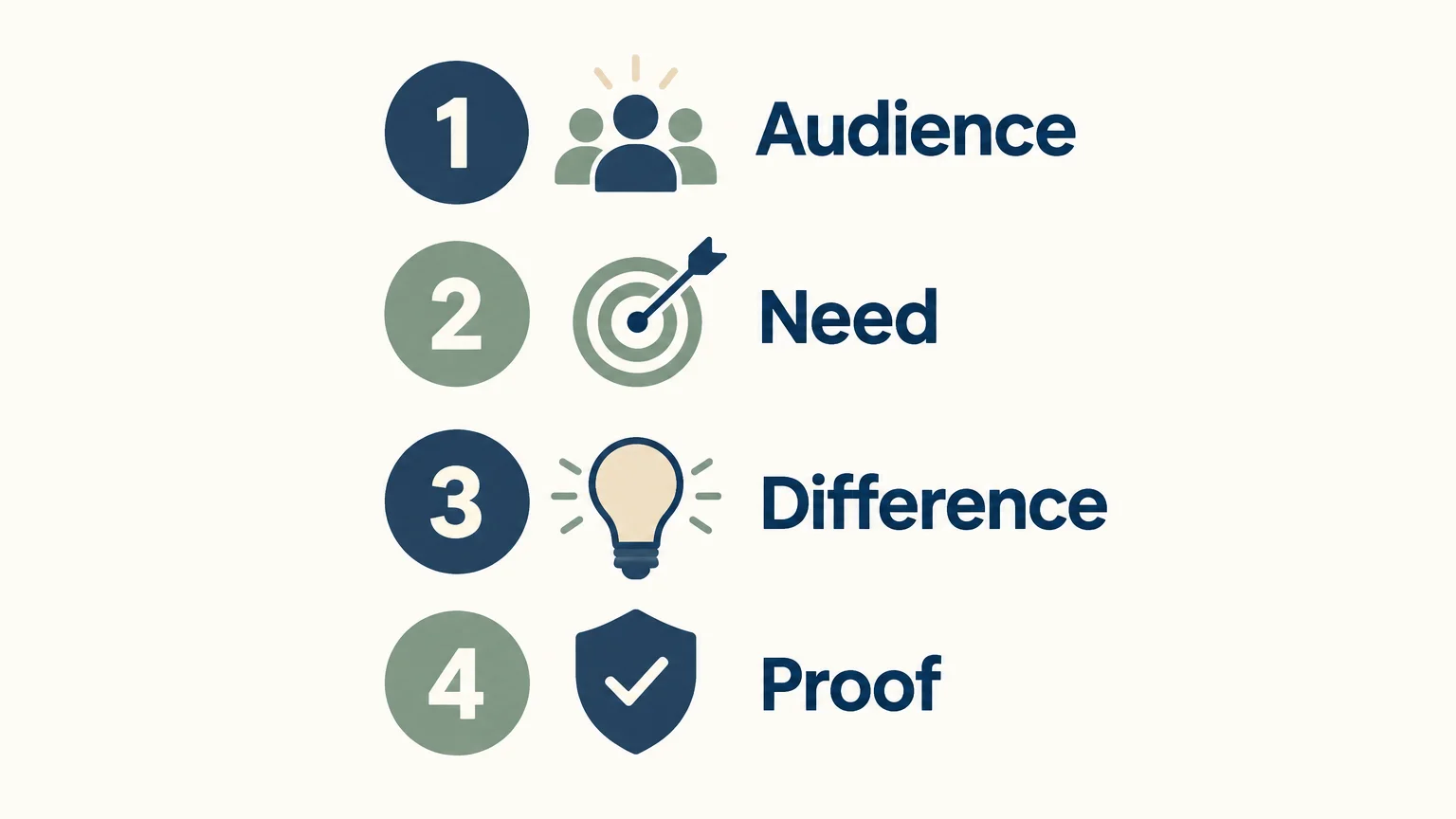
Before publishing, review the statement against four questions:
- Can the intended audience recognize itself in the wording?
- Does the statement name a meaningful customer need or outcome?
- Is the difference clear and relevant to a real alternative?
- Can you support the promise with evidence?
If one answer is unclear, revise that part rather than making the sentence longer. A clear value proposition is specific enough to guide a buyer’s understanding, but concise enough to use consistently across a homepage, sales conversation, or presentation.
When should you use a canvas instead of a statement?
A one-sentence proposition is the message you want customers to understand. A canvas is a working tool for exploring whether your offer fits their needs. It can help a team map customer jobs, pains, and desired gains alongside products, pain relievers, and gain creators before writing the final statement.
If your team is also considering channels, customer relationships, or revenue logic, a wider business model view may help place the proposition in context. Our business model canvas and value proposition canvas resources relate these strategic questions without treating the canvas as a substitute for customer evidence.
Once the statement is clear, it may need to work in an executive presentation as well as on a website. Our materials bring strategic frameworks together with structured storytelling and board-level visuals. Our strategy guide covers more than 15 frameworks and includes a framework selection guide, while our presentation materials are built for PowerPoint, Keynote, Figma, and more. For a message that needs a compelling presentation, explore our approach to a strong value proposition.
Keep the two tools in their proper roles. Use the canvas to organize and challenge your thinking; use the statement to express the most important customer value clearly. If customer needs or your offer changes, revisit both rather than treating an old draft as permanent.
Conclusion
A customer-focused value proposition template can bring structure to a difficult messaging task, but the quality of the result depends on the insight behind it. Define a specific audience and need, explain the outcome, identify a meaningful difference, and support your promise with evidence. Then test whether customers understand the message as intended, and revise it when their feedback reveals a gap.
Make Your Value Proposition Clearer in Presentations
A strong statement is more useful when your team can connect it to the broader strategy and communicate it consistently. If you are moving from customer insight to a presentation, use a structured framework to organize the logic before you refine the narrative and visuals.
Our visual strategic-thinking materials combine strategic frameworks, narrative structures, and presentation-ready slide systems for consultants, executives, and business leaders. To map customer needs against your offer, explore our value proposition canvas template as a starting point for that work.
Frequently Asked Questions
What is a unique value proposition template?
It is a structured prompt for describing a target customer, their need, your offer, its relevant difference, and the evidence supporting its value. It helps you organize a draft, but does not validate your assumptions.
How long should a value proposition be?
Keep the central statement concise enough to understand quickly, often one sentence. Add a short supporting explanation when buyers need more context about the offer or its proof.
Is a value proposition the same as a tagline?
No. A tagline is a short brand phrase, while a value proposition explains who an offer helps, what value it provides, and why that value matters. A tagline may reinforce the proposition without replacing it.
What is the difference between a value proposition and a value proposition canvas?
A value proposition is the concise message about the value your offer provides. A canvas is a framework for mapping customer needs against your offer before deciding what that message should say.
Can a value proposition change over time?
Yes. Customer needs, alternatives, and your offer can change, so review the statement when new evidence or business changes make its claims less relevant. Our strategy guide and visual strategic-thinking materials can help teams organize that work for presentations.