How to Write a Clear, Customer-Focused Value Proposition
A vague promise can make a capable business sound interchangeable. A precise value proposition statement can clarify your relevance within seconds. Before you refine the wording, read our guide to what a value proposition is so you can separate customer value from slogans, mission statements, and product descriptions.
The strongest statements do not begin with clever language. They begin with a clear understanding of the customer, the problem that matters, and the result your offer can credibly deliver. The wording is the visible surface of a deeper strategic decision.
What should a value proposition statement accomplish?
A value proposition statement should answer one practical question: why should a particular customer choose your offer instead of another available option?
That answer requires more than describing your product or service. Features explain what an offer contains. A value proposition explains why those features matter to a defined audience and how they improve the customer’s situation.
A useful statement usually connects four ideas:
- Target audience: the people or organisations you intend to serve.
- Customer problem: the situation, risk, cost, or frustration you address.
- Customer outcome: the meaningful improvement your offer creates.
- Point of difference: the reason your approach is more relevant than common alternatives.
For example, “We provide strategic presentation templates” describes an offer. “We help consultants turn complex strategic analysis into board-ready presentations through structured storytelling and refined visual systems” communicates a more complete promise.
The second version identifies an audience, describes a result, and suggests a distinct method. It also gives the reader a way to judge relevance before discussing price, features, or implementation.
A 2018 empirical study of business customers found that a robust value proposition involves value points, value statements, and value substantiation. The study also connected the proposition to the customer’s value in use, meaning the benefits customers achieve while pursuing their own goals. You can review a 2018 empirical study for the research context.
This distinction matters because customers do not experience your offer as a sentence. They experience it through saved time, reduced risk, improved performance, clearer decisions, or a more reliable process. Your statement should point toward that lived outcome.
Which elements make a value proposition more persuasive?
Consider a buyer comparing three providers that all claim to deliver quality, innovation, and excellent service. Those words provide little decision value because they do not identify a specific situation or measurable improvement.
A persuasive statement becomes more useful when it includes the following elements.
A clearly defined audience
Specificity helps the right people recognise themselves. “Businesses” is too broad for most situations. “Founders of scaling B2B software companies preparing to move upmarket” gives the statement a sharper commercial context.
You do not need to exclude every possible customer. You do need to identify the audience whose needs your offer understands particularly well. A focused audience also makes research, messaging, proof collection, and sales qualification more efficient.
A meaningful customer outcome
Lead with the change the customer wants, rather than the activity your organisation performs. Customers rarely want a workshop, dashboard, template, or consulting process for its own sake. They want a clearer decision, faster execution, lower risk, stronger demand, or a more credible presentation.
When possible, describe the outcome in the customer’s language. “Improve strategic communication” is reasonable but broad. “Help leadership teams align on strategic choices before resources are committed” provides more context and practical meaning.
A credible difference
Your difference may come from a specialised audience, a distinctive method, unusual expertise, a delivery model, or a specific combination of capabilities. It does not need to be completely unique in the world. It needs to be relevant and defensible for the customer you want to reach.
For example, a presentation provider may compete on speed. Another may focus on custom production. Our positioning combines consulting-grade strategic frameworks with refined visual design, structured storytelling, action titles, and board-ready presentation systems.
For a deeper explanation of the characteristics that support a strong value proposition, examine whether your promise is specific, relevant, differentiated, and supported by evidence.
Proof that reduces uncertainty
A promise without evidence asks the buyer to do all the believing. Proof can include case results, demonstrations, customer language, relevant experience, before-and-after examples, or a transparent explanation of how the offer works.
Proof does not need to overload the main statement. The statement can make the promise, while a subheading, case study, testimonial, or sales conversation supports it. The important point is alignment between what you claim and what customers can verify.
Why does customer evidence matter more than clever wording?

Imagine writing a proposition entirely from internal opinions. Your team may describe the offer as innovative, flexible, or comprehensive. Customers may care more about reducing review cycles, avoiding strategic confusion, or securing leadership approval.
This gap explains why customer evidence should shape the statement. Interviews, sales calls, support conversations, win and loss notes, surveys, and usage data can reveal the language customers already use to describe their needs.
Customer research should explore four practical questions:
- What task is the customer trying to complete?
- What makes that task difficult, expensive, slow, or risky?
- What result would make the customer consider the engagement successful?
- What alternatives has the customer already considered?
The answers help you distinguish a real customer outcome from an internal feature description. They also help you decide which benefits deserve priority. A statement cannot communicate every possible benefit without becoming vague.
The 2026 BDA guide treats stakeholder-specific analysis and evidence as important parts of developing a credible value proposition. That approach supports a useful principle: differentiation should be connected to what a specific audience values, not merely to what the provider wants to say.
Customer evidence also reveals differences between audiences. A founder may value speed and flexibility. A procurement team may prioritise consistency, risk control, and documented outcomes. An executive sponsor may focus on decision quality and strategic alignment.
You may therefore need one central promise with several audience-specific versions. The core idea should remain consistent, but the emphasis can change according to the customer’s context and decision criteria.
How can you write a value proposition statement step by step?
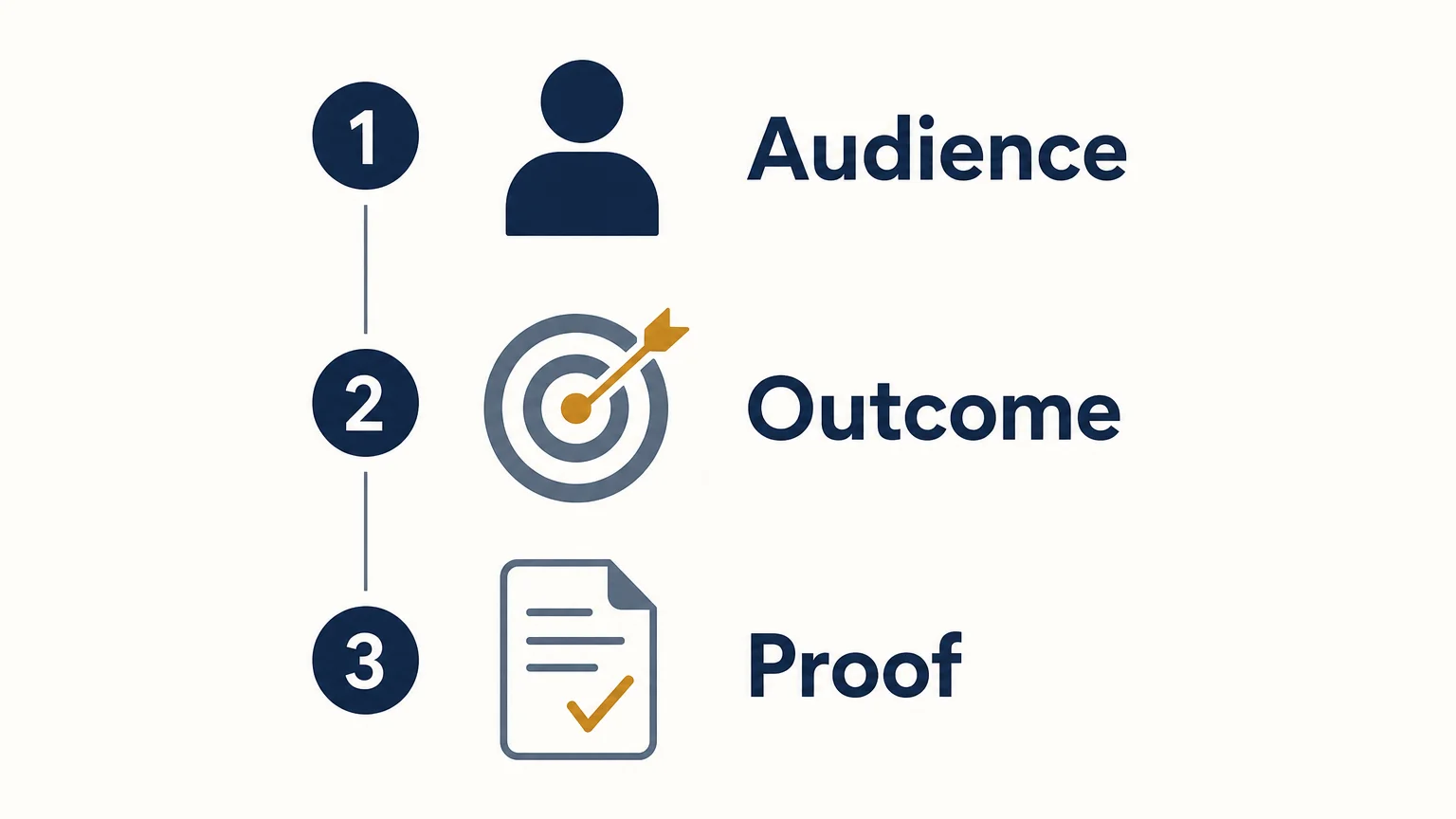
Start with substance, then edit for clarity. The following process helps you move from strategic evidence to a concise statement.
- Choose one primary audience. Identify the customer group whose needs you understand and serve most directly. Include relevant context, such as company stage, role, industry, use case, or buying situation.
- Define the customer’s most important problem. List the practical difficulties, financial costs, emotional frustrations, and risks connected to the situation. Select the problem with the greatest commercial or strategic importance.
- Describe the desired outcome. State what improves after the customer uses your offer. Focus on the result, not only the activity you perform.
- Explain your mechanism. Show how your offer creates the outcome. This might involve a process, framework, technology, specialist capability, design approach, or service model.
- Identify your point of difference. Decide why your approach is more relevant than the alternatives available to this audience. Choose one or two meaningful differences rather than listing every capability.
- Add proof. Select evidence that supports the promise. Use specific examples, measurable results, customer language, demonstrations, or relevant credentials.
- Draft several versions. Write three to five alternatives before choosing one. Different structures may reveal a clearer relationship between audience, outcome, and difference.
- Test the wording. Ask customers or colleagues to explain what they believe the statement means. If their interpretations vary widely, the message needs more precision.
A practical starting formula is: “We help [audience] achieve [outcome] through [distinctive approach].” You can add the most important pain when it improves clarity: “We help [audience] achieve [outcome] without [relevant obstacle].”
For strategy and presentation work, our value proposition canvas model can help you connect customer jobs, pains, gains, products, pain relievers, and gain creators before you finalise the wording.
Do not treat the formula as a finished statement. It is a diagnostic tool. If you cannot complete one of the fields without using broad language, you may need more customer research or a narrower audience.
Examples of stronger and weaker statements
Weak: “We help companies grow with innovative marketing solutions.” The audience is broad, the outcome is unclear, and the difference could describe thousands of providers.
Stronger: “We help specialist B2B firms generate qualified demand through focused positioning and evidence-led content.” This version identifies a customer type, an outcome, and an approach.
Weak: “Professional presentations for modern businesses.” The sentence describes a category but does not explain the customer’s reason to choose the offer.
Stronger: “We help consultants turn complex analysis into persuasive, board-ready presentations through structured storytelling and refined slide systems.” The statement makes the use case and value more visible.
How should you test and improve the statement?
A value proposition is not complete when your team approves the wording. It becomes stronger when real customer reactions confirm that the promise is relevant, understandable, and credible.
Start with qualitative testing. Show the statement to existing customers, prospects, sales colleagues, and people unfamiliar with your business. Ask them what they think you provide, who it is for, and what result they expect.
Listen for three signals:
- Recognition: the intended audience immediately understands that the statement applies to them.
- Relevance: the stated problem and outcome matter enough to influence consideration.
- Recall: the reader can repeat the central idea without referring back to the original wording.
You can also test alternatives across landing pages, email subject lines, sales presentations, proposals, and social profiles. Measure the response that fits the channel, such as qualified replies, meeting quality, engagement, conversion, or the questions prospects ask next.
Do not optimise only for attention. A dramatic line may attract clicks while creating the wrong expectation. The strongest version is the one that attracts a suitable audience and accurately prepares them for the offer.
A 2026 value proposition guide recommends using customer data, win and loss reasons, sales conversations, and existing evidence to refine the promise. Its practical emphasis is useful because a statement should reflect value your organisation can deliver consistently, not an aspiration unsupported by operations. See a 2026 guide for this evidence-led approach.
Review the statement whenever your audience, offer, competitive context, or customer priorities change. However, do not rewrite it simply because the wording feels familiar internally. Familiarity can indicate consistency, while unnecessary changes may weaken recognition.
Before finalising the statement, confirm that your organisation can support it. The delivery process, sales materials, website copy, presentation design, and customer experience should all reinforce the same promise.
Our business model value proposition resource can help you connect the customer-facing promise with the broader business model, including the audience, offer, channels, and value creation logic.
Make the statement a strategic tool
A proposition value statement is most useful when it does more than decorate a homepage. It should clarify your target audience, guide the benefits you emphasise, distinguish your approach, and establish the evidence needed to earn trust. Begin with customer reality, choose one meaningful outcome, explain your distinctive mechanism, and test the result with people who may actually buy. The final wording should be concise, but the thinking behind it should be rigorous.
Take action with Deckadence
Once your value proposition is clear, the next challenge is communicating it with enough structure and visual precision to support real decisions. A strong idea can lose impact when the presentation is crowded, inconsistent, or disconnected from the audience’s priorities.
Deckadence brings strategy and presentation design together through premium slide decks, strategic-thinking templates, narrative structures, board-ready frameworks, and presentation-ready slide systems. Our materials are designed for consultants, agencies, executives, founders, and business leaders working in PowerPoint, Keynote, Figma, and more. Explore our strategy resources to strengthen the way your strategic thinking is structured, visualised, and communicated.
Frequently Asked Questions
What is a value proposition statement?
A value proposition statement is a concise explanation of who an offer serves, what outcome it creates, and why the customer should choose it. It focuses on customer value rather than listing every feature or repeating a general slogan.
What is the difference between a value proposition and a slogan?
A value proposition communicates practical customer value and supports a buying decision. A slogan is usually shorter and more memorable, but it may not explain the audience, outcome, mechanism, or proof behind the offer.
How long should a value proposition statement be?
There is no universal word count, but the main statement should be concise enough to understand quickly. One clear sentence often works well, supported by a subheading, proof points, examples, or a call to action.
Can one business have more than one value proposition?
Yes, a business may use one central promise with tailored versions for different customer segments, products, or use cases. The audience and outcome can change, while the underlying strategic position should remain coherent.
How can Deckadence support value proposition communication?
Deckadence provides premium slide decks, strategic-thinking templates, narrative structures, board-ready frameworks, and slide systems for communicating complex strategic ideas. These materials can help consultants, executives, founders, agencies, and business leaders turn a clear value proposition into a structured and persuasive presentation.