Business Model Canvas and Value Proposition Canvas Guide
A strong business idea can still fail when its operating model and customer promise point in different directions. The business model canvas and value proposition canvas help you connect those two perspectives, showing how a customer need relates to channels, resources, activities, costs, and revenue.
The distinction matters because a clear offer does not automatically create a viable business. A 2026 study of 161 small and medium-sized enterprises reported that the combined canvas model explained 78.8% of the variance in measured productivity within its sample. That result is specific to the study design, but it reinforces the value of examining customer fit and business logic together, rather than treating either canvas as a complete plan.
What does the Business Model Canvas show?
Imagine needing to explain your entire business model on one page. The Business Model Canvas gives you a structured way to do that without starting with a long business plan. It describes how your organisation serves customers, delivers value, operates, and generates income.
The canvas contains 9 building blocks. Each block represents a question about the logic of the business:
- Customer Segments: Which groups receive value from the business?
- Value Propositions: Which problems are solved or which benefits are created?
- Channels: How does the business reach customers and deliver its offer?
- Customer Relationships: How does the business attract, support, and retain customers?
- Revenue Streams: What are customers paying for, and how does money enter the business?
- Key Resources: Which assets, people, knowledge, or technology are essential?
- Key Activities: Which activities must happen for the model to work?
- Key Partnerships: Which external organisations or suppliers support delivery?
- Cost Structure: Which costs result from operating the model?
The canvas is useful because the blocks are connected. Changing the customer segment may affect the value proposition, channel, relationship model, activities, and costs. A subscription offer, for example, may require different customer support, technology, and revenue assumptions than a one-time sale.
The Business Model Canvas is therefore a whole-business view. It helps teams compare alternatives, reveal dependencies, and discuss assumptions using a shared visual language. It does not replace financial modelling, market research, or an operating plan. Instead, it gives those activities a clear strategic structure.
For a more detailed working reference, our business model canvas guide explains how the 9 blocks connect and how teams can use the framework for strategic analysis, planning, and communication.
What does the Value Proposition Canvas add?
The Value Proposition Canvas narrows the view. Instead of mapping the entire business, it examines one customer segment and the value proposition designed for that segment.
Its structure has two parts: the Customer Profile and the Value Map. The Customer Profile describes what customers are trying to accomplish. The Value Map describes how the offer responds.
- Customer Jobs: The functional, social, or emotional tasks customers are trying to complete.
- Customer Pains: The frustrations, risks, costs, obstacles, or negative outcomes they experience.
- Customer Gains: The outcomes, benefits, savings, or improvements they expect or desire.
- Products and Services: The specific offer intended to help customers complete their jobs.
- Pain Relievers: The ways the offer reduces important customer difficulties.
- Gain Creators: The ways the offer creates desired or unexpected benefits.
The key discipline is to keep the two sides separate. Customer jobs, pains, and gains are observations or hypotheses about the customer. Products, pain relievers, and gain creators are design choices made by the organisation.
This distinction prevents a common mistake: describing customers through the lens of what the company already wants to sell. You should first investigate what the customer is trying to achieve. Only then should you decide which parts of the offer deserve investment.
A separate canvas is usually appropriate for each important customer segment. A procurement leader, daily user, and executive sponsor may all interact with the same product, but their jobs, pains, gains, and buying criteria can differ substantially.
Our value proposition canvas model resource provides a practical way to organise this customer-focused analysis before you turn it into a presentation, workshop output, or strategic decision document.
Business Model Canvas versus Value Proposition Canvas
Both frameworks use visual blocks, but they answer different questions. The Business Model Canvas asks how the organisation works as a system. The Value Proposition Canvas asks whether a specific offer fits the needs of a specific customer segment.
| Criterion | Business Model Canvas | Value Proposition Canvas |
|---|---|---|
| Primary purpose | Describe the organisation’s full business model | Design and assess customer value |
| Scope | 9 connected building blocks | Customer Profile and Value Map |
| Customer focus | Defines customer segments at a high level | Explores one segment’s jobs, pains, and gains |
| Operational focus | Channels, relationships, resources, activities, partnerships, costs, and revenue | Products, pain relievers, and gain creators |
| Main use | Business model design, comparison, planning, and communication | Offer design, customer research, and product-market fit work |
| Typical output | A coherent view of how the business creates, delivers, and captures value | A clearer hypothesis about why a customer would choose the offer |
The VPC does not replace the BMC. It expands two connected areas of the BMC, namely the customer segment and value proposition. This makes it useful when a team knows its general business model but needs more precision about customer priorities.
Why does using both canvases improve strategic thinking?
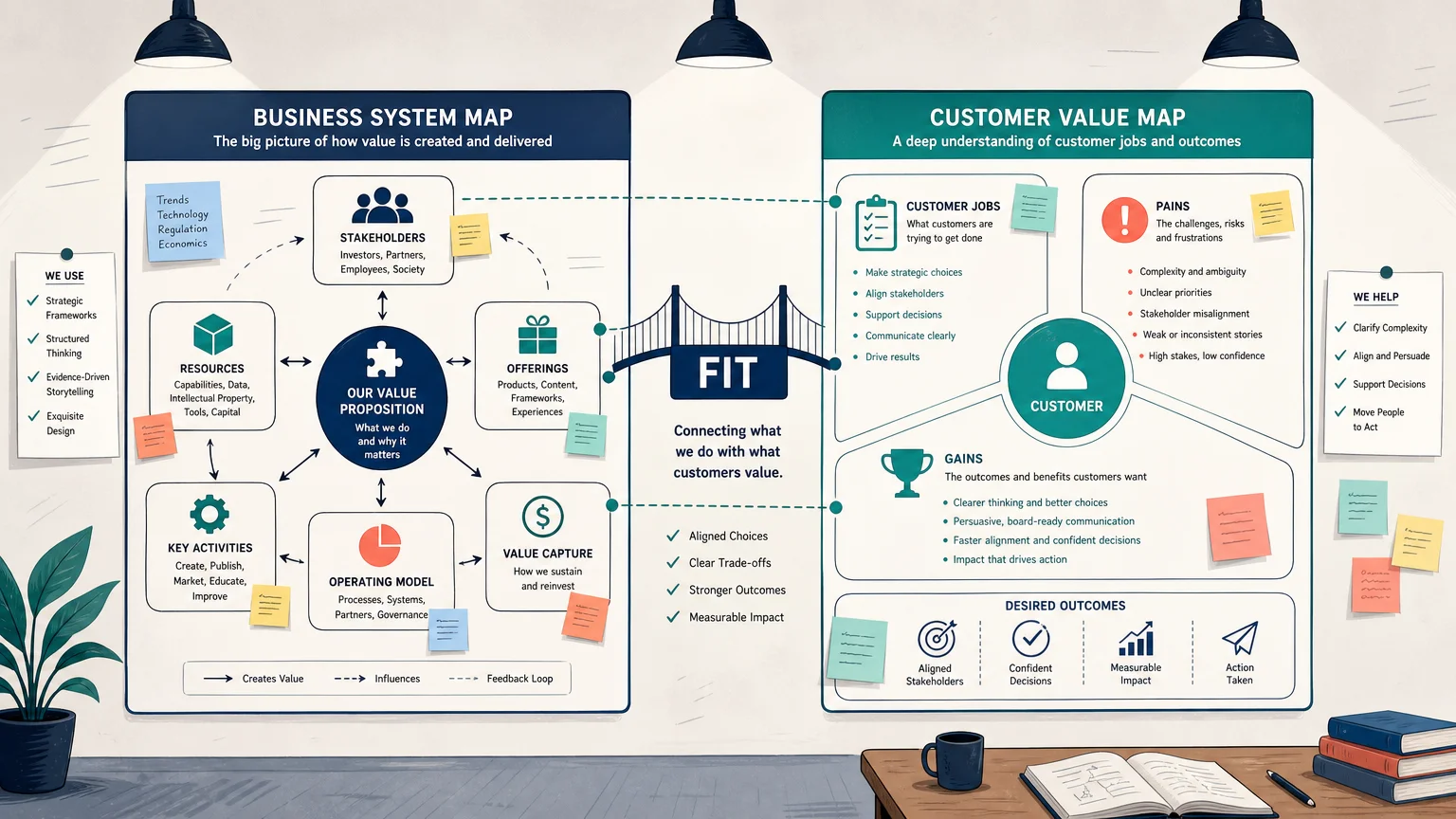
Consider a company that has identified an attractive customer problem but has not checked whether it can deliver the proposed solution profitably. The Value Proposition Canvas may reveal strong customer relevance, while the Business Model Canvas may expose high costs, weak channels, or an unrealistic revenue stream.
The reverse problem is also common. A business may have efficient operations and a clear route to revenue, but its value proposition may address a problem customers do not consider urgent. A complete business model cannot compensate for weak customer relevance.
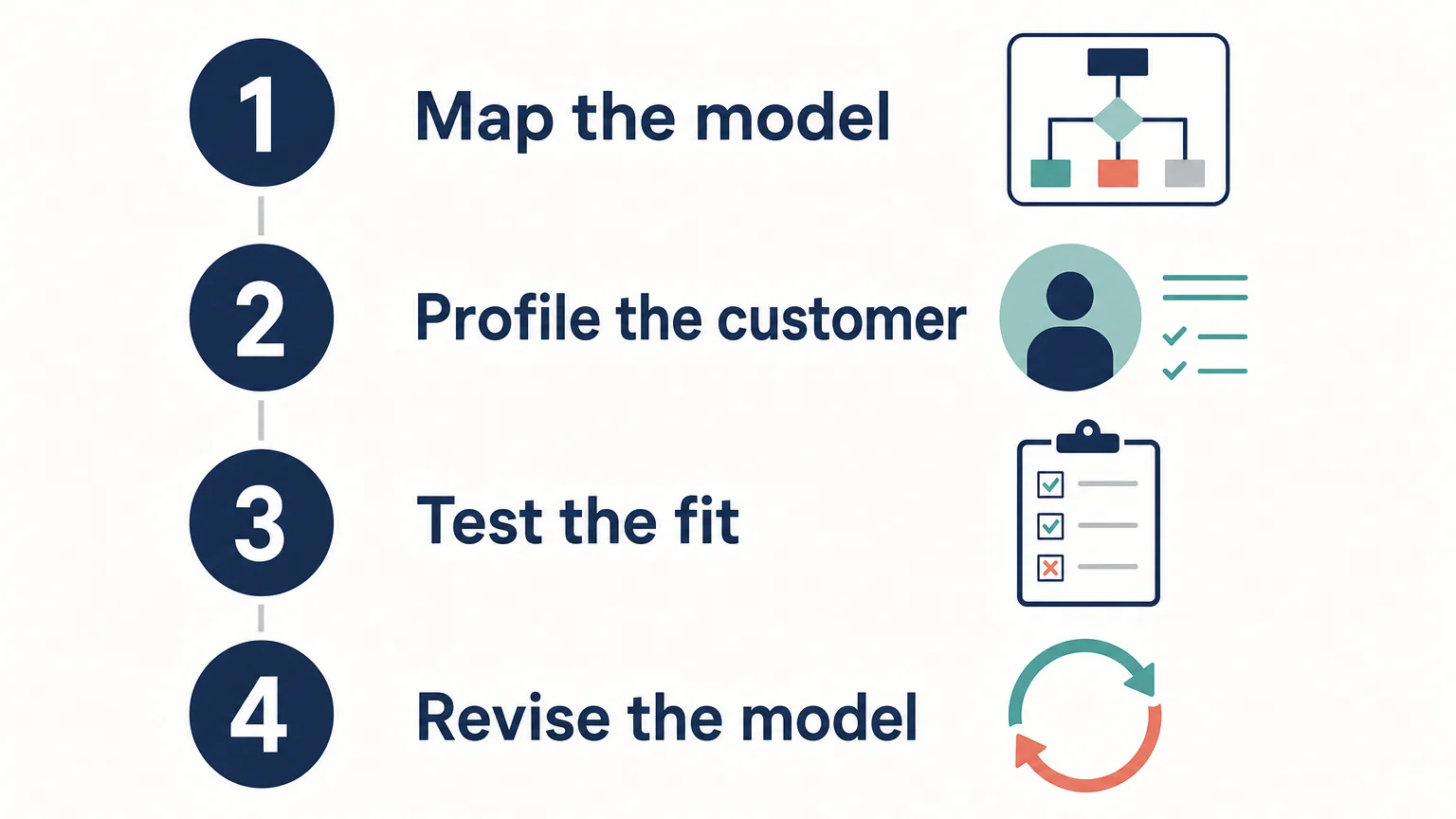
Using both canvases creates a useful sequence:
- Map the overall business model.
- Select a customer segment that deserves deeper analysis.
- Describe that segment’s jobs, pains, and gains.
- Connect the proposed offer to the highest-priority customer needs.
- Return to the Business Model Canvas and revise the related assumptions.
This process turns the canvases into a strategic feedback loop. Customer research can change the value proposition. A revised value proposition can change the channel, relationship, resources, activities, costs, and revenue assumptions.
A September 2026 practitioner guide recommends treating each canvas block as a hypothesis rather than a fact. That approach is valuable because a completed canvas can look precise even when every statement is based only on internal opinion.
You should therefore record the evidence behind important assumptions. Note whether an idea comes from a customer interview, usage data, a market observation, a competitor comparison, or an internal belief. This makes the canvas easier to challenge and update.
How should you use the canvases in practice?
Start with a defined decision, not with a desire to fill every space. You may be evaluating a new product, entering a market, redesigning an existing offer, or preparing an executive discussion.
Then choose one business model and one customer segment for the first iteration. Avoid combining several unrelated products, markets, or audiences on the same canvas. A crowded canvas hides trade-offs and makes it difficult to identify which assumptions need testing.
1. Define the business model
Complete a first version of the Business Model Canvas with concise statements. Focus on relationships between blocks rather than polished wording. At this stage, the goal is to expose the logic of the model.
2. Build the customer profile
Use interviews, observations, support conversations, search behaviour, surveys, or product data to identify customer jobs, pains, and gains. Prioritise them by importance and frequency. Do not treat every possible need as equally valuable.
3. Design the value map
List the products and services that address the selected jobs. Then connect them to the most important pains and gains. A strong value map makes deliberate choices. It does not promise to solve every customer problem.
4. Test the highest-risk assumptions
Test customer needs before investing heavily in delivery. Test the offer before assuming adoption. Test willingness to pay before treating revenue as certain. The method should match the risk, whether that means interviews, prototypes, landing pages, pilots, experiments, or sales conversations.
5. Revise both canvases
Update the canvases when evidence changes your assumptions. A 2026 study using survey data from 161 MSME respondents and structural equation modelling found a positive relationship between BMC and VPC use and measured productivity. The result should not be treated as universal proof, but the study’s method illustrates why structured testing is more informative than relying on an attractive diagram alone.
The practical value of this workflow is not the canvas itself. It is the quality of the decisions that the canvas helps your team make. A useful version should clarify what you believe, what you need to learn, and what you will change if the evidence disagrees.
When the work must support a board meeting, client presentation, or leadership workshop, visual structure becomes especially important. Our library combines strategic frameworks, narrative structures, action titles, concise messaging, and presentation-ready systems for PowerPoint, Keynote, Figma, and more. You can also use our business model canvas template as a structured starting point for presenting the logic of a model clearly.
What mistakes should you avoid?
The first mistake is confusing the two canvases. The BMC is not a detailed customer research tool, and the VPC is not a complete description of operations, costs, or revenue.
The second mistake is mixing customer segments. If a buyer, user, and decision-maker have different priorities, combining them in one profile will produce vague jobs, pains, and gains.
The third mistake is writing the customer profile from the organisation’s perspective. Statements such as “customers need our platform” describe the proposed solution, not the customer’s underlying job.
The fourth mistake is treating assumptions as validated facts. A canvas is a working model. It should evolve as you gather stronger evidence.
The fifth mistake is trying to address every pain and gain. Focus on the few customer priorities where your offer can create meaningful value and where your business model can support delivery.
Make the two canvases work as one system
The business model canvas and value proposition canvas serve different purposes, but their real strength appears when you use them together. The BMC gives you the system view, while the VPC tests whether a specific customer promise is relevant, deliverable, and worth developing. Start with focused assumptions, validate the most important risks, and revise the model as evidence accumulates.
Turn Your Canvas Into a Clear Strategic Story
A completed canvas is useful only when people can understand it, challenge it, and use it to make decisions. If your team needs to communicate customer value and business logic with greater clarity, a structured visual format can turn complex thinking into a more persuasive strategic conversation.
Our value proposition canvas template supports clear framework-based communication through presentation-ready strategic materials. Our visual strategic-thinking assets are built for PowerPoint, Keynote, Figma, and more, helping consultants, founders, executives, and business leaders organise ideas and present decisions with consistency.
Frequently Asked Questions
Can you use the Business Model Canvas without the Value Proposition Canvas?
Yes. The Business Model Canvas can map the full business model on its own. The Value Proposition Canvas becomes useful when you need deeper insight into a customer segment and a more precise assessment of customer value.
Which canvas should you complete first?
Many teams begin with a high-level Business Model Canvas, then use the Value Proposition Canvas to examine one customer segment in greater detail. You can also begin with customer research when the main uncertainty concerns the problem or audience.
How many Value Proposition Canvases should you create?
Create a separate canvas for each important customer segment when their jobs, pains, gains, or buying criteria differ. Keeping profiles separate makes prioritisation and testing more precise.
Are these canvases a substitute for a business plan?
No. They are visual strategy tools that help you structure assumptions and conversations. Financial forecasts, operational plans, legal analysis, market research, and implementation planning may still be required.
How can Deckadence help with canvas-based strategy work?
We provide visual strategic-thinking assets, framework references, presentation systems, and templates that help communicate complex strategy clearly. Our strategy guide covers more than 15 frameworks, while our presentation materials support executive, consulting, agency, and leadership communication.