Test Your Business Assumptions Before You Invest in Growth
What would happen if your most confident business belief were wrong? To test your business assumptions properly, you need to expose the beliefs behind your idea before they become expensive commitments. Our business model prototyping approach can help you turn those beliefs into visible, testable choices.
A business idea is rarely one assumption. It is a connected set of beliefs about customers, problems, pricing, channels, capabilities, costs, and growth. Testing them in the right order gives you better evidence while the cost of changing direction remains manageable.
Why should you test business assumptions before execution?
Every business plan contains assumptions, even when the document presents them as facts. A forecast may assume a particular customer segment will buy, a channel will deliver affordable acquisition, or an internal team can support the proposed service. Until you have evidence, each point remains a hypothesis.
The practical risk is not simply that one assumption may be wrong. The greater risk is that several assumptions depend on one another. If customers do not value the offer, pricing becomes irrelevant. If the price is acceptable but delivery costs are too high, demand still does not create a viable business. If demand and economics work, but the channel cannot reach customers repeatedly, growth remains theoretical.
Current evidence can also change faster than a static business plan. The U.S. Census Bureau’s Business Trends and Outlook Survey collects data on revenue, employment, demand, prices, and business expectations through ongoing releases. Its 2026 Census release explains how the survey supports timely business decision-making across sectors and locations.
That does not mean external data will answer every question. It means your research should combine market evidence with direct tests of the specific behavior your business needs. Industry growth may indicate opportunity, but it does not prove that your target customer will choose your offer.
Which business assumptions should you map first?
Start by asking one question: what must be true for this business to succeed? Write the answer as a specific statement that could be supported or weakened by evidence.
For example, “customers want a better workflow” is too broad. A more useful assumption might be, “operations managers at companies with more than 50 employees experience this problem weekly and will pay for a faster process.” The second version identifies a customer, a situation, a frequency, and a commercial behavior.
Map assumptions across the main parts of the business model:
- Customer assumptions: You know who experiences the problem, who uses the solution, who pays, and who influences the decision.
- Problem assumptions: The problem is frequent, costly, urgent, or frustrating enough to justify a change.
- Value assumptions: Your proposed outcome is more useful than existing alternatives.
- Channel assumptions: You can reach the right customers through a practical and repeatable route.
- Pricing assumptions: Customers will accept the proposed price or payment structure.
- Feasibility assumptions: Your team can build, deliver, support, or source the offer.
- Partner assumptions: Suppliers, distributors, platforms, or strategic partners will cooperate under workable terms.
- Cost assumptions: Delivery, acquisition, operations, and support costs will remain compatible with the model.
- Growth assumptions: The business can repeat its sales and delivery process without exceptional effort.
Use our Business Model Canvas questions to examine each area systematically. The objective is not to produce a longer document. It is to reveal hidden dependencies that could change your next decision.
How do you prioritize assumptions by risk?
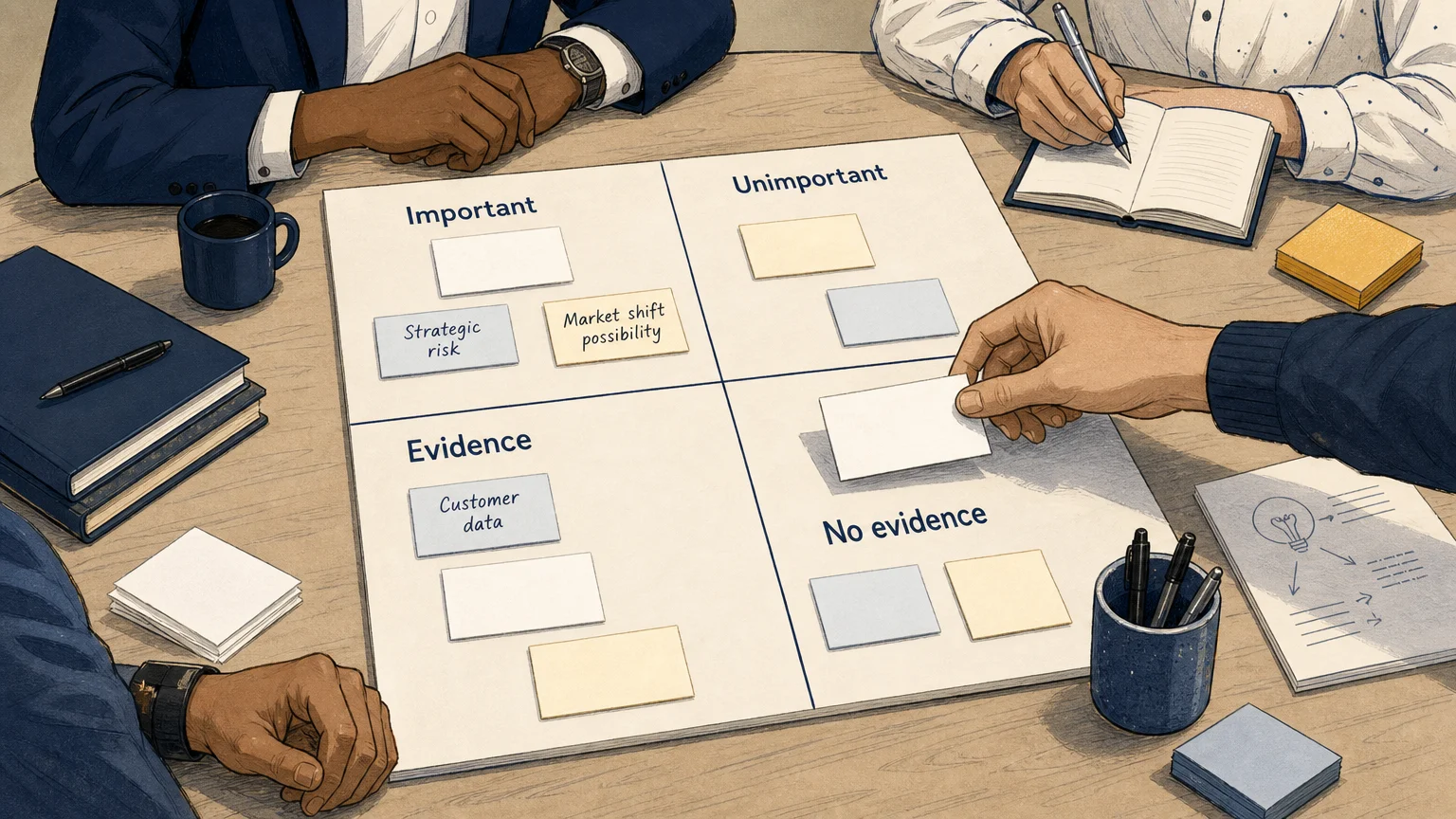
Testing everything at once creates activity without useful learning. Prioritize the assumptions that combine high importance with low evidence. These are the beliefs that could seriously damage the business if they prove false.
A simple prioritization method uses four questions:
- How important is this assumption to the business model?
- How uncertain is it today?
- How severe would the consequences be if it were wrong?
- How quickly and cheaply can you obtain credible evidence?
This approach separates curiosity from risk. An uncertain assumption may deserve attention later if it has little effect on the business. A well-supported assumption may still require testing if failure would destroy the model.
Consider two examples. You may be uncertain about the color of a product interface, but that issue probably has limited strategic impact. You may also be highly confident that customers will pay a particular price, but if the assumption has not been tested, it could still represent a major commercial risk.
Forecasting deserves particular caution. A Census working paper published in 2026 used administrative data from about 17 million business applications submitted between 2017 and 2021. It examined how expected initial employment compared with realized outcomes, illustrating why entrepreneurial expectations should be treated as evidence to examine, not certainty to protect.
Rank your assumptions before choosing a test. Otherwise, teams often test what is easiest, such as whether a prototype can be built, rather than what is most dangerous, such as whether anyone will pay for it.
What is the smallest credible test for each assumption?
The right experiment answers one important question with the least commitment possible. A test should produce evidence about behavior, not simply collect opinions about your idea.
Begin by writing a test statement:
- Assumption: What do you believe is true?
- Question: What specific uncertainty must the test resolve?
- Method: What is the smallest experiment that can produce useful evidence?
- Measure: What behavior or result will you record?
- Threshold: What result will count as sufficient evidence?
- Decision: What will you do if the result is positive, negative, or ambiguous?
Match the method to the uncertainty. Customer interviews can help you understand current behavior and existing workarounds. A prototype can test whether users understand a proposed experience. A landing page can test interest in a clearly described offer. A paid pilot, deposit, or signed commercial commitment provides stronger evidence of willingness to pay.
Operational assumptions require operational tests. If you believe a service can be delivered in two days, observe the process with real cases. If you believe a partner can supply materials at a target cost, request a concrete quote and test a small order. If you believe an internal team can support a new offer, observe how the work fits alongside its existing priorities.
A test should also avoid changing several variables at once. If you change the audience, message, price, and channel simultaneously, the result will be difficult to interpret. Isolate the most important variable whenever the decision depends on knowing what caused the outcome.
How can you test customer demand and willingness to pay?
Customer interest is not the same as commercial demand. People may praise an idea because the conversation is interesting, because they want to be helpful, or because they do not face the cost of adopting it.
Start with evidence of the customer’s existing behavior. Ask what they do today, what they have already tried, what the problem costs them, and when the problem becomes urgent. Questions about past actions usually reveal more than questions about future intentions.
Then test the proposed value in stages:
- Problem evidence: Confirm that the target customer experiences the problem in a meaningful context.
- Alternative evidence: Identify the tools, processes, suppliers, or workarounds already used.
- Solution evidence: Show a simple representation and observe whether the customer understands its relevance.
- Commercial evidence: Ask for a concrete next step, such as a paid pilot, deposit, purchase order, or defined buying process.
Pricing tests should reflect the real decision. A survey question about an acceptable price can inform research, but it does not equal a purchase. If possible, present a specific offer to the person who controls the relevant budget.
Our page on what a business model is can help you connect customer value with the way an organisation creates, delivers, and captures value. This connection matters because strong demand for a benefit does not automatically create a sustainable business model.
How do you test feasibility, delivery, and viability?
A business can be desirable without being feasible. It can also be feasible without being viable. Test these dimensions separately, then examine how they interact.
Feasibility asks whether the proposed solution can be created and delivered. Test the required technology, people, resources, partnerships, processes, and compliance conditions. Document the effort involved, including exceptions and manual work that a polished plan may hide.
Delivery capability asks whether the business can provide the promised value repeatedly. A successful pilot may depend on senior attention, specialist intervention, unusually cooperative customers, or temporary workarounds. Those conditions may be useful during learning, but they should not be mistaken for a scalable operating model.
Viability asks whether the economics can support the business. Examine price, gross margin, acquisition cost, service cost, retention, payment timing, and the investment required to reach repeatable demand. Use ranges rather than one optimistic estimate, then identify which variable creates the greatest exposure.
External business data can provide context, but it should not replace your own tests. In the UK’s 2025 to 2026 Business Data Survey, 29% of large businesses said data use led to more efficient internal processes always or most of the time, compared with 11% of small businesses and 10% of microbusinesses. The UK business survey shows why business size and operating context matter when interpreting evidence.
Use the same discipline for financial assumptions. If your plan depends on external funding, compare your expectations with current conditions affecting employer firms. The Federal Reserve’s 2026 employer-firm report is one example of survey-based evidence that can complement your internal financial model.
How should evidence change your next business decision?
Testing only creates value when the result changes what you do. Before running an experiment, define the decision it will inform.
Use three broad outcomes:
- Continue: The evidence supports the assumption, and the next risk should be tested.
- Change direction: The evidence weakens an important assumption, but a revised customer, offer, channel, or operating model could still work.
- Stop: A critical assumption fails, and no credible adaptation preserves an attractive opportunity.
Do not treat ambiguous results as automatic approval. Weak interest, polite feedback, low usage, or inconsistent buying signals may indicate that the problem is not urgent enough. In those cases, repeat the test only if you can improve the question, audience, or evidence quality.
Record every test in a decision log. Include the assumption, the method, the sample or context, the result, the interpretation, and the decision. This prevents teams from repeating old debates and makes learning visible to people who were not present during the experiment.
Evidence also needs a communication system. Our Business Framework Model content can help structure complex strategic thinking into a clearer narrative. Our visual strategic-thinking assets combine frameworks, narrative structures, action titles, concise messaging, and evidence-driven storytelling for professional presentations.
When assumptions are tested, the presentation should show more than a conclusion. It should show the belief, the evidence, the uncertainty that remains, and the decision that follows. That structure helps stakeholders distinguish learning from opinion.
Make assumption testing part of the business rhythm
Testing business assumptions is not a one-time exercise before launch. It is a disciplined way to reduce uncertainty whenever you consider a new offer, market, channel, partnership, or investment. Map the assumptions, prioritize the risks, run small experiments, and decide against clear thresholds. The goal is not to prove that your original idea was right. It is to improve the next decision before the cost of being wrong becomes too high.
Turn Tested Assumptions Into Clear Strategic Decisions
Evidence becomes more useful when your team can organize it, explain it, and connect it to a decision. Our strategy resources support clearer analysis, structured storytelling, and communication that helps stakeholders understand what has been learned.
Explore our presentation-ready frameworks, strategic-thinking assets, and educational content for business planning, competitive analysis, innovation, and executive communication through business strategy consulting.
Frequently Asked Questions
What does it mean to test your business assumptions?
It means turning the beliefs behind your business idea into specific hypotheses and examining them with evidence. The evidence may come from customer behavior, commercial commitments, operational trials, financial analysis, or external research.
Which assumption should you test first?
Start with the assumption that is both important and uncertain. Give priority to beliefs that could change your target customer, value proposition, pricing, delivery model, or decision to continue.
Are customer interviews enough to validate an idea?
Interviews can reveal problems, existing behaviors, and language customers use. They are usually stronger when combined with behavioral tests, prototypes, paid pilots, pre-orders, or another concrete commercial action.
How do you know when to pivot?
Consider a pivot when evidence weakens a critical assumption but suggests that a revised customer, problem, offer, channel, or revenue model could still create value. Define the new assumption clearly and test it rather than treating the pivot as a conclusion.
How can Deckadence support assumption testing?
Our strategy guide, framework reference content, and visual strategic-thinking assets can help you organize assumptions, structure evidence, and communicate decisions clearly. They are intended for consultants, agencies, executives, founders, and business leaders working on strategic analysis and professional presentations.