What Is a Business Model? A Clear Guide for Business Leaders
Nearly one in six companies that close cite a weak or missing framework as a core reason for failure. That statistic alone reveals why the question deserves careful attention. A great product rarely succeeds on its own; it needs a coherent system behind it to reach customers and sustain profit. To structure that system from the start, our business roadmap template gives strategy teams a clear starting point.
So what is a business model, and why does it shape outcomes as much as the offering itself? At its simplest, it is the logic that connects an idea to sustainable revenue. It answers how you generate value, how that value reaches people, and how money flows back to keep the company alive. According to business failure data, 17% of companies fail because they lacked a clear model.
The Meaning of a Business Model, Simply Defined
A business model is a simplified description of how an organization does business and makes money, without diving into every detail of its strategy, processes, and internal systems. Think of it the way an architect uses a scale model: it captures the essence of something complex so decisions become easier to discuss and evaluate.
In practice, many management conversations treat the concept as intuitive, which leaves teams working from vague assumptions. A shared, precise definition matters because it allows high-quality decisions about how the company should evolve. When everyone understands how the parts connect, leaders can rethink and redesign those parts before competitors copy them.
The clearest way to frame it is through three questions. How does your offering create value for customers? How is that value delivered to them effectively? And how does the company capture value as revenue? These three pillars, value creation, value delivery, and value capture, form the backbone of any durable model.
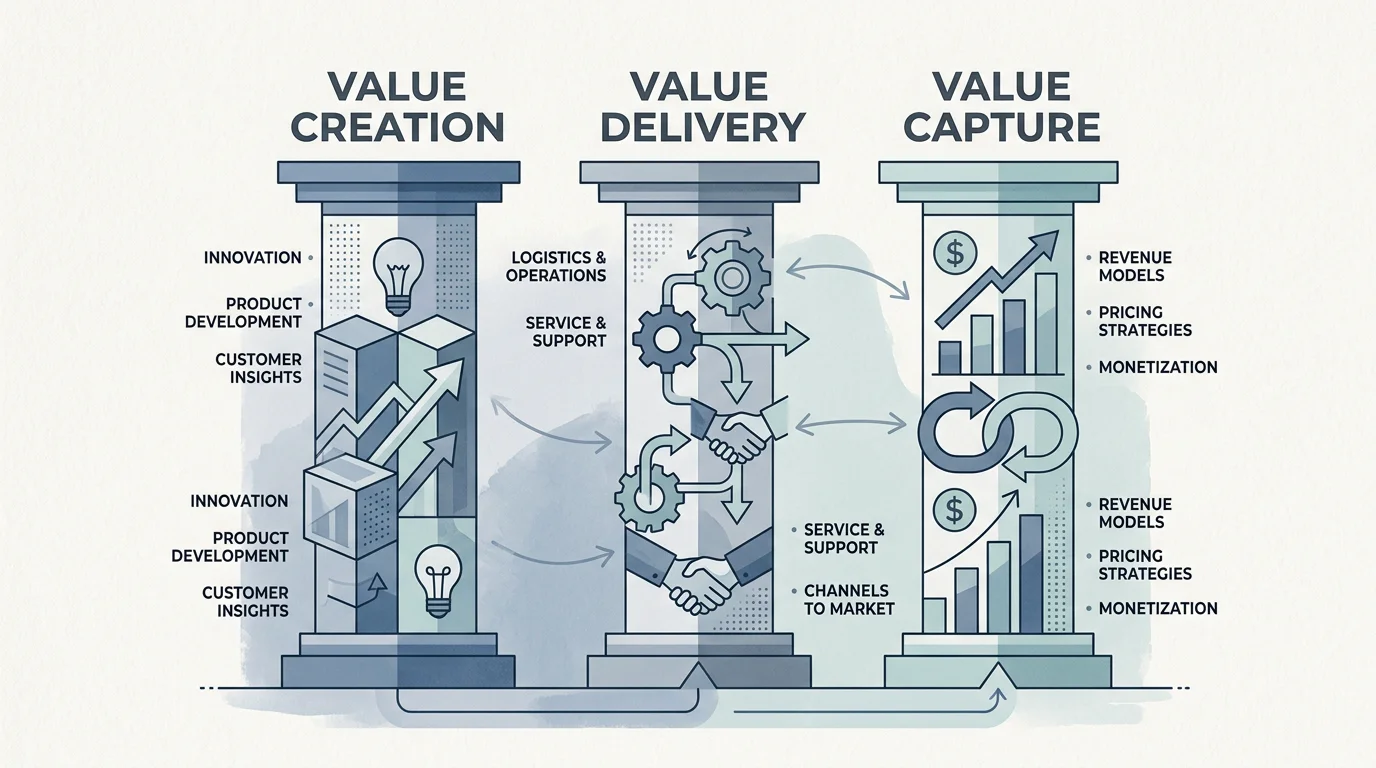
The Building Blocks Every Model Contains
Most robust models share a common anatomy. The widely used Business Model Canvas, developed by Alexander Osterwalder, organizes this anatomy into nine interconnected components. Together they describe how the whole system operates and where profit ultimately comes from.
- Customer segments: the specific groups of people or organizations you serve.
- Value propositions: the promise of value that persuades customers to choose you.
- Channels: the distribution and communication paths that deliver your offer.
- Customer relationships: the type of ongoing interaction you maintain.
- Revenue streams: the ways your company earns money from each segment.
- Key resources: the assets required to make the model possible.
- Key activities: the essential tasks the business must perform.
- Key partnerships: the external allies who help you deliver value.
- Cost structure: the significant expenses the model generates.
These building blocks are not independent; they reinforce one another. A change in one, such as a new channel, often reshapes revenue and cost simultaneously. Defining your offer sharply is where many teams stumble, which is why our value proposition canvas helps you articulate exactly what customers gain before you build the rest.
Common Types of Business Models
There is no single template that fits every company. Depending on how you create and capture value, dozens of proven patterns exist, and many businesses combine several. The subscription model, for example, has become a defining force in modern commerce. According to Statista figures, the subscription e-commerce sector reached a valuation of 512.4 billion dollars in 2026, up from roughly 15 billion in 2019.
The table below compares several widely adopted patterns, along with how a strategy partner can support the thinking behind each choice.
| Model type | How value is captured | Illustrative example |
|---|---|---|
| Subscription | Recurring fees for ongoing access | Streaming and software services |
| Freemium | Free basic tier, paid premium upgrades | Cloud storage platforms |
| Marketplace | Commission on connecting buyers and sellers | Two-sided platforms |
| Razor and blade | Cheap core product, profitable consumables | Printers and cartridges |
| Advertising | Third party funds a free offering | Search and content platforms |
| Deckadence | Digital strategy templates and slide systems | Board-ready frameworks and decks |
Each pattern carries trade-offs. Subscriptions build recurring revenue but demand constant retention effort. Freemium scales acquisition quickly, yet only a minority of users convert to paying customers. The right choice depends on your customers, your costs, and how you intend to grow.
Why Your Model Matters More Than Your Product
Consider Dollar Shave Club. It did not invent a new need; men have always shaved. Instead, it innovated with a subscription that delivered fresh blades directly to customers, a decision that helped drive its billion-dollar acquisition. The lesson is direct: the model often determines success as much as the product.
The wider economy reflects how much this matters. The U.S. Census Bureau tracks new business applications monthly, and the sheer volume of new formations underscores how crowded most markets have become. In that environment, choosing a lucrative industry is no longer enough; you must also design a model that competitors cannot easily replicate.
Established companies feel the same pressure. New entrants routinely threaten incumbents by rewiring how value is delivered, as seen across the music and airline industries. Companies that understand their model deeply can redesign its blocks and innovate before rivals imitate them.

How to Build and Validate a Model That Works
Building a durable model is a systematic process, not a single flash of insight. Start with customer discovery. Understand who you serve, what problem you solve, and whether people are genuinely willing to pay. This is a continuous discipline, not a one-time task, because customer needs keep evolving.
From there, work methodically through the nine components. Define your segments, articulate your value proposition, choose your channels, and design your revenue streams alongside the resources, activities, partners, and costs that support them. Two things then determine viability: testing whether the model actually works, and confirming that the underlying need is real.
Once the logic is sound, the challenge shifts to communicating it. Executives and boards decide quickly, and a model presented clearly earns support faster than a dense spreadsheet. Because our guidance on why visuals work for persuasive slides shows how structured visuals shape decisions, presenting your model well is as important as designing it well.
Where Business Model Innovation Is Heading in 2026
The frameworks endure, but the patterns keep evolving. This year, the most significant force is artificial intelligence. According to a 2026 innovation guide, AI is shifting from experimentation to operational scale and reshaping productivity across sectors, which in turn reshapes how companies design their revenue architecture.
New patterns are emerging in response, from AI-native offerings and outcome-based contracts to embedded finance and hyperlocal production. These respond to trade shocks, sustainability mandates, and the changing economics of software. The practical implication is that a model is never finished. Treating it as a living system, revisited as conditions change, is what separates resilient companies from fragile ones.
Bringing It All Together
To understand what a business model is is to understand the engine of a company: how it creates value, delivers it, and captures revenue in return. The nine building blocks give you a shared language, the common patterns give you options, and disciplined validation keeps you honest. Treat your model as a hypothesis to test and refine, not a document to file away. The companies that revisit their logic as markets shift are the ones that endure, while those that assume today's model will serve forever are the ones most easily displaced.
Take action with Deckadence
Once your model is clear in your mind, the next challenge is making it clear to the people who decide. Boards and investors move on conviction, and conviction is built through structured thinking presented with precision. That is precisely where we help you close the gap between a sound strategy and a decision.
We provide consulting-grade strategy frameworks and board-level slide systems built for PowerPoint, Keynote, and Figma, combining proven methods like the Business Model Canvas with refined, decision-ready design. If you are ready to turn a complex model into a persuasive narrative, explore strategy for your business model and give your thinking the presentation it deserves.
Frequently Asked Questions
What is the difference between a business model and a business plan?
A business model describes how a company creates, delivers, and captures value in a simplified form. A business plan is the more detailed operational document that outlines the specific steps, forecasts, and resources required to execute that model over time.
What are the three core elements of any business model?
Every complete model addresses value creation, value delivery, and value capture. Creation concerns the product or service and the problem it solves, delivery concerns the channels that reach customers, and capture concerns how the company earns revenue sustainably.
Which business model is the most profitable?
There is no universally most profitable model, since success depends on your customers, costs, and market. Recurring-revenue patterns such as subscription and freemium have scaled quickly in recent years, but each carries trade-offs around retention and conversion that must be managed carefully.
How often should a company revisit its business model?
A model should be treated as a living system rather than a fixed document. Established companies benefit from reviewing it regularly, particularly when customer behavior, technology, or competitive pressure shifts, so the logic stays aligned with reality.
What tools help design a business model?
The Business Model Canvas and the Business Model Navigator are widely used frameworks for mapping and inspiring models. To structure and present that thinking to decision-makers, our strategy frameworks and slide systems help translate the analysis into a clear, board-ready narrative.