Business Model Canvas Questions: A Practical 2026 Guide
A filled canvas can look complete while hiding weak assumptions. The more useful approach is to ask what must be true for each block to work, then connect those answers into a coherent business model. Our Business Model Canvas guide can help you frame that analysis as a clear strategic story rather than a collection of disconnected notes.
The framework is built around 9 connected building blocks covering customers, value, delivery, infrastructure, costs, and revenue. A university Business Model Canvas template presents these blocks as practical prompts, but the quality of the result depends on the depth and precision of your answers.
What questions belong on a Business Model Canvas?
Start with the 9 blocks, but do not treat them as isolated sections. Each answer should explain how your business serves a specific customer, delivers a specific benefit, and earns enough value to sustain the model.
1. Customer Segments
Customer segments define the people or organizations for whom you create value. Ask:
- Who experiences the problem most urgently?
- Who uses the product or service?
- Who pays for it?
- Are the user, buyer, decision-maker, and beneficiary the same person?
- Which segment should receive priority at launch?
- What behaviors, needs, budgets, or situations make this segment distinct?
A vague answer such as “small businesses” is rarely sufficient. A stronger answer identifies a meaningful group, such as independent consulting firms that need board-ready strategy presentations but lack internal presentation design capacity.
2. Value Propositions
Your value proposition explains why a customer should choose your offer. Ask:
- Which customer problem are you solving?
- Which need, job, or desired outcome are you addressing?
- What becomes easier, faster, safer, cheaper, or more valuable?
- What alternatives does the customer use today?
- Why would the customer switch?
- Is the offer essential, useful, or merely attractive?
The answer should describe a benefit, not simply a feature. “Includes presentation templates” is a feature. “Helps consultants turn complex analysis into a persuasive executive narrative” expresses a clearer customer outcome.
3. Channels
Channels describe how customers discover, evaluate, purchase, receive, and continue using your offer. Ask:
- Where does the customer look for solutions?
- Which channels build awareness?
- How will customers compare your offer with alternatives?
- Which channel supports purchase or adoption?
- How will delivery take place?
- Which channels are effective, affordable, and compatible with customer routines?
Separate communication from distribution when necessary. A professional may discover a product through educational content, evaluate it through a sample deck, purchase it through a website, and receive support through an automated knowledge base.
4. Customer Relationships
Customer relationships define the experience customers expect before, during, and after purchase. Ask:
- Does the customer need personal guidance or self-service access?
- How will you acquire customers?
- What will encourage repeat purchase or renewal?
- Which interactions can be automated?
- Where does trust matter most?
- How will customer feedback influence the offer?
The appropriate relationship depends on complexity and risk. A low-cost digital asset may need clear instructions and responsive support. A strategic service may require workshops, tailored guidance, and ongoing stakeholder communication.
5. Revenue Streams
Revenue streams show how the model captures value. Ask:
- What exactly is the customer paying for?
- How much is the customer willing to pay?
- Is payment one-time, recurring, usage-based, licensed, or transaction-based?
- Who pays, and when?
- Which segment generates each revenue stream?
- What must happen before revenue is recognized?
Do not write “sales” and move on. Specify the mechanism, such as individual product purchases, enterprise licenses, subscriptions, usage fees, or paid implementation. Each stream should connect to a customer segment and a value proposition.
6. Key Resources
Key resources are the assets required to create and deliver value. Ask:
- Which people, capabilities, technology, data, intellectual property, or funding are essential?
- Which resources must be owned?
- Which can be leased, licensed, or supplied by partners?
- Which resources create defensibility?
- Which resource becomes a bottleneck if demand increases?
For a digital presentation publisher, resources may include strategic frameworks, editorial expertise, design systems, platform knowledge, content libraries, and distribution infrastructure. The important question is not whether a resource exists, but whether it is critical to the promised customer outcome.
7. Key Activities
Key activities are the actions that make the model work. Ask:
- What must the organization do consistently well?
- Which activities create the value proposition?
- Which activities support distribution and customer relationships?
- What should remain internal?
- What can be outsourced without weakening quality or control?
Activities should be specific. “Marketing” is broad. “Publish evidence-led strategy content that helps qualified buyers evaluate presentation assets” is more useful because it connects the activity to acquisition and value creation.
8. Key Partnerships
Key partners provide resources, capabilities, access, or risk-sharing support. Ask:
- Which suppliers are essential?
- Which partners provide capabilities that would be inefficient to build internally?
- Who can improve reach or credibility?
- Which partnerships reduce cost or uncertainty?
- What does each partner gain?
- What dependency could create operational risk?
A partnership belongs on the canvas only when it affects the model. Listing every supplier creates noise. Focus on relationships that support a key activity, resource, channel, customer relationship, or revenue stream.
9. Cost Structure
Cost structure captures the expenses required to operate the model. Ask:
- Which resources create the highest costs?
- Which activities consume the most time or money?
- Which costs are fixed?
- Which costs increase with each customer or transaction?
- What costs are required before revenue begins?
- Can the model scale without a matching increase in cost?
Cost analysis should follow the other blocks. Once you know the activities, resources, partners, channels, and relationships required, you can estimate the cost of delivering the value proposition with greater precision.
How do you turn broad prompts into useful questions?
Broad prompts create broad answers. To improve the canvas, convert each block into a set of hypotheses that can be tested through observation, interviews, experiments, or financial analysis.
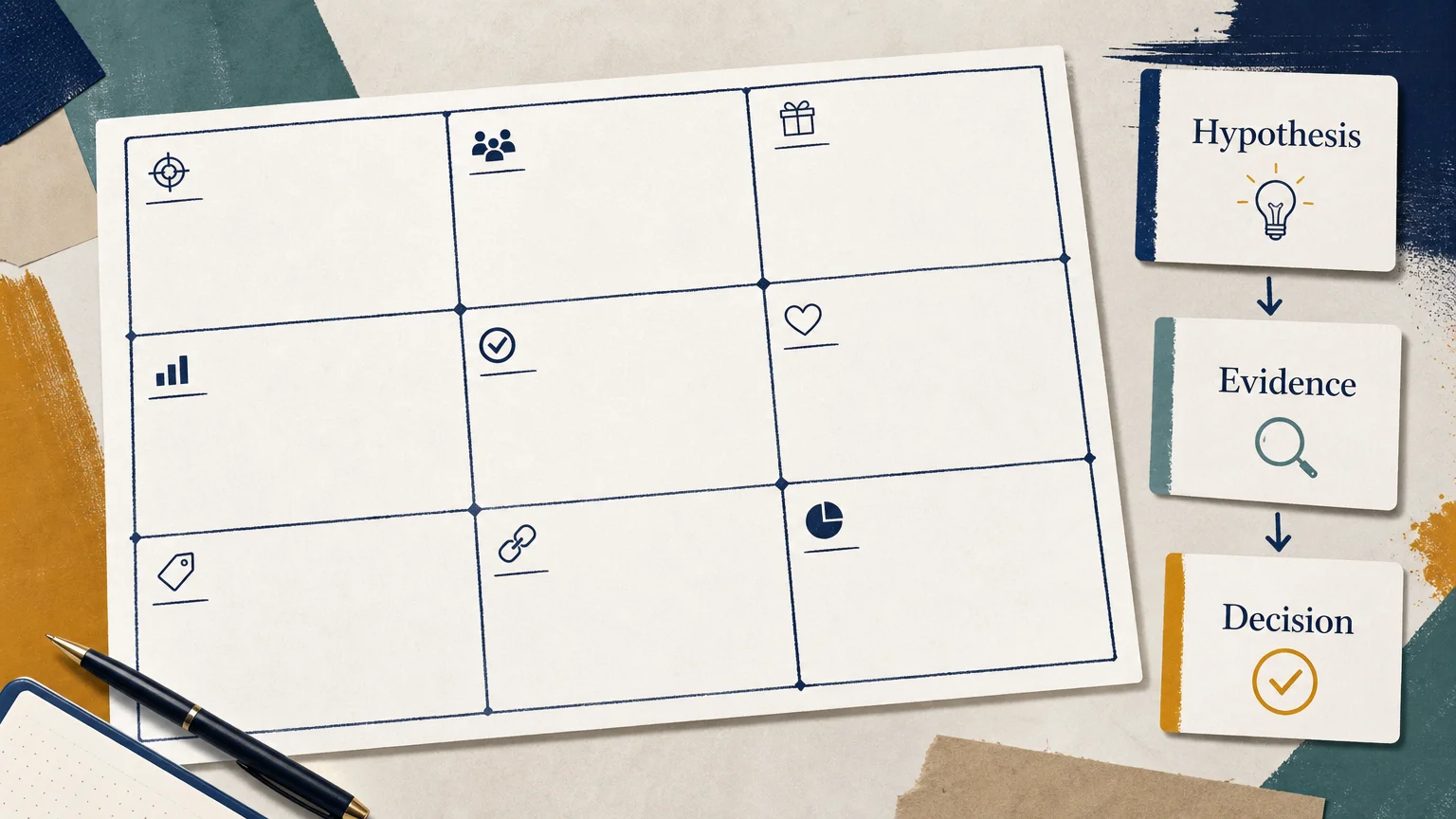
Use a three-part question pattern
For every block, ask three questions:
- What do we believe? State the assumption clearly.
- What evidence supports it? Identify interviews, behavior, transactions, experiments, or data.
- What decision follows? Define what you will change, continue, or investigate.
For example, a company might believe that startup founders want a premium strategy presentation template. Evidence could include repeated requests, sample downloads, interviews, and completed purchases. The resulting decision might be to develop a founder-focused collection, revise the positioning, or test a different segment.
Ask questions that expose connections
A canvas becomes more useful when you test relationships between blocks. Ask which value proposition belongs to which segment, which channel delivers it, which activity supports it, and which revenue stream captures the value.
This prevents orphan answers. A customer segment without a distinct need is weak. A revenue stream without a clear payer is incomplete. A key partner without a contribution to resources or activities may not be strategically important.
Which questions test desirability, feasibility, and viability?
Three lenses help organize the questions. Desirability asks whether customers want the solution. Feasibility asks whether the organization can deliver it. Viability asks whether the financial logic can support the model.
Desirability questions
- What job is the customer trying to complete?
- How painful or urgent is the problem?
- How does the customer solve it today?
- What would make the customer change behavior?
- What proof would demonstrate meaningful demand?
A 2018 exploratory study of 271 cleantech accelerator teams found that customer segmentation, value proposition, and channels were especially relevant to early performance. The study reported that teams using this combination heavily performed twice as well as teams that used it lightly, although the authors described the findings as exploratory and focused on early-stage ventures. The 2018 venture study supports a practical lesson: begin with the customer, the promised value, and the route to market before adding operational complexity.
Feasibility questions
- Can the organization deliver the promised result repeatedly?
- Which capabilities are scarce or difficult to replace?
- What operational process supports quality?
- Which activities require specialist knowledge?
- What happens when demand increases?
Feasibility is not limited to production. It includes customer support, onboarding, compliance, data management, fulfillment, and the ability to maintain quality as volume grows.
Viability questions
- Does the price reflect the value customers perceive?
- Do gross margins remain attractive after delivery costs?
- How long does it take to recover acquisition costs?
- Which costs grow faster than revenue?
- Can the model generate reliable cash flow?
These questions help distinguish an interesting idea from a workable business model. A customer may want the offer, and the company may be able to deliver it, but the model still fails if the economics do not support continued operation.
How do you validate and update the canvas?
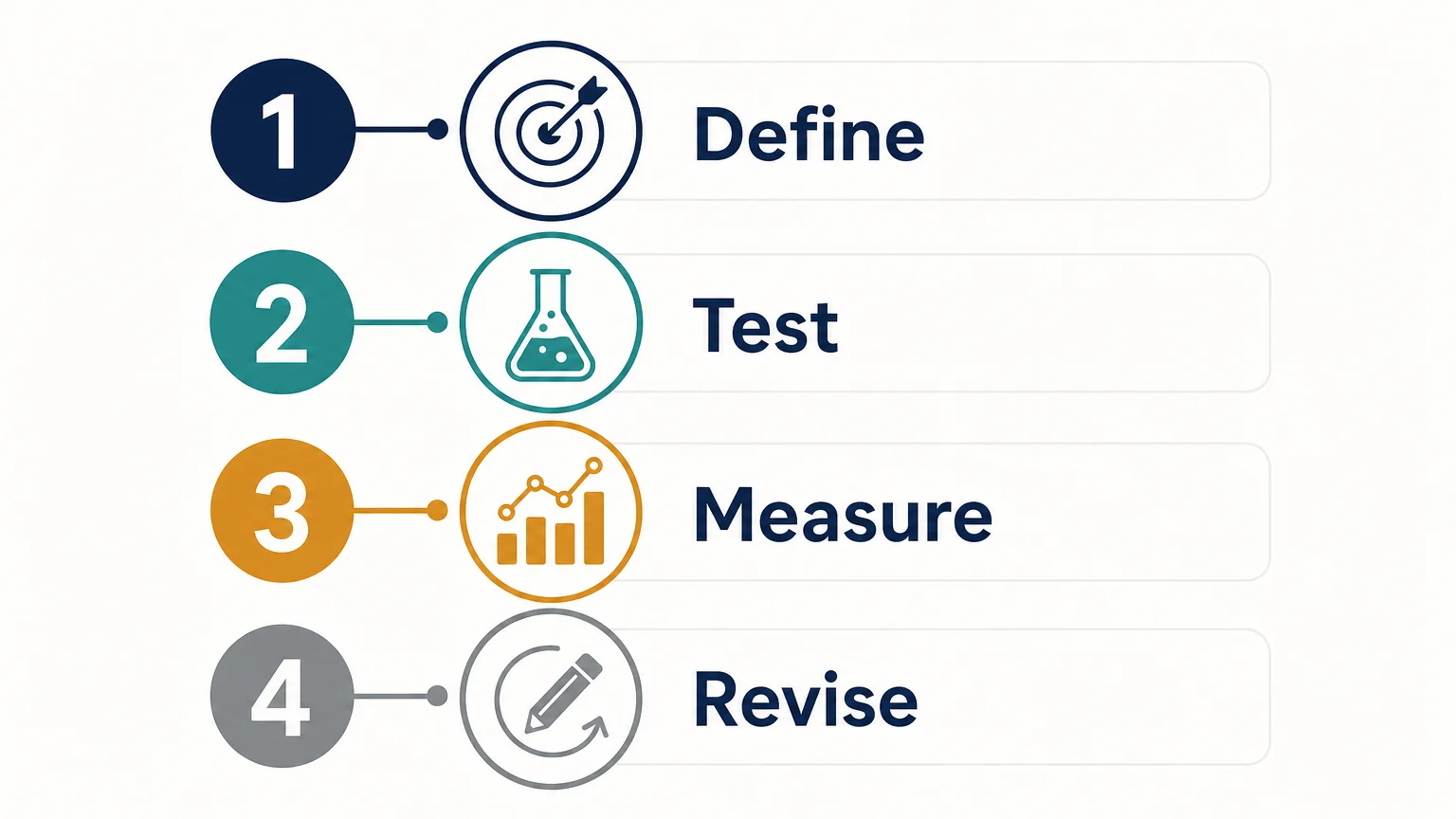
A canvas should change as evidence improves. Treat every important statement as either a known fact, a supported inference, or an assumption that still requires testing.
Use customer interviews to understand jobs, pains, alternatives, and buying triggers. Use landing pages, prototypes, sample content, pilots, or preorders to test behavior. Use financial models to examine pricing, contribution margin, acquisition cost, and break-even conditions.
When the model depends on information, ask how that information will be collected, analyzed, protected, and shared. The UK Business Data Survey 2026 found that businesses using artificial intelligence reported higher rates of data collection, analysis, and sharing than businesses that did not use AI. These figures relate to surveyed UK businesses, not to all organizations internationally, but they illustrate why data practices can become part of the operating model. The 2026 UK survey provides a useful reminder to include data responsibilities in relevant resource, activity, partnership, and cost questions.
Set a review rhythm
Review the canvas after meaningful evidence appears, not only during annual planning. A new customer segment, pricing result, partnership constraint, regulatory change, or delivery problem may require several connected blocks to be revised.
Version control also matters. Date each canvas, record major changes, and distinguish the current model from the model you want to build. This makes strategic conversations more precise and prevents teams from treating an old assumption as a current fact.
How can you make the canvas decision-ready?
A canvas is easier to use when every block is concise, specific, and visually connected. Avoid paragraphs inside the blocks. Use short statements that identify the customer, outcome, activity, resource, partner, cost, or revenue mechanism.
For workshops, our Business Model Canvas template can provide a structured starting point for organizing the 9 blocks. If you are still exploring an idea, our blank Business Model Canvas gives your team room to build the model from first principles.
Presentation quality should support strategic clarity. Use action titles, clear evidence, restrained color coding, and consistent language. For example, distinguish current evidence from future assumptions, and separate the customer promise from the internal activity required to deliver it.
For founders, the questions may need greater emphasis on uncertainty, early validation, and resource constraints. Our Startup Business Canvas is relevant when the model is still evolving and the team needs to communicate choices before every answer is known.
A 2026 journal article on digital technologies and the Business Model Canvas argued that digital technology is not always represented clearly in the original 9 blocks. It proposed a digital extension with two additional technology-related elements, which reinforces a broader point: adapt the questions when the operating environment introduces capabilities or risks that the standard canvas does not show clearly. The 2026 digital canvas research is particularly relevant for platform, data, software, and AI-enabled models.
Final thoughts on Business Model Canvas questions
The strongest business model canvas questions do more than populate a template. They connect customer problems to value propositions, channels, relationships, activities, resources, partners, costs, and revenue. Ask each question as a hypothesis, identify the evidence that could confirm or challenge it, and revise the canvas when reality changes. This turns the canvas into a practical decision tool rather than a static summary.
Turn Strategic Thinking Into Clear Presentations
A well-tested business model still needs to be explained clearly to executives, investors, partners, and teams. The right visual structure can make the logic easier to understand, challenge, and act on.

Our visual strategy resources combine structured storytelling, strategic frameworks, concise messaging, and presentation-ready design for consultants, founders, agencies, and business leaders. Explore Deckadence’s visual strategy resources to support clearer strategic communication in PowerPoint, Keynote, Figma, and related workflows.
Frequently Asked Questions
What is the purpose of Business Model Canvas questions?
They help you examine how a business creates, delivers, and captures value. They also reveal assumptions that require customer, operational, or financial evidence.
Which Business Model Canvas block should you complete first?
Many teams begin with customer segments and value propositions because these clarify who the model serves and why the offer matters. You can then connect those answers to channels, relationships, revenue, and operations.
How detailed should the answers be?
Use enough detail to make each statement testable and decision-relevant. Avoid long descriptions that hide uncertainty or make relationships between blocks difficult to see.
Can the Business Model Canvas be used for an existing company?
Yes. You can map the current model, compare it with a desired future model, and identify gaps between customer expectations, operational capabilities, and financial results.
Can Deckadence help with a Business Model Canvas presentation?
Deckadence provides strategic-thinking templates, slide systems, and presentation assets designed to make complex ideas clearer and more persuasive. Its materials can support consultants, founders, executives, and business leaders who need to communicate strategic choices.