Business Framework Model: Build a Stronger Business Strategy
A business can have a strong product and still lack a coherent way to serve customers, deliver value, or earn sustainable revenue. That is why a business framework model matters. It gives you a structured view of how the essential parts of the organization fit together. To establish that structure quickly, our business model framework can help you organize strategic thinking on one visual page.
The term is often used interchangeably with business model, business model framework, or business model canvas. These concepts overlap, but they are not identical. A business model describes the logic of the business, while a framework gives you a method for examining, communicating, and improving that logic.
What Is a Business Framework Model, Really?
At its simplest, a business framework model is a structured representation of how an organization works as an economic and operational system. It identifies the customers you serve, the value you provide, the capabilities required to deliver that value, and the mechanisms that support financial sustainability.
This definition goes beyond a revenue model. Revenue is only one part of the system. A subscription, licensing, usage-based, advertising, or direct-sales mechanism will work only when it fits customer expectations, delivery capabilities, cost levels, and operational priorities.
The Christensen Institute framework describes a business model through four interlocking elements: value propositions, resources, processes, and a profit formula. This perspective is useful because it shows why isolated changes can fail. A new offer may create customer interest, but the organization may lack the resources or processes needed to deliver it profitably.
For example, imagine a professional services firm moving from project fees to a recurring subscription. The new revenue stream may appear attractive, but it also changes delivery expectations, staffing requirements, customer relationships, forecasting, and support costs. The model is not truly redesigned unless these connected elements change together.
A useful framework therefore answers five practical questions:
- Who are you serving?
- What problem are you solving?
- How will customers receive the value?
- What capabilities and partners make delivery possible?
- How will the organization capture enough value to remain viable?
How Does It Create a Coherent Business Logic?
Consider a framework as a chain of connected choices. Customer segments influence the value proposition. The value proposition shapes channels and customer relationships. These choices determine the resources, activities, and partnerships required for delivery. The full system then influences costs and revenue.
This connection is the central benefit of a business framework model. It helps you see dependencies that are difficult to detect in separate departmental plans. Marketing may promise speed, operations may lack the capacity to provide it, and finance may set a price that does not cover the required service level.
The model can also expose strategic trade-offs. A premium proposition may require specialized talent, higher service levels, and stronger quality controls. A low-cost proposition may require standardization, automation, limited customization, or a narrower customer promise. Neither approach is automatically correct. The important question is whether the choices reinforce one another.
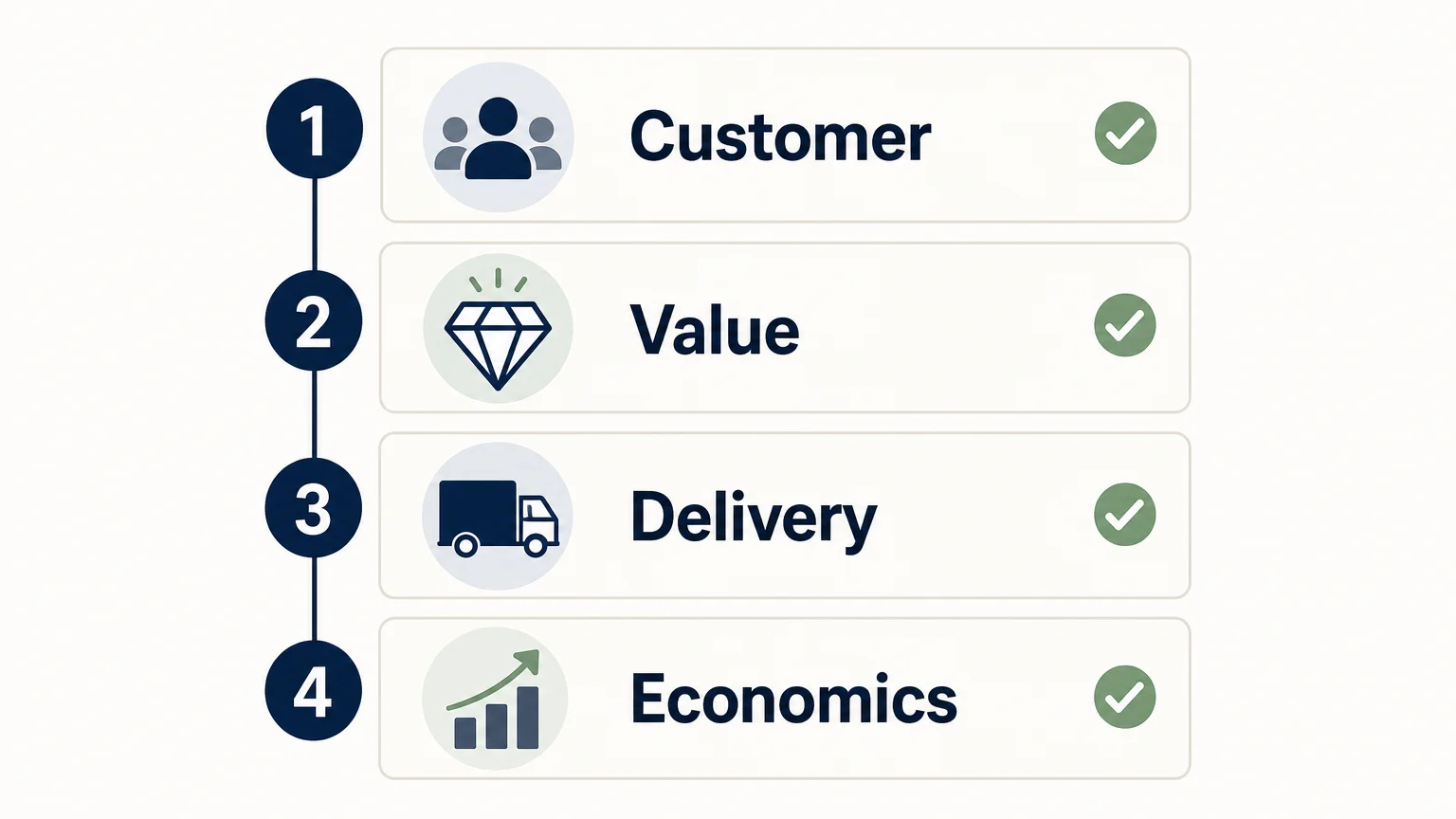
You can organize the logic into four layers:
Customer and value
Define the customer groups you intend to serve and the specific outcomes they value. Avoid describing the audience too broadly. A framework becomes more useful when it distinguishes between different needs, buying situations, urgency levels, and willingness to pay.
Delivery and operations
Identify how customers discover, access, and use the offering. Then map the activities, resources, technology, and partners required to deliver it consistently. This layer turns an appealing concept into an operational proposition.
Economics and sustainability
List the revenue streams and the main cost drivers. Consider whether revenue is transactional, recurring, usage-based, licensed, or partner-generated. Then test whether the expected margin can support acquisition, delivery, development, administration, and future investment.
Adaptability and governance
Include the external forces that can change the model. These may involve regulation, technology, customer behavior, competitors, suppliers, or macroeconomic conditions. A framework that ignores these forces can describe the business accurately today while providing little guidance for tomorrow.
In 2026, this final layer is especially important for businesses operating through rapidly changing technologies and customer expectations. You do not need to predict every change. You do need a process for identifying which assumptions require review.

Which Framework Structure Fits Your Situation?
There is no single framework that serves every strategic purpose. Your choice should depend on the question you need to answer, the maturity of the business, and the level of uncertainty you face.
The Business Model Canvas is useful when you need a shared visual language for describing an existing model or exploring a new one. Its nine blocks cover customer segments, value propositions, channels, customer relationships, revenue streams, key resources, key activities, key partnerships, and cost structure.
A startup may need a more assumption-driven format. In that situation, a lean canvas can focus attention on problems, solutions, customer segments, channels, unfair advantage, and key metrics. It is often more suitable when the offering, audience, and route to market remain uncertain.
A business model pattern library provides another type of support. Instead of asking you to describe your current model immediately, it gives you examples of mechanisms such as subscription, freemium, marketplace, direct selling, licensing, or pay-per-use. These patterns can stimulate alternatives, but they still require validation in your specific market.
A sustainability-oriented framework may add stakeholders, impact, governance, risk, or environmental considerations. This extension is relevant when commercial performance alone does not define success. A 2022 Frontiers research paper proposed a sustainable framework for community water supply businesses that integrated organizational, technological, risk, transparency, and social considerations.
You can select a framework by matching it to the decision at hand:
- Use a business model canvas to create a shared overview.
- Use a lean format to test uncertain startup assumptions.
- Use pattern libraries to generate alternative business model ideas.
- Use an extended framework when stakeholders, impact, or governance are central.
These formats should not be treated as competing doctrines. You can use one to describe the system, another to test assumptions, and a third to evaluate broader consequences. If you are developing a new venture, our startup business canvas provides a more focused structure for early-stage strategic thinking.
How Do You Build and Test the Model?
Begin with the customer problem, not with the internal structure of the company. A framework becomes weaker when it starts with departments, assets, or products before establishing why a specific customer would choose the offering.
- Define the target customer. Identify the group with the clearest need, strongest urgency, or most accessible buying process. Separate users, buyers, decision-makers, and beneficiaries when they are different people.
- State the value proposition. Explain which problem you solve, which outcome you improve, and why your approach differs from available alternatives. Keep the statement specific enough to test.
- Map the customer journey. Describe how people discover, evaluate, purchase, receive, use, and renew the offering. Every stage can create friction or cost.
- List delivery requirements. Identify the key resources, activities, technologies, skills, and partnerships needed to fulfill the promise.
- Define the economics. Record revenue streams, pricing logic, fixed costs, variable costs, acquisition costs, and major investment requirements.
- Write the assumptions. Mark which statements are facts, estimates, beliefs, or unresolved questions. This distinction prevents confidence from being mistaken for evidence.
- Design practical tests. Use interviews, prototypes, landing pages, pilots, pricing conversations, or small-scale launches to examine the most uncertain assumptions.
- Update the model. Revise the framework when evidence changes your understanding of customers, delivery, or economics.
The first version should be concise. Excess detail can make the model look precise while hiding the assumptions that matter most. A short statement such as “mid-sized agencies will pay monthly for board-ready strategy templates” is more testable than a paragraph filled with general market language.
A 2022 study published by Wiley examined Business Model Canvas use among Saudi small and medium-sized enterprises. The research received 63 valid responses from an initial survey of 200 businesses, which illustrates an important point: adoption and satisfaction require evidence from a specific context rather than assumptions about universal effectiveness.
For more uncertain ideas, our business model prototyping approach can help you turn an initial framework into testable variations. The objective is not to create a polished document immediately. It is to learn which combination of customer value, delivery choices, and economic assumptions can work together.
How Do You Turn the Model Into Decisions?
A framework earns its value when it changes what you do. After mapping the model, connect each block to a decision, an owner, a measure, and a review date. This turns a visual overview into a management instrument.
For example, a weak value proposition may require customer interviews or a revised offer. An expensive channel may require a distribution experiment. A fragile partnership may require a second supplier or a different operating process. A revenue assumption may require pricing tests before investment increases.
You should also distinguish between changes that improve the existing model and changes that require a new model. Replacing a software tool may be a resource change. Redesigning the delivery process is deeper. Changing the target customer, value proposition, and profit formula may require a separate team or business unit.
This distinction matters because established organizations often have processes and priorities designed for the current model. A new initiative can appear strategically sound while conflicting with existing incentives, budgets, skills, or performance measures. The framework helps reveal that conflict early.
Use the model during several recurring conversations:
- Strategic planning: compare the current model with the model required by your objectives.
- Investment decisions: determine which resources and capabilities deserve funding.
- Innovation reviews: compare alternative ways to create, deliver, and capture value.
- Portfolio management: identify which offers share capabilities and which require different operating logic.
- Executive communication: give stakeholders a common view of choices, dependencies, and risks.
The model should also support scenario thinking. Create one version for the current business, one for the desired future state, and one for a credible disruption. Compare the differences. This exercise can show where you need new skills, different partners, revised pricing, or a more focused customer segment.
Do not confuse the framework with a complete business plan. The framework shows the logic of the system. A plan adds objectives, actions, schedules, budgets, responsibilities, and forecasts. Both are useful, but they answer different questions.
What Are the Most Common Framework Mistakes?
The first mistake is treating the framework as a one-time workshop exercise. Markets, customer expectations, technologies, and costs change. A model that is accurate in January may require revision by September, particularly when important assumptions have not been tested.
The second mistake is trying to include every detail. A business framework model should clarify the logic of the business, not reproduce every process, policy, or financial spreadsheet. Move detailed evidence into supporting documents and keep the core model readable.
The third mistake is describing activities without explaining their purpose. “Marketing,” “sales,” and “technology” are broad categories. A stronger model specifies which activity supports which customer promise and which outcome it is intended to produce.
The fourth mistake is separating the customer promise from the economics. A premium service may require high-touch relationships, specialized staff, and substantial support. A low-price offer may need automation and volume. If these connections are absent, the model describes aspirations rather than a viable system.
The fifth mistake is allowing senior leaders to create the model alone. Leadership involvement is important, but employees close to customers, operations, delivery, and finance often hold the evidence needed to challenge weak assumptions.
The sixth mistake is using a framework to justify a decision already made. A useful model should make uncertainty visible. If every block is written as a certainty, the framework cannot support learning or debate.
Finally, avoid measuring only revenue. Review customer retention, conversion, delivery quality, acquisition cost, margin, cycle time, partner performance, and relevant impact measures. The right metrics depend on the business model, but they should collectively show whether the system is creating and capturing value.
Build a Model That Can Guide Action
A business framework model is most useful when it connects customer needs, strategic choices, operational capabilities, and financial logic. Choose a structure that fits your situation, keep the first version concise, test the riskiest assumptions, and revise the model as evidence improves. The goal is not to create a perfect diagram. It is to create a clear, shared basis for better decisions.
Take action with Deckadence
Once your business logic is clear, the next challenge is communicating it with enough structure for others to understand, question, and support it. A well-organized presentation can help you align stakeholders, explain strategic choices, and prepare discussions with executives or boards.
Deckadence combines consulting-grade frameworks with structured storytelling, action titles, concise messaging, and board-ready visual systems. Our materials support strategic planning, analysis, innovation, transformation, and executive communication across PowerPoint, Keynote, Figma, and more. Explore our business strategy frameworks to give your next strategic conversation a clearer visual structure.
Frequently Asked Questions
Is a business framework model the same as a business model?
They are closely related, but they are not exactly the same. A business model describes how the organization creates, delivers, and captures value, while a framework provides a structured way to analyze and communicate that logic.
What should a business framework model include?
It should usually include customers, value propositions, channels, relationships, resources, activities, partnerships, costs, and revenue. You may also add risks, stakeholders, impact, governance, or key metrics when they are relevant to the decision.
Which framework is best for a startup?
A startup often benefits from a framework that makes assumptions visible and supports rapid testing. A lean format or a startup-focused canvas can be useful when the customer, solution, or revenue model is still evolving.
How often should you update the model?
Update it whenever important evidence changes your understanding of customers, delivery, competition, costs, or revenue. You can also review it on a regular planning cycle, such as quarterly or before major investment decisions.
Can a framework replace a business plan?
No. A framework summarizes the logic of the business, while a business plan usually adds detailed objectives, actions, budgets, forecasts, responsibilities, and timelines. You can use the framework as a foundation for developing those detailed plans.