Roughly nine in ten new ventures eventually close, and the most common reason is painfully simple: they build something the market does not need. Behind that failure sits a weak or absent promise of value. A precise statement of worth is the difference between an idea people ignore and one they pay for. Before any pitch deck, homepage, or sales call, the fundamentals of your value proposition must be clear. To structure that thinking, many teams start with a proven tool such as the Value Proposition Canvas model.
The concept is not new, yet it is frequently misunderstood. Many founders confuse it with a slogan or a feature list. In reality, it is a strategic decision about who you serve, what problem you solve, and why your solution stands apart. Getting this right shapes everything downstream, from marketing spend to product roadmap.
What a value proposition actually is
So, what are value propositions in practical terms? A value proposition is a concise statement that identifies the measurable benefits a prospective customer can expect from a product or service, and explains why that offering is preferable to competing options. It is part mission statement and part marketing tool, describing what you do, for whom, and how you differ.
The term has a documented lineage. It first appeared in a 1988 staff paper at the consulting firm McKinsey and Company, where authors Michael Lanning and Edward Michaels described it as a clear, simple statement of the tangible and intangible benefits a company provides, alongside the approximate price for each customer segment. Since then, the idea has matured into a full strategic anchor that aligns an organization around a single, consistent message. A strong statement of worth rests on genuine customer needs, not on internal enthusiasm for features.
The components of a strong value proposition
What separates a compelling promise from a forgettable one? The strongest examples share recurring traits. They concentrate on the jobs, pains, and gains that matter most to customers, rather than trying to please everyone. They target a small number of these priorities but address them extremely well.
Consider these defining characteristics:
- They focus on unsatisfied jobs, unresolved pains, and unrealized gains.
- They move beyond functional tasks to address emotional and social motivations.
- They align with how customers themselves measure success.
- They differentiate on dimensions customers genuinely care about.
- They outperform alternatives substantially on at least one dimension, and they are difficult to copy.
A useful mental model is Value equals Benefits minus Cost. If the perceived benefits do not clearly exceed the perceived price, effort, and risk, the proposition collapses. Clarity is decisive here: your audience should grasp the promise without working for it. If people have to think too hard, the message has already failed.
Why a weak value proposition sinks businesses
The stakes are not theoretical. According to startup data compiled in 2026, roughly 90 percent of businesses fail at some point in their lifecycle, and analysts increasingly trace this to weak demand validation rather than technical shortcomings. A famous analysis of startup post-mortems, cited in a 2026 review of failure statistics, found that "no market need" was the single most common cause, named in 42 percent of cases.
The pattern is consistent across broader data too. Drawing on Bureau of Labor Statistics figures reported in a 2026 industry analysis, about 21.5 percent of all private-sector businesses fail within their first year and 48.4 percent within five years. Cash usually delivers the final blow, but the underlying problem is almost always a product that customers do not want badly enough to pay for. A precise customer value statement is the first defense against that outcome. Because it forces you to name the real problem you solve, it exposes shaky assumptions before you spend heavily on building.
How to create a value proposition step by step
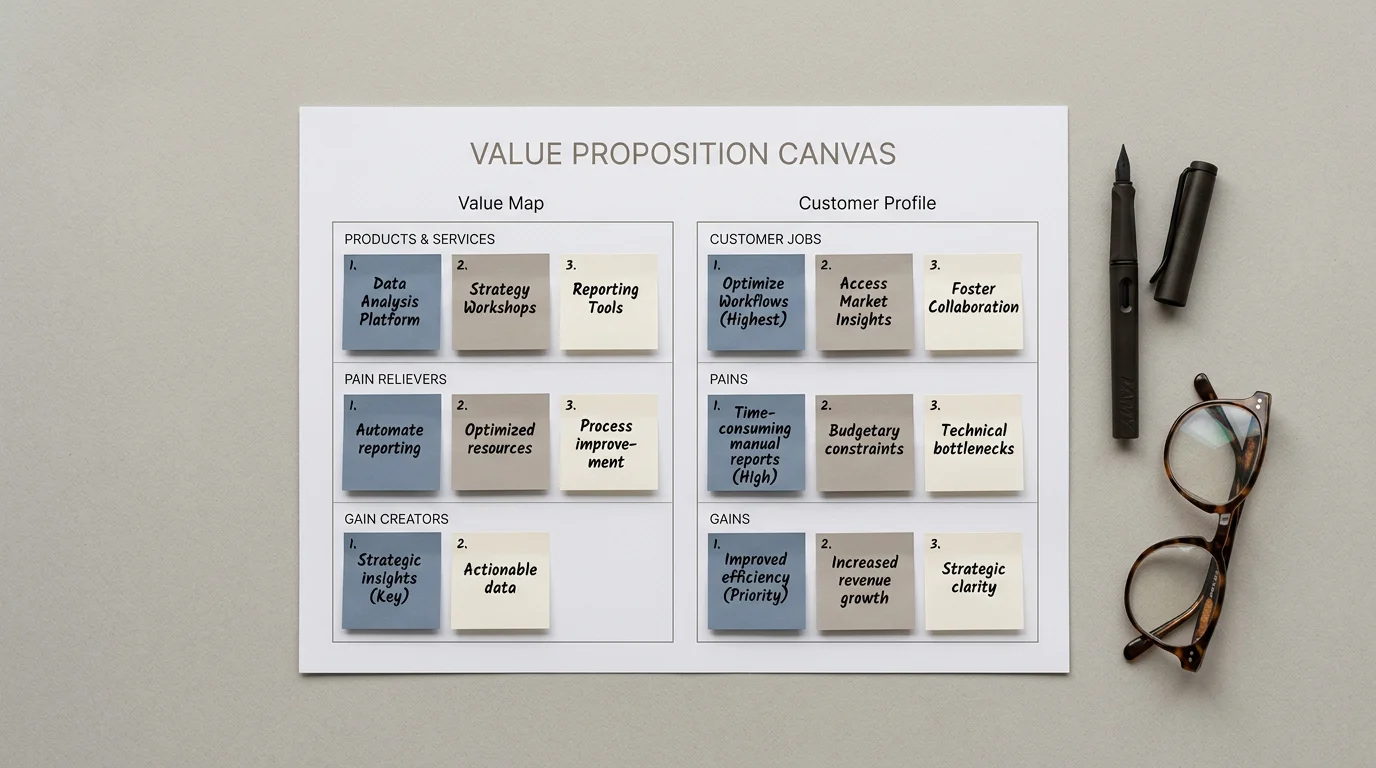
Start with the customer, never with the product. The most reliable method is to sketch two connected halves: a customer profile and a value map. On the customer side, describe three things in detail.
- Customer jobs: the functional, social, and emotional tasks your customer is trying to complete.
- Customer pains: the frustrations, risks, and undesired costs experienced before, during, and after those jobs.
- Customer gains: the outcomes and benefits they expect, desire, or would be delighted to receive.
On the value side, list your products and services, then articulate your pain relievers and gain creators, describing precisely how each element eases a pain or produces a gain. The magic happens when the two halves align: your relievers address the most intense pains, and your creators deliver the most relevant gains. To move faster on this step, our Value Proposition Canvas template gives you a ready structure for both halves.
Remember that this exercise is never finished once. Markets and customer needs evolve constantly, and initial assumptions are frequently flawed. Regular iteration, informed by interviews, surveys, and testing, keeps the fit accurate over time. A value proposition also lives inside a wider commercial context, so it is worth grounding your work in solid business model foundations before you refine the messaging.

Value proposition examples worth studying
Concrete examples reveal how theory becomes copy. Warby Parker, the eyewear company, built its entire brand around a job to be done that its founders discovered firsthand: affordable, well-designed glasses. Its published promise centers on leaving buyers happy, good-looking, and with money still in their pocket, reinforced by a socially conscious mission. The lesson is that a memorable proposition names both the functional and the emotional payoff.
Other patterns recur across strong homepages. Payment platform Stripe leads with a single clear identity, financial infrastructure to grow revenue, then adds specifics in a scannable subheader. Delivery service DoorDash uses an emotional, benefit-first headline that promises the outcome the customer wants. The common thread is discipline: one clear promise, supported by concise proof, with the customer positioned as the hero of the story rather than the company.
| Element | Weak proposition | Strong proposition |
|---|---|---|
| Focus | Features and internal jargon | Customer jobs, pains, and gains |
| Clarity | Requires effort to understand | Grasped in seconds |
| Differentiation | Generic, easy to copy | Distinctive and defensible |
| Proof | Unsupported claims | Specifics and social proof |
Common mistakes to avoid
Even experienced teams stumble in predictable ways. The first error is trying to be everything to everyone. Because you cannot realistically solve every problem, you must strategically select the pains and gains with the highest impact and the best potential for differentiation. Spreading yourself thin dilutes the promise until it means nothing.
A second frequent failure is confusing a value proposition with a tagline. A tagline is a marketing flourish; a value proposition is a strategic statement about who you serve and why you win. A third mistake is skipping validation entirely, launching on assumption rather than evidence. Testing the promise with real customers, and refining it based on what you learn, turns a hopeful guess into a durable advantage. Treating the message as a live prototype, and even prototyping your business model around it, keeps the whole strategy honest.
Turning clarity into a competitive advantage
A value proposition is not a marketing afterthought; it is the strategic core that decides whether customers understand, choose, and stay with you. Begin with a genuine customer problem, map your offering against the pains and gains that matter most, and express the result in language anyone can grasp in seconds. Then test it, refine it, and revisit it as your market shifts. The discipline of naming the value you create, precisely and honestly, protects you from the most common and most avoidable cause of business failure: building something nobody truly wants.
Take action with Deckadence
Once your thinking is clear, you still have to make decision-makers see it and act on it. That is where a well-structured presentation matters, because a promise that reads clearly on a canvas must also command the room in front of a board or an investor. We help you close that gap between sound strategy and persuasive delivery.
At Deckadence, we combine consulting-grade strategy frameworks with board-ready design, structured storytelling, and slide systems built for PowerPoint, Keynote, and Figma. If you are ready to turn your analysis into a message that moves people, explore our guidance on building a strong value proposition and present your ideas with confidence and clarity.
Frequently Asked Questions
What is the difference between a value proposition and a slogan?
A slogan is a short, memorable marketing phrase designed for recall. A value proposition is a strategic statement that explains what you offer, to whom, and why it is preferable to alternatives. The two can coexist, but a slogan can never replace the underlying promise of value.
Who should be involved in creating a value proposition?
It should not be written in isolation by marketing alone. Input from product, sales, and customer support ensures the promise reflects both what you deliver and what customers actually experience. This mix keeps the statement grounded in reality rather than internal assumptions.
How long should a value proposition be?
It is typically no more than a few sentences, and often a single headline supported by a short subheader. Brevity forces clarity and makes the promise easy to understand and remember. If it cannot be grasped quickly, it needs further refinement.
How do I know if my value proposition is working?
Test it with people unfamiliar with your business and watch for confusion. Strong indicators include higher conversion, clearer sales conversations, and improved retention. Because markets change, you should revisit and validate the statement regularly rather than treating it as fixed.
Can a tool help me build one faster?
Yes. A structured framework keeps you focused on customer jobs, pains, and gains rather than on features. Our Value Proposition Canvas template provides a ready two-part structure that maps customer needs directly against your offering, which speeds up the design and testing process.