A business model can contain excellent resources, activities, and revenue logic, yet still fail if customers do not understand the value being offered. The value proposition gives the model its commercial meaning. To structure the wider model clearly, begin with our Business Model Canvas guide and define the customer, the problem, and the promised outcome before describing operational details.
The phrase the value proposition in the Business Model Canvas refers to the products and services that solve customer problems or create meaningful benefits. It is not simply a slogan, product description, or list of features. It is a strategic statement that should connect customer priorities with delivery capabilities, channels, relationships, costs, and revenue.
What does the value proposition mean in the Business Model Canvas?
Imagine that you are reviewing a business model on one page. The value proposition answers the central question: why should the selected customer segment care about this offer?
In practical terms, the block describes the value created by your products or services. That value may come from solving a problem, reducing effort, saving time, lowering risk, improving performance, creating convenience, or enabling a desired experience. It can also come from quality, design, accessibility, customization, status, or a more attractive price.
The value proposition therefore sits between customer demand and business delivery. It should be specific enough to guide decisions, but broad enough to connect with the other eight building blocks. A 2022 review describes the Business Model Canvas as a widely used framework for representing value, customers, infrastructure, and finances through interconnected blocks. Read the 2022 review for the academic context.
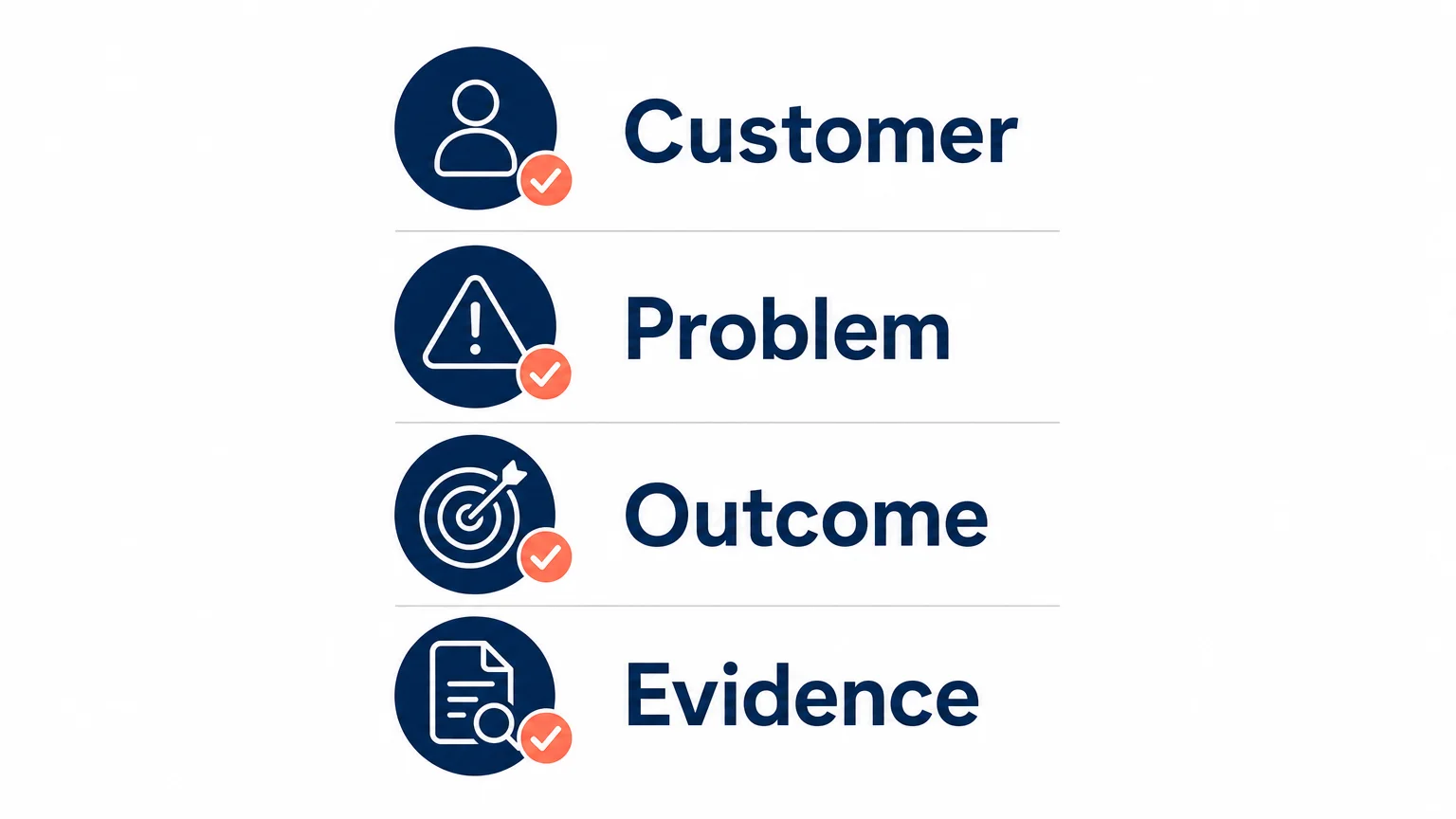
A useful value proposition typically contains four elements:
- Target customer, the person or organisation receiving the value.
- Customer problem, the obstacle, risk, frustration, or unmet need being addressed.
- Offer, the product, service, experience, or combination being provided.
- Customer outcome, the practical, emotional, financial, or strategic benefit created.
For example, “We provide project management software” describes an offer. “We help distributed consulting teams coordinate complex projects without losing visibility” communicates a clearer value proposition. The second version identifies a customer group, a problem, and a useful outcome.
Why should customer fit come before product description?
Many teams begin with what they already have. They list their technology, capabilities, content, or services, then search for customers who might want them. This approach often produces feature-heavy messaging with limited evidence of relevance.
A stronger approach begins with the customer profile. Ask what the customer is trying to accomplish, what makes that task difficult, and what a successful result would look like. These questions reveal the difference between a feature and a benefit.
A feature is something your business provides. A benefit explains how that feature changes the customer’s situation. A presentation template is a feature. Faster preparation, clearer strategic communication, and more confident executive discussion are potential benefits. The benefit matters only when it connects with a real customer priority.
Customer fit also requires segmentation. A founder, procurement leader, consultant, and board director may interact with the same offer differently. They can have different jobs, concerns, decision criteria, and definitions of value. One broad value proposition may therefore be too vague to guide positioning.
For each major segment, identify the following:
- The functional job the customer needs to complete.
- The social or professional outcome the customer wants to demonstrate.
- The emotional concern the customer wants to reduce or avoid.
- The main barriers, risks, frustrations, or unwanted outcomes.
- The expected, desired, and unexpected gains that could influence adoption.
This process prevents a common error: treating every possible benefit as equally important. A strong value proposition prioritizes the few pains and gains that influence the customer’s decision most directly.
How do the Business Model Canvas and Value Proposition Canvas work together?
The Business Model Canvas provides the broad structure of how an organisation creates, delivers, and captures value. The Value Proposition Canvas offers a closer examination of the relationship between a customer segment and a specific offer.
The two tools should not be treated as competing frameworks. The Value Proposition Canvas deepens two areas of the Business Model Canvas: customer segments and value propositions. It helps you examine whether the proposed offer actually responds to the customer’s jobs, pains, and gains.
Start with the customer profile. List customer jobs, pains, and gains without immediately describing your solution. This separation is important because it reduces the risk of forcing customer needs to match an existing product.
Next, complete the value map. Describe the products and services you provide, the pain relievers you create, and the gain creators you enable. Then compare both sides. The goal is not to connect every item. The goal is to address the most important customer priorities with credible, relevant value.
Our Value Proposition Canvas Model can help you structure this analysis before transferring the clearest insights into the broader business model. The process is especially useful when you are refining an existing offer, preparing a launch, or comparing several strategic options.
The relationship between the two canvases is iterative:
- Sketch the customer segments and value propositions in the Business Model Canvas.
- Choose one important segment and create a detailed customer profile.
- Map the products, pain relievers, and gain creators connected to that segment.
- Identify gaps, weak assumptions, and unsupported claims.
- Update the Business Model Canvas based on the evidence.
- Repeat the process as your understanding improves.
Research on adapted canvas models also shows why context matters. A higher education study proposed a modified canvas because standard business model categories may not fully represent the stakeholders and value relationships in every sector. This supports a practical principle: use the original structure as a starting point, then adapt the analysis when your business environment requires it. The broader discussion appears in the academic study.
How do you write a value proposition for each customer segment?

Consider an illustrative example. A strategy consultancy wants to serve leaders of scaling businesses. Its initial statement might be, “We provide strategic advice.” That description is too broad to support clear positioning or consistent delivery.
A more useful analysis could identify the following:
- Customer segment: leaders who need to prepare important growth decisions.
- Customer jobs: assess markets, prioritise initiatives, and align senior stakeholders.
- Customer pains: scattered analysis, limited preparation time, and disagreement about priorities.
- Customer gains: clearer choices, stronger decision confidence, and aligned leadership discussion.
- Value map: structured analysis, decision frameworks, concise recommendations, and executive-ready communication.
The resulting value proposition might be: “We help leaders of scaling businesses turn complex growth questions into clear, prioritised decisions that their teams can act on.” This statement is more useful because it describes the customer, the situation, the transformation, and the outcome.
A practical value proposition should also make the boundaries of the offer clear. If you provide templates, do not imply that you provide implementation or bespoke consulting unless that is part of the offer. If you provide education, do not promise guaranteed commercial results. Precision builds credibility because customers can understand exactly what they are evaluating.
Our content on what value propositions are can support this distinction between describing an offer and explaining the value it creates. The most effective statement is usually concise, but the thinking behind it should be detailed.
How can you test and improve the value proposition?
A value proposition written in a workshop is only a hypothesis. It becomes strategically useful when customers recognise the problem, care about the outcome, and believe your organisation can deliver the promised value.
Begin by ranking each customer job, pain, and gain. Mark which items are essential, important, or minor. Then assess whether your offer addresses the highest-priority items. If your value map focuses on convenient features while customers are mainly concerned about risk, the proposition is misaligned.
Use interviews, sales conversations, product trials, support questions, surveys, and observed behaviour to test assumptions. Avoid asking only whether customers like the idea. Ask what they do today, what alternatives they use, what the current process costs, and what would make them change.
A 2020 study that examined Business Model Canvas variables in manufacturing connected value proposition analysis with resources, revenue, costs, and wider economic conditions. The research is sector-specific, so it does not prove that one variable automatically causes commercial success. It does show why the value proposition should be examined alongside the capabilities and economics required to deliver it. The study is available through the 2020 research record.
Use the following tests during revision:
- Can the target customer recognise the situation immediately?
- Does the statement focus on an outcome rather than a feature list?
- Does it address a meaningful pain or gain?
- Can your organisation deliver the promise through its resources and activities?
- Is the benefit sufficiently distinct from available alternatives?
- Can you identify evidence that customers value the promised outcome?
Our guide to a strong value proposition can help you review clarity, relevance, differentiation, and evidence before you finalise the canvas.
Which mistakes weaken the value proposition block?
Several recurring mistakes make the value proposition vague or difficult to use.
Starting with features
Features are easy to list because they are visible inside the business. However, customers usually evaluate the consequence of those features. Translate each feature into a specific customer outcome, then verify whether that outcome matters.
Serving everyone
A statement aimed at every possible customer often becomes too general to guide marketing, product decisions, or sales conversations. Create a separate customer profile when different segments have substantially different jobs, pains, or gains.
Using unsupported superlatives
Words such as “best”, “leading”, and “unique” do not create differentiation by themselves. Explain what makes the offer relevant, credible, or difficult to replace. Evidence may include customer feedback, performance records, specialist capability, or a clearly defined method.
Confusing the proposition with a mission
A mission describes the organisation’s broader purpose. A value proposition explains the customer value created by a specific offer. Both can matter, but they answer different questions and should not be merged into one abstract statement.
Ignoring delivery requirements
A compelling promise can damage trust if the rest of the canvas cannot support it. Review the channels, customer relationships, key resources, key activities, partnerships, cost structure, and revenue streams required to deliver the proposition consistently.
How does the value proposition connect to the other canvas blocks?
The value proposition should not remain isolated in the centre of the canvas. It acts as a link between customer demand and operational design.
Customer segments define who receives the value. A proposition without a clear segment usually lacks relevance because different customers evaluate benefits differently.
Channels determine how customers discover, evaluate, buy, and receive the offer. A high-value proposition can still underperform if it is delivered through channels that customers do not trust or use.
Customer relationships describe the interaction required to create confidence and retention. A complex advisory offer may require personal support, while a simple digital product may rely more heavily on self-service education.
Key resources and activities reveal what your organisation must possess and do to keep its promise. If the proposition depends on speed, the model may require specialised processes, technology, or capacity.
Key partnerships can extend delivery capabilities or reduce operational risk. Partners may provide distribution, expertise, infrastructure, data, or production capacity.
Revenue streams and cost structure test commercial viability. Customers may value an offer, but the model still needs a sustainable relationship between price, delivery cost, acquisition effort, and expected retention.
Review these connections whenever you change the proposition. A new customer promise may require different channels, additional resources, stronger partnerships, or a revised pricing logic. The canvas is most useful when it exposes those implications rather than presenting the proposition as an isolated marketing statement.
Make the value proposition a strategic decision
The value proposition in the Business Model Canvas should explain a credible connection between a customer priority and an organisational capability. Start with one clearly defined segment, identify its most important jobs, pains, and gains, then map the offer against those priorities. Test the assumptions with evidence and revise the wider canvas when delivery requirements change. A customer-centred value proposition is not merely persuasive language. It is a decision about whom you serve, what value you create, and how the business will deliver it consistently.
Take action with Deckadence
Once your value proposition is clear, the next challenge is communicating it in a way that helps stakeholders understand the logic and act on the decision. A structured visual framework can make customer needs, strategic choices, and delivery priorities easier to discuss across teams.
We create premium slide decks, strategic-thinking templates, board-ready frameworks, narrative structures, and slide systems for consultants, executives, founders, agencies, and business leaders. Our materials combine consulting-grade structure with refined visual communication for PowerPoint, Keynote, Figma, and more. Use our value proposition canvas template to organise customer jobs, pains, gains, and value map assumptions in a clear working format.
Frequently Asked Questions
What is the value proposition in the Business Model Canvas?
It is the block that explains the value a business creates for a defined customer segment. It connects products or services with customer problems, desired outcomes, and reasons to choose the offer.
Is a value proposition the same as a unique selling proposition?
They are related but not identical. A value proposition describes the customer value created by an offer, while a unique selling proposition usually emphasises the specific distinction used to separate that offer from alternatives.
How many value propositions should a Business Model Canvas contain?
There is no universal number. You may need different value propositions when customer segments have different jobs, pains, gains, buying criteria, or delivery requirements.
Should you use the Value Proposition Canvas with the Business Model Canvas?
Yes, especially when customer needs are uncertain or the offer is being refined. The Value Proposition Canvas provides deeper detail on customer jobs, pains, gains, products, pain relievers, and gain creators.
How can Deckadence support value proposition work?
We provide visual strategic-thinking materials, including templates, frameworks, narrative structures, and presentation-ready slide systems. These resources can help you structure complex strategic ideas and communicate customer value clearly to executives, boards, and wider stakeholder groups.