What should a presentation consulting firm actually improve: the slides, the story, or the decision behind them? A strong partner addresses all three. It clarifies the objective, organizes evidence, and creates a persuasive path from analysis to action. For a practical reference on board-level structure, our Boston Consulting Group presentation guide shows how a consulting narrative can connect findings with recommendations.
Presentation work has also become more decision-focused. Recent executive communication guidance recommends leading with the action that decision-makers need to consider, rather than making them reconstruct the conclusion from supporting data. That principle is reflected in executive presentation guidance published in 2026.
What does a presentation consulting firm actually deliver?
A presentation consulting firm can support several connected parts of strategic communication. The work may include clarifying the presentation objective, shaping the storyline, editing the message, designing the slides, visualizing data, and preparing the deck for delivery. The scope varies significantly between providers, so you should define the required outcome before comparing firms.
Some engagements focus on presentation production. In that model, you provide the analysis and the firm turns it into a polished deck. Other engagements include narrative development, which means the partner helps determine what the audience should understand, believe, and do. A smaller number of providers work closer to strategic communication, helping translate complex analysis into a recommendation that supports leadership decisions.
The distinction matters because attractive slides cannot compensate for an unclear argument. A presentation may have consistent typography and strong visual hierarchy while still failing to answer the central question. Before contacting a provider, write down the decision, audience, deadline, source material, and expected next step. Those details will help you identify whether you need design execution, narrative support, or a more structured strategic-thinking solution.
Why should the work begin with the decision?

Imagine that your leadership team has thirty minutes to approve a market entry plan. The deck contains extensive research, several charts, and a detailed appendix. However, the recommendation appears on slide twenty-two. The audience must work through the analysis before understanding the decision they are being asked to make.
A decision-focused deck reverses that sequence. It states the recommendation early, explains why it matters, and then provides the evidence needed to test the conclusion. This approach does not remove rigor. It creates a clearer hierarchy between the decision, the supporting arguments, and the backup material.
A 2026 report from A1 Slides claims that 92% of surveyed executives say poor slides slow decisions. Because the figure comes from a provider’s own industry report, it should be treated as a directional signal rather than a universal benchmark. Its underlying point remains useful: the 2026 presentation report frames clarity as part of decision velocity, not merely as a matter of visual polish.
When assessing a firm, ask whether its process begins with questions such as these:
- What decision must the audience make?
- What evidence will change their view?
- Which risks or objections must the deck address?
- What action should follow the meeting?
If a provider begins by discussing colors, layouts, or slide counts without first clarifying the decision, its process may be too production-led for a high-stakes strategic presentation.
How can you test strategic depth before hiring?
A simple test is to ask the firm to explain how it would turn a complex brief into a storyline. You are not asking for free consulting. You are testing whether the provider can distinguish an objective from a topic, an insight from a fact, and a recommendation from a description.
Look for a clear explanation of how the firm will move from raw material to executive message. A credible process usually includes a review of the audience, a definition of the decision, a working hypothesis, a storyline outline, and a method for validating the evidence. It should also explain how unresolved questions will be handled.
Action titles are another useful indicator. A descriptive title such as “Market Overview” tells the audience what the slide contains. An action title such as “The market is growing, but distribution capacity limits near-term expansion” communicates the slide’s conclusion. The second version gives the audience a reason to examine the evidence below it.
For examples of how structured thinking can shape the visual language of a consulting deck, you can review our McKinsey presentation PPT. The point is not to copy a particular firm’s style. It is to understand how consistent logic, concise messaging, and evidence-led sequencing make complex material easier to evaluate.
What should a board-ready consulting deck contain?
A board-ready deck does not need to be short in every case. It needs to be easy to navigate, clear about its purpose, and disciplined about the difference between the main story and supporting detail.
A practical structure often includes the following elements:
- Decision context: Explain why the issue matters now and what has changed.
- Executive recommendation: State the proposed direction and the expected effect.
- Supporting arguments: Present the few reasons that make the recommendation credible.
- Evidence: Use relevant data, benchmarks, customer insight, or operational analysis.
- Risks and trade-offs: Address the concerns that could prevent approval.
- Implementation roadmap: Show milestones, owners, resources, and dependencies.
- Decision request: Specify what the audience must approve, fund, or change.
- Appendix: Store detailed calculations, definitions, methodology, and backup analysis.
This structure can support a live presentation, a document for independent reading, or both. The format should influence the density of each slide. A live presentation generally benefits from a simpler visual message, while a read-ahead document may require more explanatory detail and stronger source notes.
Our Deloitte slide best practices provide another useful reference for examining structure, information hierarchy, and professional visual consistency. You should use examples as thinking tools rather than as templates to copy without adapting them to your audience and decision.
Which delivery model fits your team?
There are three common ways to obtain presentation support. You can commission a bespoke presentation consulting firm, use an internal team, or combine internal expertise with reusable strategic-thinking assets. Each model has a different balance of control, speed, cost, and strategic involvement.
A bespoke firm may be appropriate when the presentation involves unfamiliar analysis, senior stakeholders, sensitive recommendations, or a complex narrative that your team does not have time to develop. The main question is whether the provider will understand the business context or simply format supplied content.
An internal team may be more suitable when the subject matter is highly specialized, the presentation will evolve frequently, or confidentiality limits outside involvement. However, internal teams can struggle with consistency when several contributors create slides under deadline pressure.
A hybrid model can provide a practical middle ground. Your subject-matter experts retain control of the evidence, while a structured library helps with narrative, frameworks, visual systems, and slide consistency. This is where our premium slide decks, board-ready frameworks, and narrative structures can support consultants, executives, agencies, and business leaders without claiming to replace bespoke strategy work.
The choice should also reflect the type of strategy you are presenting. The 2026 CMO Survey reports that brand activity was tracked by 94.4% of respondents, while marketing analytics was tracked by 78.6%. That combination illustrates why many leadership decks need both strategic interpretation and clear evidence. A visually polished deck still needs a credible connection between market signals, business choices, and expected outcomes.
How should you evaluate process, platforms, and proof?
The provider’s process should be specific enough for you to understand how the work will progress. Ask what happens during discovery, who owns the storyline, when you will review the outline, how feedback will be consolidated, and how the final deck will be checked.
Platform compatibility deserves equal attention. Confirm whether the materials must work in PowerPoint, Keynote, Figma, or another environment. Ask whether charts remain editable, whether fonts and assets are licensed appropriately, and whether the presentation can be updated by your team after delivery.
You should also examine proof of working quality. A portfolio is more useful when it shows the brief, the audience, the narrative challenge, and the final communication outcome. Look for examples that resemble your situation, such as board communication, strategic planning, competitive analysis, transformation, product strategy, or investor communication.
Do not evaluate only the most visually impressive sample. Instead, review whether the provider can handle dense evidence without creating clutter, simplify technical information without distorting it, and make recommendations visible without overstating certainty. Our guide to facilitating strategic conversations with visuals explores how visual structure can support discussion, alignment, and decision-making.
What selection checklist should you use in 2026?
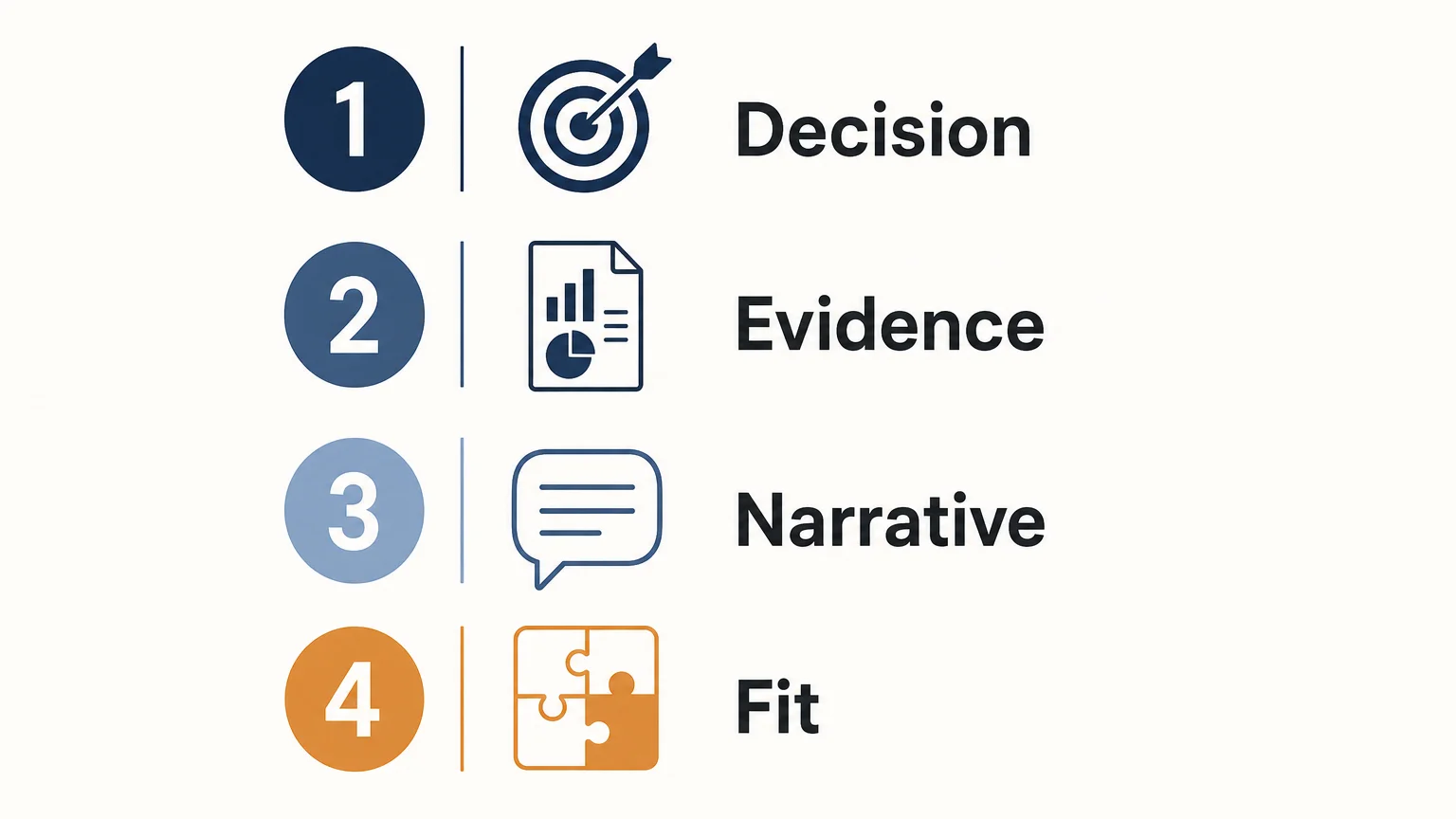
Before selecting a partner, score each option against the same practical criteria. A short written assessment will expose differences that a portfolio alone may conceal.
- Decision clarity: Can the provider explain the decision the deck is designed to support?
- Strategic depth: Can it shape a storyline from incomplete, technical, or conflicting material?
- Audience fit: Can it adapt the deck for a board, client, investor, internal team, or public audience?
- Evidence discipline: Does it preserve source notes, assumptions, limitations, and analytical integrity?
- Visual reasoning: Does the design make relationships, comparisons, and priorities easier to understand?
- Production quality: Are files editable, consistent, accessible, and compatible with your workflow?
- Review process: Are responsibilities, milestones, feedback rounds, and final checks clearly defined?
- Long-term usability: Can your team adapt the structure for future presentations?
One 2026 perspective on consulting presentations describes them as decision tools that should connect each slide with a measurable business outcome. You can read that view in a 2026 consulting presentation analysis. Whether or not you agree with every part of its framework, the selection principle is sound: assess the provider by the decisions its work helps people make, not by decoration alone.
The strongest candidate will usually make the work easier to govern. It will separate the main narrative from backup material, explain what evidence is missing, and show how feedback will change the deck. Those behaviors are more valuable than a particular color palette or a fashionable slide style.
Choose for clarity, not decoration
The right presentation consulting partner helps your audience understand what matters, why it matters, and what should happen next. Evaluate firms through their reasoning, storyline, evidence handling, platform discipline, and ability to support the specific decision in front of your stakeholders. If your need is repeatable strategic communication rather than a single production engagement, a structured library of frameworks and presentation-ready systems can also provide a practical foundation.
Take action with Deckadence
When your team has strong ideas but needs a clearer way to organize and present them, the right visual system can reduce friction. You can use structured thinking, concise messaging, and evidence-led storytelling to make complex strategy easier to discuss with executives, clients, boards, and other decision-makers.
Our library brings together premium slide decks, strategic-thinking templates, board-ready frameworks, narrative structures, and slide systems for PowerPoint, Keynote, Figma, and more. Explore our presentation strategy guidance to find practical resources for turning analysis into clear, persuasive communication.
Frequently Asked Questions
What is a presentation consulting firm?
A presentation consulting firm helps organizations turn complex information into structured, persuasive presentations. Depending on the engagement, it may support strategy, narrative development, data visualization, slide design, rehearsal, or final production.
When should you hire a presentation consulting firm?
Consider outside support when the presentation has high strategic importance, senior stakeholders, a tight deadline, or a complex storyline. You may also benefit from help when internal contributors have strong subject knowledge but limited time for narrative and visual development.
How is presentation consulting different from presentation design?
Presentation design usually focuses on layout, visual hierarchy, typography, and production quality. Presentation consulting can include those elements, but it also examines the objective, audience, argument, evidence, recommendation, and decision required.
Can presentation templates replace a consulting engagement?
Templates can support repeatable work when your team already understands the subject and needs a strong structure or visual system. They do not replace bespoke research, stakeholder interviews, or specialist judgment when the strategic problem is unfamiliar or highly sensitive.
Can Deckadence help with consulting-style presentations?
Yes. Our premium slide decks, strategic-thinking templates, board-ready frameworks, narrative structures, and slide systems are designed to help consultants, agencies, executives, founders, and business leaders communicate complex strategy with greater clarity.