Facilitating Strategic Conversations With Visuals That Work
Picture a leadership offsite where every executive uses a different vocabulary for the same goal. The debate circles for hours, yet nothing is decided. Now imagine the same discussion mapped live on a single canvas, where dependencies, bottlenecks, and priorities become instantly readable. That shift is the heart of facilitating strategic conversations with visuals, and it is why board-level teams increasingly refuse to plan without them. If you want proof of how the best firms structure this thinking, study our breakdown of Real McKinsey presentations and what they reveal.
The rationale is grounded in how people process information. According to a Raftelis analysis citing Stanford research by Robert Horn, visual images combined with text can increase memory retention by up to 89 percent, and roughly 80 percent of people are visual learners. When strategy is only spoken, most of it evaporates by January. When it is drawn, it endures.
Why visuals reshape the dynamics of a strategy session
Why do so many high-stakes planning meetings end in fragmentation rather than clarity? Conversations sprawl, the loudest voices dominate, and whiteboards are wiped clean without documentation. A visual approach counters each of these failure points by making every contribution concrete and comparable in real time.
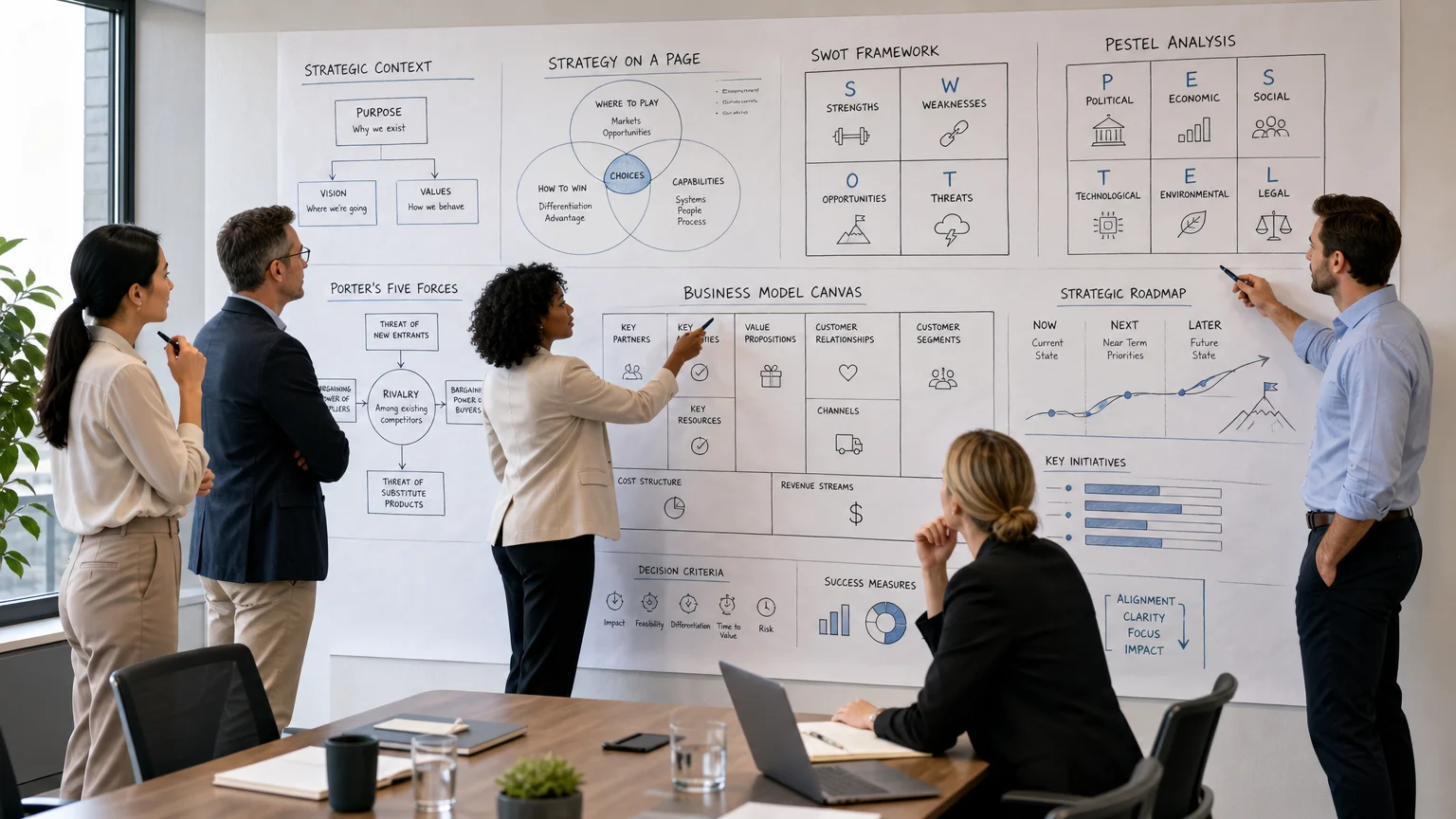
When ideas are mapped on a shared surface, participants can literally see how their plans connect, where friction sits, and what the future roadmap looks like. Visuals also create a common language that bridges departments, so sales, operations, and technology teams stop talking past one another. The result is faster alignment, broader participation, and a durable artifact the team can act on well after the room clears.
Active visual facilitation versus passive recording
Not all visual capture is equal. Passive graphic recording listens for key phrases and draws a chronological sequence, using generic metaphors and leaving the group to connect its own conclusions. It suits broad keynotes and informational panels. Active visual facilitation, by contrast, maps relationships, isolates friction points, and partners with the meeting leader to steer focus toward consensus.
This distinction matters for board retreats and change management, where the visual must function as a working model, not a souvenir. Academic work supports the shift toward deliberate practice. A 2024 study on graphic facilitation in organisations examined how strategic visualisation enables powerful processes and how practitioners sequence individual reflection, small-group dialogue, and large-group sharing to shape the energy of a room. The lesson is that structure, not artistry, drives outcomes. To carry that structure into your slides, our guidance on how to write action titles in PowerPoint that drive decisions helps translate live insight into a persuasive deck.
Frameworks that make strategic thinking visible
A blank canvas can intimidate. Established frameworks give a session gravity and prevent it from drifting into unstructured brainstorming. Practitioners frequently reach for a visual SWOT to surface strengths and threats, gap-to-goal diagrams to focus decisions, stakeholder alignment maps to expose interdependencies, and future-casting to bridge aspiration and execution.
These structures do more than organise ideas; they cut through complexity so that trade-offs are debated on evidence rather than volume. Frameworks such as SWOT, PESTEL, Porter's Five Forces, and the Business Model Canvas each answer a different strategic question, and choosing the right one is half the battle. When you need consulting-grade layouts to present these models cleanly, our library of McKinsey strategy slides gives you a starting point that already reads as board-ready.
Facilitating alignment in hybrid and remote sessions
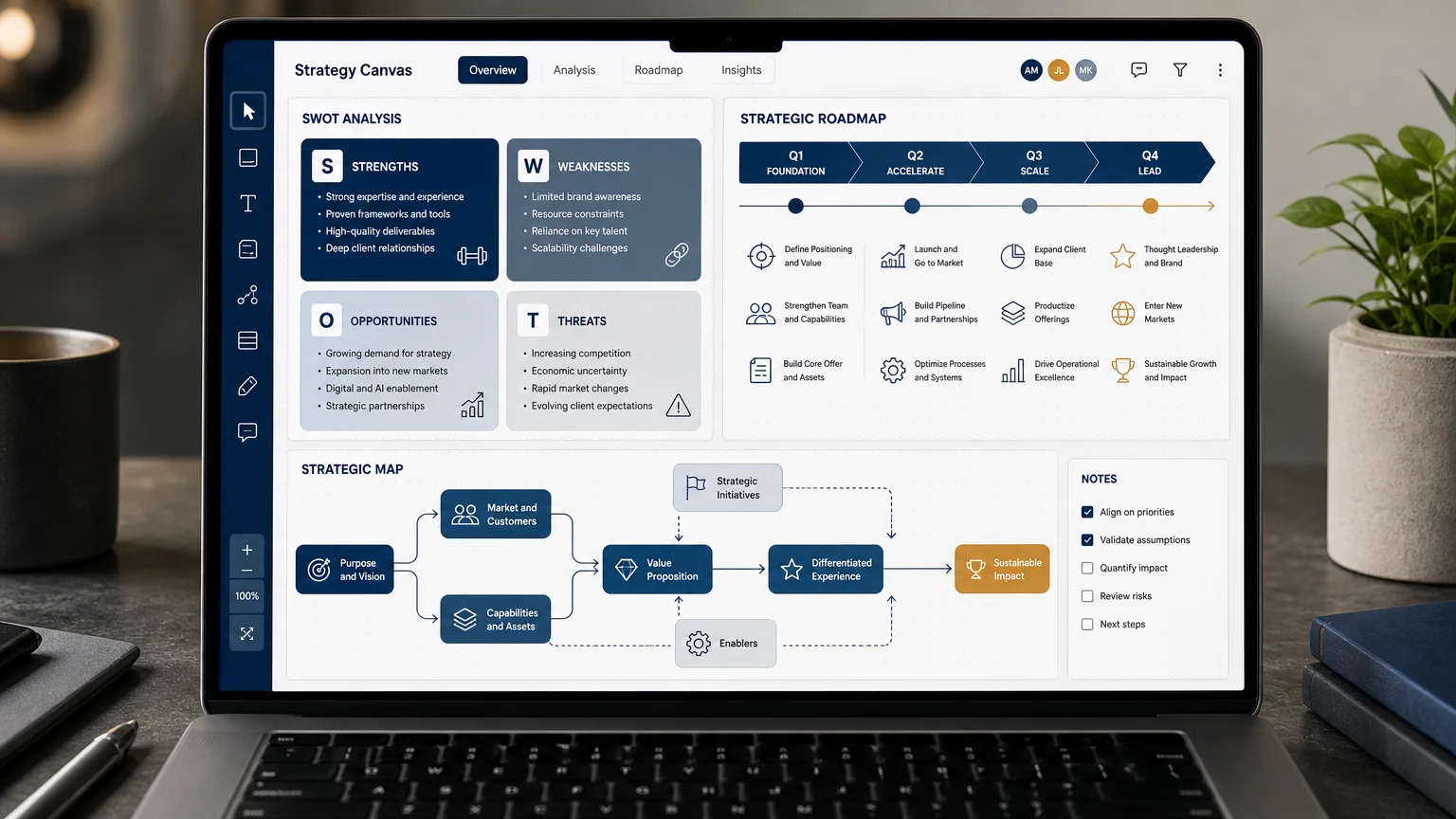
Distributed teams complicate the picture, yet visual methods travel well into virtual rooms. Digital whiteboards and shared canvases give remote participants a common surface, which sustains focus and encourages contribution across time zones. The discipline required, however, is higher.
A 2024 scoping review on virtual facilitation emphasises piloting, evaluating, and refining processes rather than assuming that in-person habits transfer directly. It recommends continuous quality improvement, including checking visual aids for understanding before meetings. In practice, that means testing your templates, rehearsing the flow, and confirming that every remote voice can annotate the canvas, not merely watch it.
Turning conversations into decisions that stick
A beautiful drawing is worthless if it does not produce action. The most effective sessions define two or three outcomes before anyone enters the room, document decisions as they happen, and assign owners and dates before anyone leaves. Visuals accelerate each step because they make ownership and next steps unmissable.
Timelines deserve particular care, because roadmaps are where strategy meets reality. A well-built sequence shows resource constraints, milestones, and dependencies at a glance, so commitments become concrete. To design that artifact convincingly, consult our walkthrough on how to design a McKinsey timeline slide that persuades, then keep the visual as a living reference long after the offsite ends.
Comparing common approaches to visual strategy work
The table below contrasts the dominant approaches so you can match method to moment. Note that a template-driven system and live facilitation are complementary rather than mutually exclusive.
| Approach | Primary strength | Best used for | Decision readiness |
|---|---|---|---|
| Passive graphic recording | Faithful visual transcript | Keynotes, large panels | Low |
| Active visual facilitation | Live synthesis and steering | Board retreats, change management | High |
| Digital whiteboarding | Remote participation | Hybrid and distributed teams | Medium |
| Our board-level slide systems and frameworks | Consulting-grade structure and reusable clarity | Executive decks, strategy reviews, follow-through | High |
Bringing it all together
The evidence and the practice point the same way: guiding strategic discussions through visuals converts scattered debate into shared, decision-ready direction. Start with two or three clear outcomes, choose a framework that fits the question, capture the conversation actively rather than passively, and close every session with owners and dates. When the thinking is visible, alignment is faster and commitments hold. Treat visuals not as decoration but as the working infrastructure of your strategy.
Take action with Deckadence
You have seen why visible thinking accelerates alignment and why structure beats improvisation in high-stakes rooms. The next step is equipping yourself with materials that carry that clarity from the whiteboard into a persuasive, board-level deck your stakeholders can act on.
We build premium, consulting-grade strategy frameworks and slide systems with board-ready visuals, blending structured storytelling with proven models so your thinking shows as clearly as it reads. Explore why visuals work and turn your next strategy session into decisions that stick.
Frequently Asked Questions
What does facilitating strategic conversations with visuals actually involve?
It involves capturing and structuring a discussion visually as it happens, using drawings, canvases, and frameworks. The facilitator maps ideas, relationships, and priorities so the group can see and refine its thinking together. The goal is shared clarity that leads directly to decisions.
How is active visual facilitation different from graphic recording?
Graphic recording is largely passive, producing a faithful visual transcript without steering the conversation. Active visual facilitation synthesises ideas in real time, isolates friction, and partners with the meeting leader to drive alignment. The latter is better suited to board retreats and consequential decisions.
Which frameworks work best for strategic sessions?
SWOT, PESTEL, Porter's Five Forces, and the Business Model Canvas each address a distinct strategic question, so the right choice depends on your objective. Gap-to-goal diagrams and stakeholder maps are useful for prioritisation and alignment. Our board-ready framework library helps you present these models cleanly and consistently.
Can visual facilitation work for remote and hybrid teams?
Yes, digital whiteboards and shared canvases give distributed teams a common surface that sustains focus. Research on virtual facilitation stresses piloting and refining the process rather than copying in-person habits directly. Rehearse the flow and ensure every remote participant can annotate, not merely observe.
How do you ensure a visual session leads to real decisions?
Define two or three outcomes before the meeting, document choices as they are made, and assign clear owners and deadlines before anyone leaves. Visuals make ownership and next steps unmissable, which improves follow-through. The final artifact should remain a living reference, not a forgotten photo.