What makes a strategy PDF worth studying: the logo, the layout, or the reasoning behind every page? If you are searching for our McKinsey strategy slides, the most productive approach is to treat public examples as lessons in structured communication, not as ready-made designs to imitate.
McKinsey slides in PDF format are especially useful when you want to examine how complex research becomes a recommendation. A strong document usually reveals its central argument through titles, supporting exhibits, source notes, and a deliberate progression from problem definition to decision.
What does a McKinsey slides PDF actually contain?
A McKinsey slides PDF is not one fixed template. It may be a client project, industry report, research publication, training document, conference presentation, or a short extract from a larger engagement. These categories have different purposes, audiences, levels of detail, and permissions.
The distinction matters because a public research report does not necessarily represent the same working format as a confidential client deck. For example, the official PDF for McKinsey’s 2026 State of Organizations report identifies a survey conducted from June to September 2025, with more than 10,000 leaders across 16 countries and 17 industries. That is valuable material for studying evidence presentation, but it is a published research document rather than proof of an internal client workflow.
Before downloading a file, classify it using four questions:
- Who published it? Check whether the original publisher is McKinsey, a public institution, a client organisation, or a third-party host.
- What is the purpose? Determine whether the deck explains research, recommends action, documents a project, or teaches a method.
- Who is the audience? A board presentation may use different levels of detail from a public industry report.
- What is the date? Use the publication year when interpreting market data, forecasts, technology claims, or organisational findings.
This simple classification prevents a common error. Readers often treat every document carrying a consulting logo as a universal model. In reality, the structure is shaped by the question, the available evidence, the audience, and the decision that follows.
Where can you find public McKinsey PDF presentations?
Imagine you have found a promising file through a search engine. Your next task is not to download it immediately. First, trace the document to its most authoritative available source.
The official McKinsey library is a useful starting point because it separates research topics and report collections. The Insights Store lists current and recent publications, including 2026 reports on private markets, organisational performance, mergers and acquisitions, grocery, artificial intelligence, and global competition.
Public documents generally fall into five practical groups:
- Official research reports: These usually provide methodology, exhibits, source notes, and a clear publication date.
- Public-sector project decks: These may appear through government, university, transport, healthcare, or institutional websites.
- Conference presentations: These often contain concise charts and strong visual summaries, but may omit detailed methodology.
- Training and framework documents: These can be useful for studying problem-solving structures, issue trees, and communication principles.
- Third-party archives: These can help you locate older material, but the archive is not automatically the rights holder or original publisher.
Use search phrases that combine the topic with file type and provenance. Examples include “site:mckinsey.com filetype:pdf strategy,” “McKinsey report PDF public institution,” and “McKinsey presentation PDF government.” Add the year when freshness matters.
Do not assume that a search result titled “McKinsey presentation” is an authentic client deliverable. It may be a summary, a partial extract, a client-produced document based on McKinsey research, or an uploaded copy with incomplete context.
How do you verify the provenance of a public deck?

What proves that a PDF is worth trusting? Provenance is the first answer. A polished layout cannot compensate for an unclear source, missing date, or unsupported claim.
Begin with the document properties. Look for the publisher, authors, date, copyright notice, methodology, source lines, and references to the original engagement. Then compare the file with the publisher’s website. Titles, page counts, section headings, and publication dates should be broadly consistent.
Next, separate three ideas that are often confused:
- Public availability means that you can access the document.
- Permission to reuse means that the rights holder allows you to reproduce or adapt it.
- Educational value means that the document can teach you something about structure or reasoning.
These are not interchangeable. A PDF can be publicly accessible and highly educational while still being unsuitable for direct reuse in a client presentation.
Third-party hosts require additional caution. For instance, a hosted copy of an older McKinsey Global Institute presentation may help you locate a historical example. However, you should still search for the original publisher, confirm the date, inspect the source notes, and avoid assuming that the upload grants reuse rights.
A reliable verification routine also checks whether the deck has been altered. Missing pages, cropped exhibits, removed footnotes, and rewritten titles can change the argument. If the document is central to your research, save the original source page and record the access date alongside the PDF.
Which slide principles are most useful to study?
One figure can explain why careful selection matters. McKinsey’s 2026 research on high-growth industries states that 18 identified arenas grew roughly four times faster than other industries in market capitalisation and ten times faster in revenue over the period examined. The 2026 MGI report is therefore useful not only for its subject matter, but also for how it compresses a broad argument into a sequence of exhibits.
When studying any public deck, focus on the communication system rather than the decoration. Several principles transfer well across industries.
1. Answer-first structure
The main recommendation should appear before the supporting evidence. This is the practical value of the Pyramid Principle. Readers should understand the direction of the argument before they encounter the detail.
2. Action titles
A topic title says what a slide contains. An action title says what the evidence means. “Market performance” describes a subject, while “Growth is concentrated in two segments” gives the audience a conclusion to test.
3. One analytical message per slide
Dense slides can contain several elements, but they should support one central insight. If a chart, table, and paragraph compete for attention, the reader may miss the intended conclusion.
4. MECE organisation
MECE means mutually exclusive and collectively exhaustive. In practice, it helps you divide an issue into categories that do not overlap while covering the relevant decision space.
5. Evidence with visible sources
Every important number should have a traceable source. Footnotes, definitions, time periods, sample sizes, and calculation notes are not decorative details. They allow the audience to assess the credibility and limitations of the conclusion.
6. Restrained visual design
A consulting-style slide usually benefits from a disciplined grid, clear hierarchy, limited colours, readable typography, and purposeful whitespace. The goal is not to make a page empty. The goal is to make the argument easy to scan.
These principles are more valuable than copying a particular font or colour combination. A visual style without a clear storyline produces a polished document that still fails to support a decision.
How should you read a consulting PDF efficiently?
Suppose you have a 70-page document and only 20 minutes. Reading every sentence from the beginning is rarely the most efficient method. Start by scanning the title page, table of contents, executive summary, section titles, chart titles, conclusions, and appendices.
Then create a one-page reading map with five columns:
- Question: What decision or problem does the deck address?
- Answer: What recommendation does the document make?
- Logic: Which arguments support the recommendation?
- Evidence: Which exhibits prove or challenge each argument?
- Action: What should the audience do next?
This method reveals whether the deck has vertical flow. The titles should form a coherent story when read from top to bottom. If the titles sound like disconnected topics, the underlying narrative may be weak, or the document may require more detailed reading.
Pay special attention to transitions. Strong decks make the relationship between slides visible. One page establishes the market context, the next identifies a performance gap, and a later page explains the choices available to management.
You can also inspect how the deck handles uncertainty. Does it distinguish facts from assumptions? Does it show a range rather than a single forecast? Does it explain the source and date of the data? These details often matter more than the visual treatment.
How can you rebuild the insight without copying the PDF?
What should you do after studying a strong example? Rebuild the reasoning with your own question, evidence, and recommendation.
Start with a blank page and write the decision in one sentence. Then develop three to five supporting arguments. Under each argument, list the evidence required to support it. Only after this structure is clear should you choose slide layouts.
A practical reconstruction process looks like this:
- Define the decision: State what the audience must decide, approve, fund, change, or prioritise.
- Write the answer: Draft the recommendation before collecting decorative material.
- Build the issue tree: Break the problem into distinct analytical branches.
- Test the evidence: Remove data that does not change the decision.
- Write action titles: Turn each slide into a clear conclusion.
- Design the exhibits: Select the simplest chart, table, process, or comparison that proves the point.
- Audit the narrative: Read only the titles and check whether the story remains understandable.
For more visual references, you can review our real McKinsey presentations article as a study aid. The goal is not to reproduce a published page. It is to understand how evidence, hierarchy, narrative, and visual emphasis work together.
Keep the distinction between inspiration and duplication clear. Use the structure as a reference, but replace the content, data, examples, wording, and visual expression with material that belongs to your own project.
What is a practical workflow for creating your own deck?
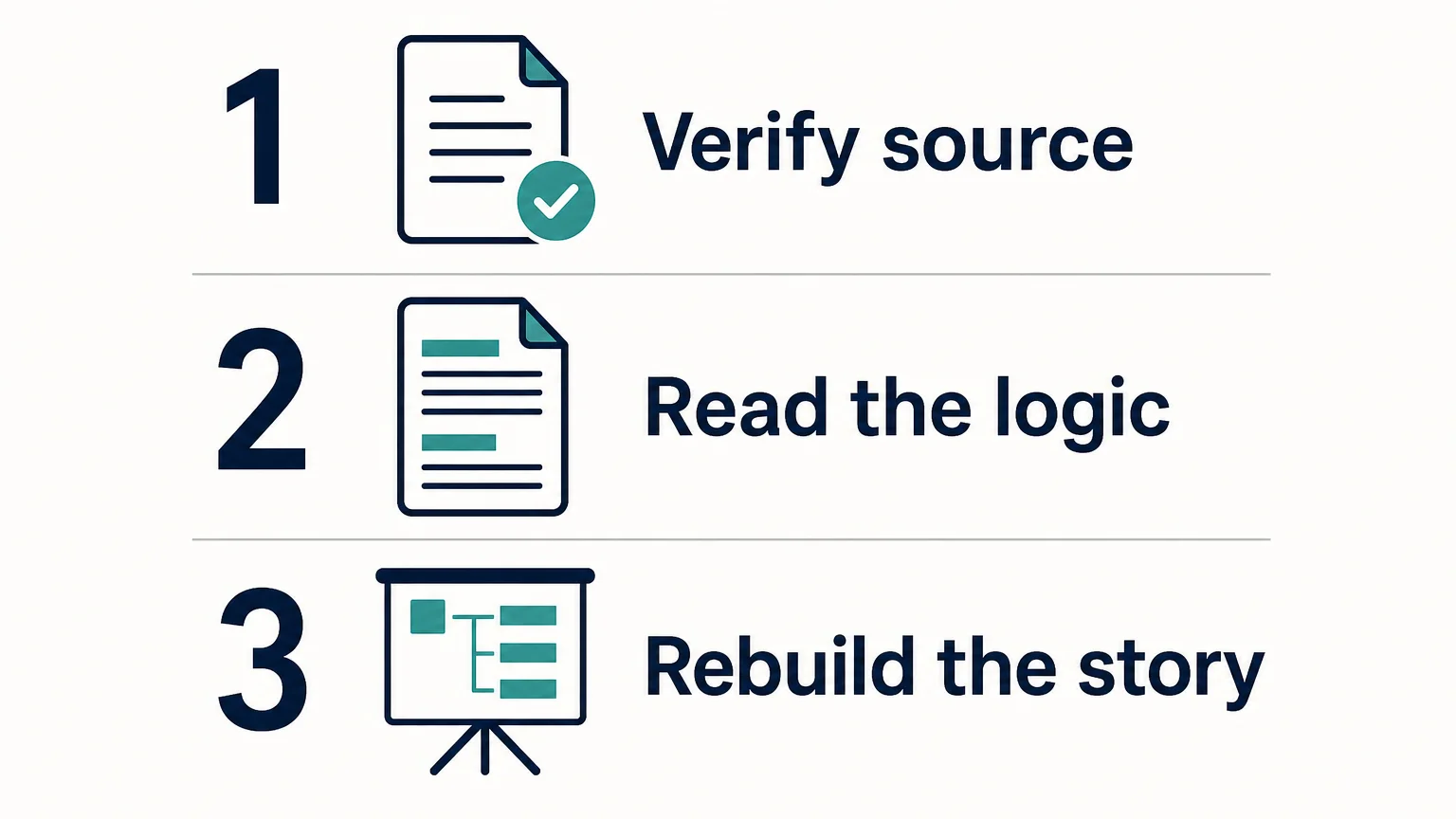
How do you move from research to a finished presentation without losing discipline? Use a staged workflow that separates thinking, evidence, and design.
Stage one is framing. Define the audience, decision, time horizon, and required level of detail. A board audience may need a concise recommendation and risk view. A working team may need more operational evidence.
Stage two is analysis. Collect only information that supports the decision. Label each source with its publication year, geography, sample, and measurement definition. This prevents older figures from appearing to describe the current situation.
Stage three is storyline. Arrange the deck using a situation, complication, and resolution structure. Establish the starting point, explain what has changed, and show why the recommendation follows.
Stage four is slide writing. Write the action title first. Then decide whether the body requires a chart, table, process, timeline, comparison, or concise text block.
Stage five is design. Apply a consistent grid, hierarchy, colour system, and source-note treatment. Remove elements that do not improve comprehension.
Stage six is review. Read the deck at three speeds: titles only, titles plus visuals, and full detail. Each level should reveal the same argument with increasing precision.
When your presentation includes milestones, dependencies, and decision points, our McKinsey timeline slide guide can help you organise the sequence without turning it into a decorative project schedule.
Which mistakes weaken McKinsey-style presentations?
Why do many presentations look consulting-inspired but remain difficult to use? The problem is usually not the template. It is a mismatch between the visual structure and the underlying reasoning.
- Starting with design: Choosing a layout before defining the message often produces attractive but unfocused slides.
- Using topic titles: A label such as “Customer Analysis” does not tell the audience what the analysis proves.
- Overloading one page: Multiple charts and unrelated points create competition instead of clarity.
- Hiding the source: A precise number without a source weakens confidence, especially in an executive setting.
- Mixing time periods: Current findings, historical data, and forecasts should not appear interchangeable.
- Copying the source too closely: Reusing a published deck can create legal, ethical, and credibility problems.
- Confusing detail with rigour: More content does not automatically make an argument more robust.
The strongest lesson from public consulting PDFs is therefore methodological. They show how to define a question, prioritise evidence, structure an argument, and make a recommendation easy to understand.
Use public PDFs as strategy lessons
A McKinsey slides PDF is most valuable when you study the decisions behind the pages. Verify the source, identify the audience, map the storyline, test the evidence, and rebuild the logic with original content. The result should be a presentation that supports your own decision, not a visual imitation of somebody else’s work. When the titles, evidence, and recommendation align, the deck becomes easier to read, discuss, and act on.
Take action with Deckadence
Once you understand the structure of public consulting PDFs, the next challenge is turning that understanding into a polished, decision-ready presentation. You need a clear narrative, credible exhibits, purposeful slide layouts, and a visual system that works across your professional workflow.
Our presentation materials combine strategic frameworks, structured storytelling, action titles, concise messaging, and board-level visual design. To move from research notes to an editable, presentation-ready asset, explore our McKinsey presentation PPT and adapt the structure to your own strategy, audience, and evidence.
Frequently Asked Questions
Where can you find McKinsey slides in PDF format?
Start with McKinsey’s official research pages, public-sector websites, university archives, and reputable document repositories. Always compare the file with the original publisher page before relying on its content.
Are public McKinsey PDFs free to reuse?
Public access does not automatically grant permission to reproduce or adapt a document. You can study the structure, but you should check copyright, licensing, attribution, and any restrictions before using material externally.
What should you study first in a McKinsey presentation?
Begin with the executive summary, slide titles, section flow, source notes, and final recommendation. These elements reveal the deck’s logic before you spend time analysing every exhibit.
Can you use a McKinsey PDF as a presentation template?
You can use public examples as references for hierarchy, storyline, evidence, and layout decisions. It is safer to create original content and design rather than copying pages, wording, charts, or proprietary visual treatments.
Can Deckadence help create a McKinsey-style presentation?
Our premium slide decks and strategic-thinking templates are designed to help consultants, executives, founders, and business leaders communicate complex ideas clearly. They combine structured storytelling with presentation-ready visual systems for professional strategy work.