Consulting firms guard their client work closely, yet a surprising number of authentic decks have surfaced online through regulatory filings, industry conferences, and published research. That scarcity is exactly why authentic McKinsey presentations attract so much attention from consultants and executives who want to reverse-engineer what makes them persuasive. If you want a faster route, our McKinsey strategy slides distill the same structural logic into ready-to-use layouts.
The appeal is not the confidential data. It is the discipline behind the slides. The Pyramid Principle that underpins these decks was created by Barbara Minto, who spent two decades at the firm, and according to one detailed guide her method still shapes how conclusions are communicated worldwide. Understanding that discipline is what turns a passive viewer into a stronger communicator.
Where real McKinsey presentations actually come from
Very few genuine consulting decks are ever meant for public eyes. When you study real McKinsey presentations, you are almost always looking at material that entered the public domain through legitimate channels rather than leaks. These fall into a handful of recognizable categories, and knowing them helps you judge what you are reading.

- Client engagement documents that later appeared in public records, such as government transportation studies or municipal recovery reports.
- Institute research from the firm's economics and business research arm, covering topics from automation to global trade flows.
- Conference and industry appearances, where partners present extracts of broader thinking to external audiences.
- Regulatory filings, where public bodies published the analysis they commissioned.
An important caveat applies. Many of the decks circulating online are several years old and were built for conference stages or report summaries, not confidential boardrooms. Treat them as illustrations of method, not as current market data. When you cite a figure from an older deck, always anchor it to its original year.
The Pyramid Principle behind every slide
Why do these decks feel so decisive? The answer sits in a single structural idea. The firm's own account describes how Barbara Minto, editing reports that crossed her desk, noticed she kept reorganizing ideas into a pyramid shape, with each higher point summarizing the ones below it.
The rule is simple and demanding. You lead with the conclusion, then present three to five supporting arguments, then back each argument with evidence. This inverts the way most people communicate, which is to walk an audience through their research before revealing the point. The pyramid gives the destination first. The same top-down logic that governs slides also governs McKinsey-style reports, where the executive summary carries the recommendation and detailed analysis moves to appendices.
Minto captured her approach in several books, and one reference on the model notes that the most recent edition was published in 2020. More than fifty years after its creation, the framework remains a standard reference for structured business communication.
MECE: structuring arguments without gaps
The pyramid needs a companion test, and that test is MECE. The letters stand for Mutually Exclusive and Collectively Exhaustive. Each supporting point must be distinct from the others, and together the points must cover the whole question. No overlaps, no gaps.
This is what prevents a strategy argument from feeling either repetitive or incomplete. When a McKinsey-style deck proposes three drivers of growth, those drivers do not bleed into one another, and they leave nothing critical unaddressed. Applying this discipline to your own consulting slide decks forces harder thinking before a single slide is designed. If you want to see how visual structure reinforces this clarity, our guide on why visuals work explains the underlying principles.
The anatomy of a McKinsey body slide
Look at any authentic deck and a consistent grammar emerges at the slide level. Every slide carries an action title, a headline that states the insight rather than the topic. Instead of a label like "Market growth", the title reads as a full takeaway the reader can act on.
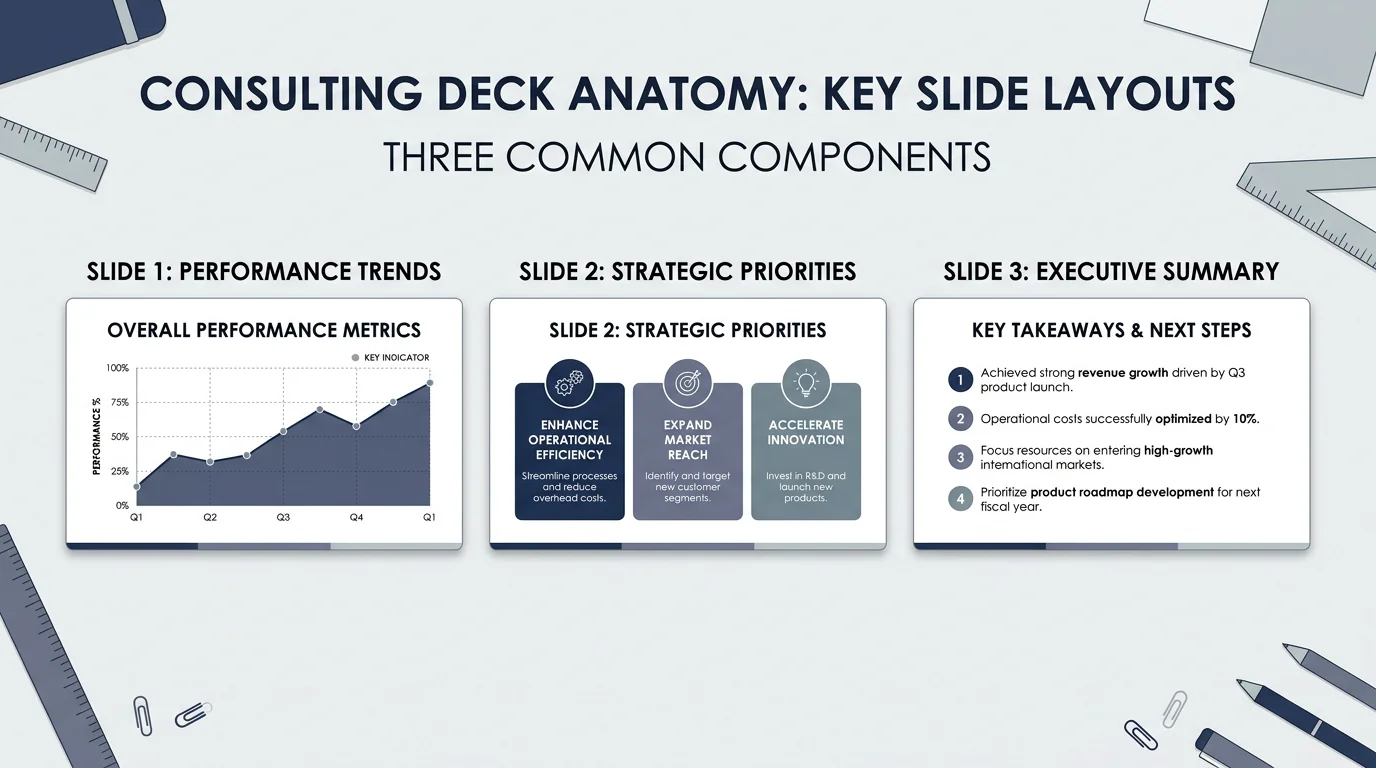
Beneath the title, the body follows a few repeatable patterns. Full-slide charts give a single data point the room to breathe. Infographics pair short captions with visuals to compress complex ideas. Occasional full-text slides summarize findings or recommendations, kept readable through white space and short lines. Across all of them, the design stays minimalist: a limited palette, consistent typography, and a clear visual hierarchy that guides the eye.
The storyline ties these slides together. Many decks use a Situation, Complication, Resolution arc: establish the context, surface the tension, then resolve it with a recommendation. Each slide becomes a stepping stone toward the decision the audience must make.
How to apply these patterns to your own decks
You do not need confidential access to build like a top consultancy. You need the method. Start by writing your conclusion before you open a slide editor. If you cannot state your recommendation in one sentence, the analysis is not finished.
Next, group your supporting arguments and test them against MECE. Draft a "ghost deck", a sequence of action titles with no design at all, and read those titles top to bottom. If they tell a coherent story on their own, the logic is sound. Only then should you design. Building strategy under uncertainty is easier when the structure carries the argument, which is one reason our Blue Ocean Strategy (Enhanced Edition 2026) pairs a proven framework with board-ready layouts.
Comparing ways to build a McKinsey-style deck
There are several routes to a consulting-grade presentation, and each involves a trade-off between speed, structure, and polish. The table below compares the most common options against the criteria that matter most for executive work.
| Approach | Strategy frameworks | Board-ready design | Ready-to-edit formats |
|---|---|---|---|
| Our Deckadence slide systems | Included (SWOT, PESTEL, Porter's Five Forces, Business Model Canvas) | Yes, built for decision-makers | PowerPoint, Keynote, Figma |
| Studying public McKinsey decks | Illustrated, not packaged | Varies by document age | No, view only |
| Generic slide templates | Rarely included | Inconsistent | Usually one format |
Public decks are excellent for inspiration, but they leave you to rebuild everything yourself. Generic templates offer speed without the underlying logic. A structured slide system gives you both the framework and the finish.
Turning observation into stronger presentations
Studying real McKinsey presentations is worthwhile only when you extract the method rather than copy the surface. Lead with the answer, structure your arguments so they are mutually exclusive and collectively exhaustive, write action titles that state insights, and let a clean design keep attention on the message. These habits are not proprietary. They are a discipline anyone can adopt. Apply them consistently, and your own decks will start to drive decisions with the same clarity that made the original examples worth studying in the first place.
Take action with Deckadence
You have seen what makes these decks persuasive. The next step is putting that structure to work on your own strategy story, without rebuilding every layout from scratch or guessing at the underlying logic. That is precisely where we can help you move faster.
Our McKinsey presentation PPT template combines consulting-grade frameworks, structured storytelling, and board-level visuals in formats built for PowerPoint, Keynote, and Figma. You get the Pyramid Principle and MECE logic already embedded in the design, so you can focus on your argument and present with confidence to the people who make decisions.
Frequently Asked Questions
Are real McKinsey presentations legal to view?
Yes, when they entered the public domain through legitimate channels. Most publicly available decks come from regulatory filings, conference appearances, or published institute reports rather than leaks. Always confirm a document's origin before relying on it.
Why do so many public decks look several years old?
Because the material that reaches the public is often tied to past client projects, older conference talks, or dated research summaries. Treat their figures as historical, and anchor any statistic you reuse to its original publication year rather than presenting it as current.
What is the single most important structural rule in these decks?
Leading with the conclusion, known as the Pyramid Principle. You state your recommendation first, then support it with structured arguments and evidence. This top-down order is the opposite of how most people naturally present.
How can I build a similar deck without consulting experience?
Start with a ghost deck of action titles, test your arguments against MECE, and design only once the logic holds. Our slide systems package these frameworks and board-ready layouts so you can apply the method directly. You supply the thinking; the structure supports it.
What does MECE mean in practice?
MECE stands for Mutually Exclusive and Collectively Exhaustive. In practice, your supporting points must not overlap, and together they must cover the entire question. It is a quick test that keeps an argument both tight and complete.