Business Model Canvas Template: A Practical Guide for 2026
A strategy can fit on one page, but its logic still needs to hold together. A business model canvas template gives you a disciplined way to map that logic, from the customers you serve to the costs required to create value. If you need a stronger visual explanation after completing the canvas, our business model canvas guide can help you connect the framework to a persuasive strategic story.
The framework is useful for startups, established companies, product teams, consultants, and executives. It helps you make assumptions visible before you invest heavily in a product, market, operating model, or growth plan. Strategyzer describes the canvas as a strategic management and entrepreneurial tool that supports designing, challenging, inventing, and pivoting business models through a visual format.
What is a business model canvas template?
What makes the canvas useful is its ability to compress a complex business model into one shared view. Instead of presenting strategy through many pages of narrative, you organize the main elements on a single page and examine how they influence one another.
A 2024 2024 CMU handout presents the canvas as a practical framework with nine core building blocks. These blocks cover the customer side of the model, the offer itself, the operating system behind it, and the financial consequences of your choices.
The canvas is not a substitute for a business plan. A business plan usually includes deeper research, forecasts, implementation details, responsibilities, and risk analysis. The canvas works earlier and more broadly, helping you clarify the model before those details become expensive to produce.
You can use a canvas to describe an existing organization, compare alternative models, prepare a new venture, or examine a proposed product. It is especially valuable when different stakeholders hold different assumptions about who the customer is, what the offer does, or how revenue will be generated.
What are the nine building blocks?
Nine blocks give the template its structure. A Cambridge template organizes these elements around the way a business creates, delivers, and captures value.
- Customer segments: Identify the specific groups of people or organizations you intend to serve. Describe their needs, behaviors, context, and purchasing role.
- Value propositions: Explain the problem you solve and the benefit customers receive. Focus on outcomes, not only features or internal capabilities.
- Channels: Define how customers discover, evaluate, purchase, receive, and use your offer. Separate communication channels from delivery and sales channels when necessary.
- Customer relationships: Describe how you acquire, support, retain, and grow customer relationships. The relationship may involve personal service, self-service, automation, communities, or co-creation.
- Revenue streams: Show how the business earns money from each customer segment. Possible structures include asset sales, usage fees, subscriptions, licensing, leasing, advertising, or commissions.
- Key resources: List the assets required to make the model work. These may include people, intellectual property, data, technology, facilities, capital, or trusted relationships.
- Key activities: Identify the most important work required to deliver the value proposition. Activities may include production, software development, marketing, research, logistics, service delivery, or platform management.
- Key partnerships: Record the external organizations, suppliers, distributors, platforms, or alliances that support the model. Include what each partner contributes and what dependency they create.
- Cost structure: Describe the significant costs created by the model. Consider fixed costs, variable costs, customer acquisition expenses, infrastructure, staffing, partnerships, and support.
The blocks should not be treated as nine independent lists. Customer segments influence value propositions, which influence channels and relationships. Those choices affect resources, activities, partnerships, costs, and revenue. The template becomes strategically useful when those connections are explicit.
How should you fill out the template?
Suppose you are evaluating a subscription service for professional customers. Writing “businesses” in the customer segment block is too broad. You might instead identify operations leaders at mid-sized companies who need predictable reporting but lack an internal analytics team.
Start with the customer problem rather than your preferred product. Then move through the canvas in a sequence that makes the assumptions easier to challenge.
- Define the target customer: Describe who has the problem, who experiences it, who decides, and who pays.
- State the customer outcome: Explain what changes for the customer after using your offer. Avoid vague claims such as “better quality” or “excellent service.”
- Map the buying and delivery path: Identify how the customer hears about you, evaluates the offer, purchases it, and receives value.
- Describe the relationship model: Decide how much human support, education, onboarding, community, or automation the customer requires.
- Identify the operating requirements: List the activities, resources, and partners needed to deliver the promised outcome consistently.
- Connect economics to operations: Estimate how the model earns revenue and what costs increase as demand grows.
- Mark uncertainty: Use different colors or labels for evidence, assumptions, and future plans.
Use short phrases rather than paragraphs inside the canvas. Add supporting evidence beside the template, not inside every block. Customer interviews, market research, pricing tests, funnel data, and operational estimates can provide the detail required to evaluate each statement.
If your challenge is turning an early idea into several coherent options, our business model prototyping guide can support a more structured process. Prototyping allows you to compare alternative customer groups, offers, channels, and revenue mechanisms before selecting one direction.
Why should you treat the canvas as a system?

A filled canvas can still describe a weak business model. The problem usually appears when the blocks are disconnected. For example, a premium value proposition may require expert service, careful onboarding, and high-touch support. Those requirements should appear in customer relationships, key activities, key resources, and cost structure.
The same logic applies to revenue. If you select a subscription model, you need activities that support activation, retention, renewal, and customer success. If you rely on a marketplace, you may need to attract and balance multiple customer segments. If you promise fast delivery, your resources and partnerships must support that promise.
Use the canvas to ask connection questions:
- Which customer segment benefits from each value proposition?
- Which channel delivers each value proposition?
- Which activities are required to maintain the customer relationship?
- Which resources and partners make the offer possible?
- Which costs increase when the model scales?
- Which revenue stream pays for the operating requirements?
A practical technique is to draw lines between related notes. If a note connects to nothing else, it may be a distraction, an unsupported assumption, or a future ambition that does not belong in the current model.
Founders can use this approach to compare a direct sales model with a self-service model. Executives can use it to examine whether a new service fits the existing operating system. Consultants can use it to reveal where a client’s stated positioning conflicts with its economics.
For startup teams that need a more focused view of an early venture, our startup business canvas guide offers a complementary way to structure founder decisions, market assumptions, and growth priorities.
How do you validate the assumptions behind it?
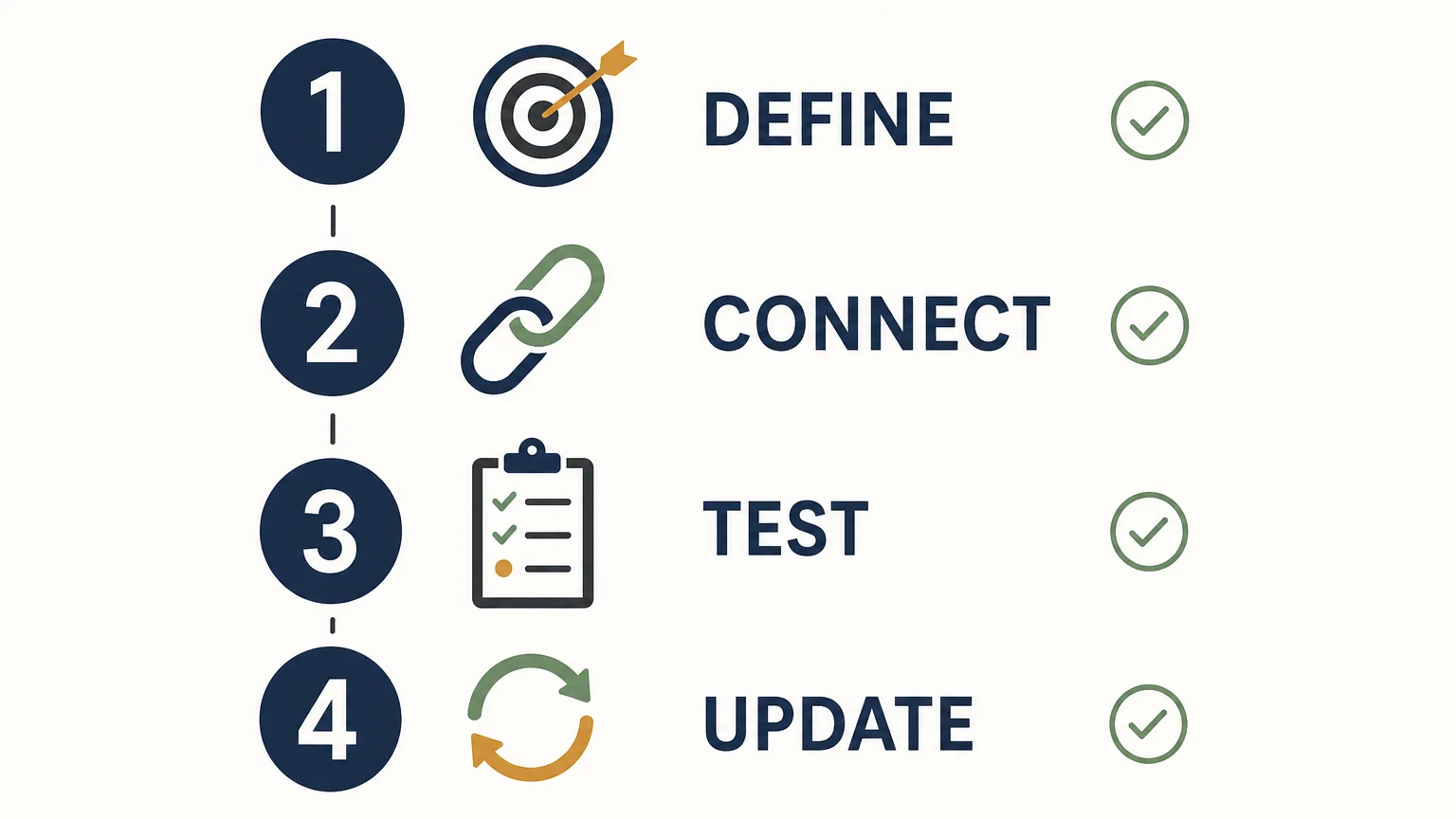
A useful test begins with the most uncertain and consequential assumption. Do not validate every note with equal effort. Prioritize the beliefs that could invalidate the model if they prove false.
For example, a new service may depend on three critical assumptions:
- A defined customer group experiences the problem frequently enough to seek a solution.
- The proposed outcome matters enough for customers to change behavior or pay.
- The business can deliver the outcome at a cost that supports the intended revenue model.
Turn each assumption into a testable statement. “Customers need better reporting” is too vague. “Operations leaders at companies with 100 to 500 employees will pay for weekly reporting that reduces manual preparation time” is more useful because it identifies a customer, an outcome, and a commercial behavior.
The World Bank toolkit includes a business model canvas example within a broader small-business resource. This illustrates why the canvas can work as a practical planning aid, particularly when a business needs to connect customers, operations, resources, and financial considerations in one view.
Choose a validation method that matches the assumption:
- Use customer interviews to examine the problem, language, urgency, and current alternatives.
- Use prototypes or concept tests to examine reactions to the proposed value proposition.
- Use landing pages, sales conversations, or pre-orders to test demand signals.
- Use a service trial or manual delivery process to test whether the outcome can be produced.
- Use cost estimates and pilot data to examine economic viability.
Update the canvas after each meaningful test. Keep a record of what changed, which evidence supported the change, and which questions remain open. This turns the document into a living decision tool rather than a polished snapshot that becomes outdated.
For a clearer customer-centered analysis, our Business Model Canvas value proposition guide can help you connect customer needs with the specific benefits your model is designed to deliver.
Use the canvas to improve decisions
A business model canvas template is most valuable when it makes strategic choices easier to discuss and test. Start with a specific customer and a meaningful outcome, then connect the offer to channels, relationships, operations, partnerships, costs, and revenue. Treat every statement as an assumption until evidence supports it. Review the canvas whenever customer behavior, technology, competition, or operating conditions change. The result should be a clear model that helps people decide what to pursue, what to test, and what to stop.
Take action with Deckadence
A completed canvas gives you strategic raw material, but stakeholders still need a clear narrative. When your model must support a pitch, leadership discussion, consulting engagement, or board conversation, the next task is to make the logic easy to follow.

Explore our visual strategic-thinking library for premium slide decks, board-ready frameworks, narrative structures, and presentation-ready slide systems. We create materials for PowerPoint, Keynote, Figma, and more, with structured storytelling, concise messaging, action titles, and evidence-driven communication.
Frequently Asked Questions
What is a business model canvas template used for?
It is used to describe how a business creates, delivers, and captures value. You can use it to design a new model, review an existing one, compare alternatives, or identify assumptions that require testing.
What are the nine sections of the canvas?
The nine sections are customer segments, value propositions, channels, customer relationships, revenue streams, key resources, key activities, key partnerships, and cost structure. Together, they show the customer, operating, and financial logic of a business.
Is a business model canvas the same as a business plan?
No. A canvas is a concise visual model, while a business plan usually contains more detailed research, forecasts, implementation actions, and risk analysis. You can use the canvas before developing a full business plan.
Should startups and established companies use the same canvas?
Both can use the same nine-block structure, but their evidence and questions will differ. Startups often focus on uncertain customer and revenue assumptions, while established companies may examine changes to existing channels, resources, partnerships, or cost structures.
How often should you update a business model canvas?
Update it whenever important evidence changes your understanding of the model. A formal review after a major customer insight, product change, market shift, partnership change, or pricing decision can prevent the canvas from becoming disconnected from reality.