Strategic Thinking Templates: How to Choose the Right One
When a team starts with a blank page, strategy discussions can drift into a long list of ideas without resolving what to do. The right strategic thinking templates give the discussion a useful structure, whether you are assessing a market, comparing options, or setting organizational priorities. If you also need to present the result, our strategic planning presentation template page explains a related way to organize strategic communication.
The key is to begin with the decision, not the template. A focused framework helps you examine a particular question, while a broader planning template organizes direction, objectives, initiatives, and measures. Match the tool to the work, and make its assumptions and evidence visible so others can understand how you reached your recommendation.
What decision are you trying to make?

Imagine your leadership team is considering a new market. A SWOT analysis could organize internal strengths and weaknesses alongside external opportunities and threats. A PESTEL analysis would instead focus attention on political, economic, social, technological, environmental, and legal conditions. Both are useful, but they answer different questions.
State the decision as a question before selecting a framework. For example: “Can we compete profitably in this market?” calls for evidence about industry dynamics and customer alternatives. “Which growth route should we pursue?” points toward options such as market penetration, market development, product development, or diversification.
This decision-first approach prevents a common mismatch: choosing a familiar diagram and then forcing the available evidence into it. Write down the decision owner, the timeframe, and what the analysis must produce. A recommendation, a shortlist of options, and a list of risks require different levels of analysis.
Which strategic thinking template fits the question?
When you know the decision, choose a framework whose inputs correspond to the evidence you can gather. A framework is a way to structure reasoning, not a substitute for reliable information. Our strategy framework overview can help clarify how structured models support strategic analysis.
Use the following distinctions to narrow the field:
- SWOT analysis organizes internal strengths and weaknesses alongside external opportunities and threats. Use it to create a broad snapshot, then verify important points with evidence rather than treating the four categories as conclusions.
- PESTEL analysis scans external political, economic, social, technological, environmental, and legal factors. It is useful when wider conditions could change the assumptions behind a decision.
- Porter’s Five Forces structures an assessment of industry competition, including rivalry, buyer and supplier power, substitutes, and potential entrants. Use it when industry structure and competitive pressure matter to the choice.
- Business Model Canvas maps how an organization creates and delivers value, including customers, activities, partners, resources, channels, costs, and revenue. It helps examine how a business model fits together, especially when developing or revisiting an offer.
- Ansoff Matrix compares growth directions through existing or new products and markets. It helps clarify whether a proposal involves deeper market penetration, market development, product development, or diversification.
- BCG matrix compares business units or products using relative market share and market growth. Treat its categories as prompts for portfolio discussion, not automatic instructions to invest or withdraw.
- Strategy diamond links choices about where to compete, how to get there, how to differentiate, the sequence of moves, and the logic for returns. It is useful when a team needs to test whether strategic choices fit together.
- Cost-benefit analysis compares anticipated costs with expected benefits for a defined decision. It can make trade-offs clearer, provided you state assumptions and include relevant nonfinancial considerations.
For a broader look at how business models are structured, our business framework model page is relevant when mapping how an organization creates and delivers value.
How do you connect analysis to a plan?
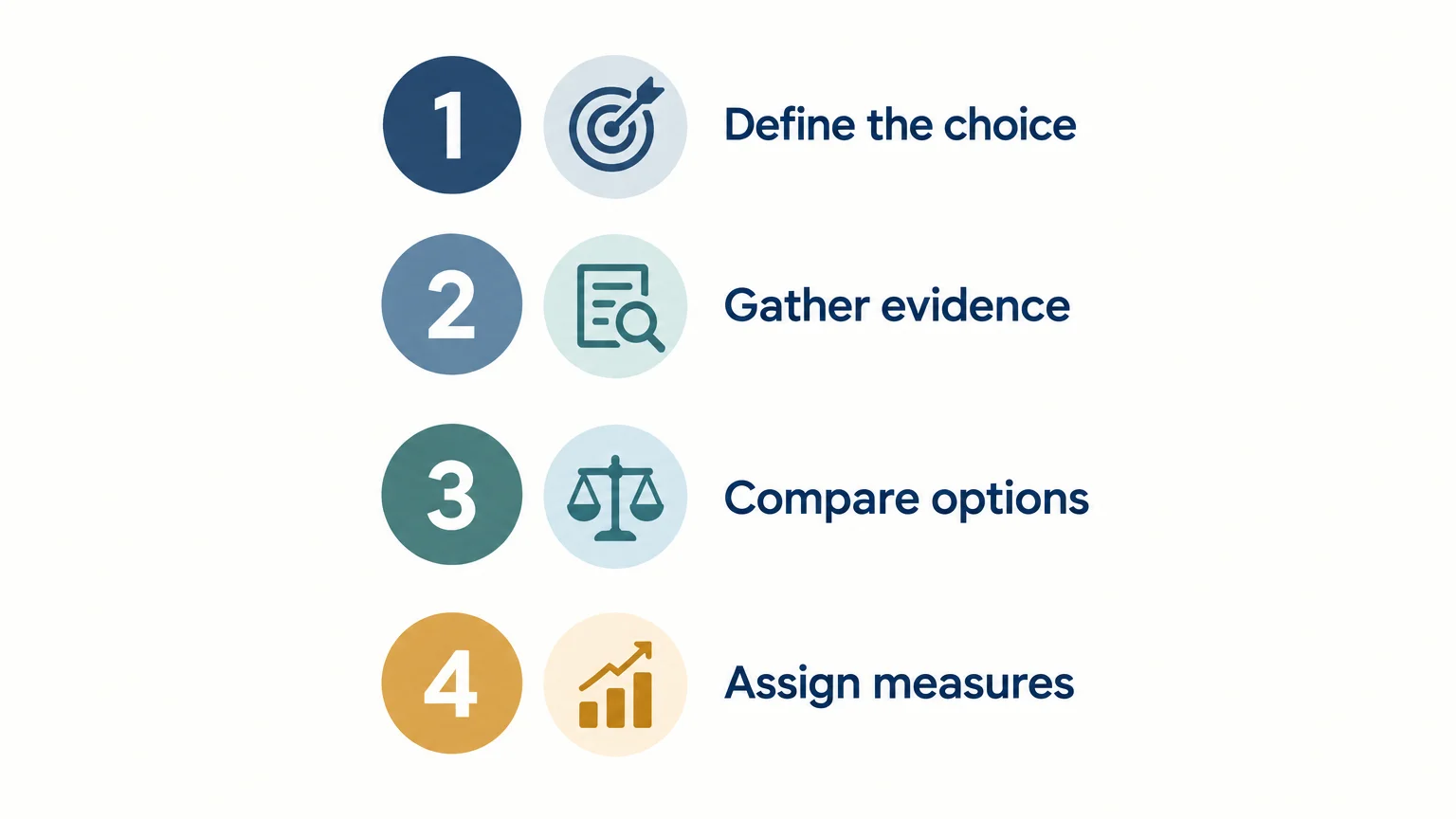
A diagnostic framework gives you a structured view of a situation. A strategic planning template helps carry that view into organizational direction, objectives, initiatives, and measures. Keep these roles distinct: analysis informs the choice, while planning translates the choice into coordinated work.
A practical sequence is to define the decision, gather relevant evidence, compare feasible options, and record the implications. Then identify the few priorities that follow from the chosen direction. For each priority, specify an owner, a measurable indicator, and a review point. These links make it easier to see whether activity is advancing the intended outcome.
North Carolina’s Office of State Budget and Management describes a planning structure that includes mission, vision, values, goals, objectives, performance measures, and priority questions. Its strategic planning guide illustrates how broad direction can be connected to questions and measures. The details should still reflect your organization’s context and decision.
For choices shaped by uncertainty, add a way to revisit assumptions. UNDP’s 2026 toolkit for public-sector and development planning describes techniques including horizon scanning, scenarios, backcasting, and stress testing. Its foresight planning toolkit treats futures work as a way to consider multiple possibilities, not predict one certain outcome.
What makes a template useful after the workshop?
A template is useful beyond a meeting when another person can follow the reasoning. Label the evidence behind important claims, distinguish facts from assumptions, and record options that were considered but not selected. If an external trend matters, note its source and the conditions under which it could affect the decision.
Keep the working document proportionate to the decision. A narrow question rarely needs every framework at once. For example, a team evaluating a potential product launch might use PESTEL to scan the external context, an Ansoff Matrix to compare growth directions, and a cost-benefit analysis to examine a specific investment. Add another framework only when it answers a distinct question.
A 2026 National Academies guide on transportation decision-making combines practical advice from agency executives with cognitive science research. It addresses decisions that may need to be made quickly and with incomplete information. Its decision-making guide is a useful reminder to make the choice and its reasoning explicit, particularly when stakeholders need to evaluate trade-offs.
Finally, choose a format your team can work with and your audience can read. If the analysis will inform an executive or board discussion, focus the final presentation on the decision, supporting evidence, trade-offs, and next steps. Our materials are built for PowerPoint, Keynote, Figma, and more; check the specific asset and platform details that suit your workflow.
How should you choose a format for the audience?
A working template and a decision presentation serve related but different purposes. The working version captures evidence, assumptions, and discussion. The presentation should make the strategic logic easy to follow, so stakeholders can see the recommendation, its rationale, and what action is required.
Before finalizing either version, check that it answers three questions: What choice is being made? What evidence supports it? What should happen next? Use concise action titles, clear visuals, and measures tied to the stated priorities. If the deck only repeats the analysis, it has not yet made the decision easier to understand.
Choose the Framework That Fits the Decision
Effective strategic thinking templates begin with a clearly stated choice, then organize the evidence and comparisons needed to make it. Select one framework for the core question, add another only when it contributes a distinct perspective, and connect the conclusion to owners and measures. The result should make both the reasoning and the next action clear.
Make Strategic Thinking Clear and Persuasive
Once your analysis identifies a direction, the next challenge is presenting it clearly to the people who need to understand and act on it. A structured narrative and considered visuals can help stakeholders follow the logic, compare priorities, and focus on the decision.
Explore our visual strategic-thinking assets, including slide decks, frameworks, narrative structures, and presentation systems. The library supports strategic analysis and communication, with materials built for PowerPoint, Keynote, Figma, and more. Our strategy guide also covers more than 15 frameworks and includes a framework selection guide, giving you a reference point when deciding which model fits your question.
Frequently Asked Questions
What is a strategic thinking template?
It is a structured tool for organizing analysis around a strategic question or decision. Examples include SWOT, PESTEL, and growth-option frameworks.
How do I choose the right framework?
Start by writing down the decision, the evidence you need, and the output stakeholders require. Then select a framework that directly structures that work.
Can I use more than one framework?
Yes, when each framework answers a distinct question. For example, an external scan and a growth-options matrix can contribute different perspectives to a market decision.
What is the difference between a strategy framework and a strategic plan template?
A strategy framework structures analysis or strategic choices. A strategic plan template organizes direction, goals, initiatives, owners, and measures into a plan for coordinated action.
Where can I find guidance on selecting strategic frameworks?
Deckadence’s strategy guide covers more than 15 frameworks and includes a framework selection guide. Use that reference to compare options, then check that the chosen framework fits your organization’s decision and available evidence.