What Is a Strategy Framework? Definition, Uses & Examples
A strategy framework gives complex business thinking a practical structure. Instead of discussing markets, capabilities, customers, or goals as disconnected topics, your team can use a defined lens to identify what matters, compare options, and focus on the decisions that shape results. If you need to turn that thinking into a clear visual system, our business framework model can help organize the logic behind your strategic communication.
The most useful frameworks do not make decisions for you. They improve the questions you ask, make assumptions visible, and create a shared language for discussion. That distinction matters because a framework can support analysis and alignment, but it still requires judgment, evidence, ownership, and follow-through.
What is a strategy framework?
A strategy framework is a structured approach, model, or lens that helps you analyze a strategic issue and decide how to address it. It breaks a broad question into connected areas, such as the external environment, customer needs, competitive pressure, organizational capabilities, goals, measures, or initiatives.
For example, a company considering market entry may need to understand competitors, substitutes, suppliers, regulation, demand, and internal readiness. Rather than examining these elements randomly, the team can apply several frameworks to organize the investigation. The framework creates a disciplined path from evidence to interpretation.
A good framework usually performs four functions:
- Structures analysis by defining the categories that deserve attention.
- Clarifies choices by showing where trade-offs and priorities exist.
- Aligns stakeholders through a common vocabulary and visual logic.
- Connects decisions to action through objectives, measures, owners, or milestones.
The framework is therefore a thinking aid, not a substitute for strategic judgment. Two teams can use the same framework and reach different conclusions because their markets, capabilities, evidence, and ambitions differ.
How is a framework different from strategy and a strategic plan?
These terms are often used interchangeably, but separating them makes strategic work easier to manage.
- Strategy is the set of integrated choices about where an organization will compete and how it will create value or win.
- A strategy framework is the structure used to examine a strategic question or organize strategic choices.
- A strategic plan translates those choices into objectives, initiatives, resources, timelines, responsibilities, and measures.
- A strategic model often describes the broader architecture of the planning process, while several frameworks may be used inside it.
Consider a product company entering a new region. Its strategy might be to focus on a narrow customer segment through a differentiated service model. A PESTEL analysis could reveal external risks. Porter’s Five Forces could clarify competitive pressure. An operating plan could then assign initiatives, budgets, owners, and deadlines.
The distinction is not merely academic. A framework can produce a strong analysis without producing a viable strategy. A strategy can be clear without being translated into a practical plan. The value comes from connecting all three levels without confusing their roles.
Why do strategy frameworks matter in practice?

A framework becomes valuable when it reduces confusion at the point where decisions are difficult. It helps a team distinguish facts from assumptions, symptoms from causes, and attractive ideas from strategically relevant choices.
It also creates a repeatable method for discussion. Without a framework, one stakeholder may focus on customer demand while another emphasizes internal capacity. A shared structure allows both perspectives to be considered within the same decision process.
Execution is where this benefit becomes especially important. A 2026 academic study reviewing strategy execution research described implementation failure as a major reason well-formulated strategies do not produce intended results, with estimates reaching up to 67 percent. The figure is a literature-based estimate, not a universal failure rate, but it highlights a practical issue: strategic insight has limited value if it does not shape priorities, behaviors, and follow-up.
A framework can help close that gap by making the logic of a decision visible. When teams can see how a market insight leads to a priority, how that priority leads to an initiative, and how the initiative will be measured, execution becomes easier to coordinate.
What belongs in a strategy framework?
There is no single universal template. However, most useful frameworks contain several recurring elements that help a team move from context to action.
1. A strategic question
The framework should begin with a question. Are you assessing market attractiveness, defining a growth path, testing customer demand, aligning the organization, or measuring progress? Without a clear question, teams often collect information without knowing what decision it should support.
2. A defined scope
Specify the business unit, product, geography, audience, time period, or strategic challenge under review. A SWOT analysis for an entire multinational organization will produce a different result from a SWOT analysis for one product line.
3. Categories or perspectives
These are the fields the framework asks you to examine. They may include internal capabilities, external forces, customer outcomes, financial results, organizational systems, or growth options.
4. Evidence and assumptions
A framework is stronger when each conclusion is supported by evidence. This may include customer research, financial data, competitor information, operational measures, expert judgment, or clearly stated assumptions.
5. Choices and priorities
Analysis alone does not create strategy. The team must identify what it will prioritize, what it will not pursue, and where resources or attention should be concentrated.
6. Measures and review points
Strategic work benefits from defined indicators and review rhythms. These may include outcomes, milestones, leading indicators, or activity measures. The right measure depends on the framework and the decision it supports.
These elements can be presented in a document, workshop canvas, slide system, scorecard, or decision map. The format matters less than whether the structure helps people make and communicate better choices.
Which common frameworks answer different strategic questions?
Each framework is designed for a different type of question. Choosing one because it is familiar can create shallow analysis. Choosing one because it fits the decision can make the work more focused.
- SWOT analysis: What internal strengths and weaknesses, along with external opportunities and threats, shape our current position? It is useful for establishing a broad starting point, although it requires prioritization to avoid becoming a long list.
- PESTEL analysis: Which political, economic, social, technological, environmental, and legal forces may affect the organization? It is particularly relevant to market entry, long-range planning, and external risk assessment.
- Porter’s Five Forces: What competitive forces influence industry attractiveness and potential profitability? It examines rivalry, new entrants, buyers, suppliers, and substitutes.
- Business Model Canvas: How does the organization create, deliver, and capture value? It organizes questions around customers, value propositions, channels, relationships, resources, activities, partners, revenue, and costs.
- Balanced Scorecard: How can the organization translate strategy into objectives and measures across financial, customer, internal process, and learning perspectives?
- Objectives and Key Results: What outcomes must be achieved, and how will progress be measured? OKRs are often used as an execution layer after broader strategic choices have been made.
These frameworks can also be combined. For example, a team may use PESTEL to scan the external environment, Porter’s Five Forces to assess industry pressure, the Business Model Canvas to examine value creation, and OKRs to translate priorities into measurable outcomes.
The combination should remain purposeful. Using too many frameworks can create repeated analysis, conflicting conclusions, and a false sense of progress. The 2026 Central Banking benchmarks identified SWOT as the most widely used strategic planning framework among central banks worldwide, while European banks showed a stronger preference for PESTEL. That contrast illustrates an important point: framework selection should reflect the question and context, not fashion alone.
How do you choose the right strategy framework?
Start with the decision you need to make, then select the framework that produces the information required for that decision.
- Define the decision. State what must be decided, such as whether to enter a market, change a product, allocate investment, or improve execution.
- Identify the perspective. Decide whether the question is mainly external, internal, customer-focused, financial, operational, or organizational.
- Select the smallest useful framework set. One framework may be sufficient. Combine two or three only when each contributes a distinct perspective.
- Gather relevant evidence. Separate verified information from assumptions and opinions.
- Turn findings into choices. Identify the priorities, trade-offs, and exclusions that follow from the analysis.
- Define measures and owners. Connect the chosen direction to outcomes, responsibilities, and review dates.
For example, a founder exploring a new product may begin with Jobs to Be Done or the Business Model Canvas. A leadership team assessing a declining market may use PESTEL and Porter’s Five Forces. An organization with clear priorities but weak follow-through may need a Balanced Scorecard, strategy map, or OKRs rather than another diagnostic exercise.
For teams that need a clearer way to compare frameworks and communicate their implications, our Blue Ocean Strategy material offers a structured visual approach to examining differentiation and market space. It should be used when the strategic question concerns how to create distinctive value, not as a universal replacement for other frameworks.
How can a framework move from analysis to execution?
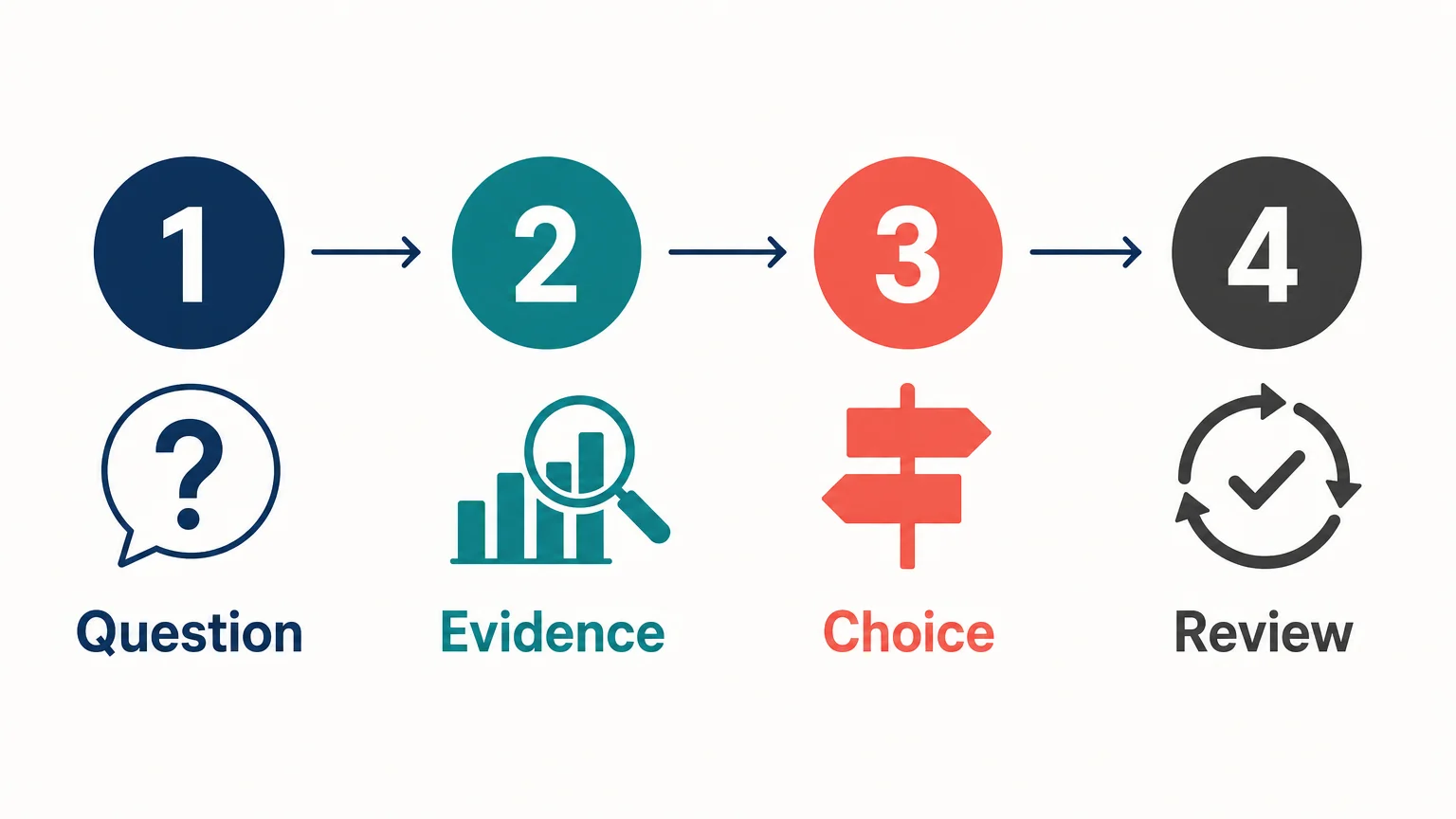
A framework should produce more than a completed worksheet. It should create a chain of reasoning that people can use after the workshop or planning session ends.
A practical sequence is:
- Question: Define the strategic issue and the decision that depends on it.
- Evidence: Gather information relevant to the framework’s categories and test important assumptions.
- Interpretation: Identify patterns, tensions, opportunities, risks, and implications.
- Choice: Select priorities and make explicit trade-offs.
- Action: Assign initiatives, owners, resources, and timeframes.
- Review: Monitor results and revisit the framework when conditions or assumptions change.
This sequence prevents a common mistake: treating the framework as the final product. The completed framework is only useful when it changes what the organization does, funds, measures, or communicates.
Shared frameworks are also valuable outside commercial organizations. The United Nations’ 2026 financing report noted that, by 2023, 79 percent of countries reported using an annual or multi-year statistical plan, while 54 percent had adopted a national strategy for the development of statistics. The example is not directly comparable to corporate planning, but it shows how structured planning instruments can coordinate priorities across complex systems. You can find a similar principle in our strategic plan template, where strategic choices can be organized into a clearer planning structure.
Why does visual communication strengthen a strategy framework?
Strategic thinking often fails to travel because its logic remains hidden inside long documents, disconnected spreadsheets, or specialist language. Visual communication makes relationships easier to inspect. It can show how a customer need connects to a value proposition, how a capability supports an objective, or how an initiative contributes to a measurable outcome.
A visual framework should not simplify the strategy until important nuance disappears. Its purpose is to create a clear hierarchy. The audience should be able to see the central choice, the supporting evidence, the main trade-offs, and the action required.
Research on strategy map research describes strategy maps as tools for formulating, controlling, and communicating strategy. It also explores how operational data could help make relationships between objectives more systematic rather than relying only on managerial judgment.
This is where presentation quality becomes strategically relevant. A well-structured slide can help executives challenge assumptions, help teams align around priorities, and help decision-makers understand what must happen next. Our business model portfolio approach is designed for this type of visual strategic thinking, particularly when several business choices must be communicated as one coherent system.
The goal is not decoration. It is visual strategy, where design reinforces the reasoning and makes the decision easier to understand, discuss, and act on.
What should you remember about strategy frameworks?
A strategy framework is a structured lens for asking better strategic questions and organizing the evidence needed to answer them. It is different from the strategy itself and from the strategic plan that translates choices into action. Choose a framework according to the decision, keep the analysis evidence-based, make trade-offs explicit, and connect the outcome to owners, measures, and review points. The clearest answer to what is a strategy framework is therefore practical: it is a disciplined structure that turns complex strategic thinking into clearer choices and coordinated action.
Turn strategic thinking into clear communication
A useful framework should help people understand the decision, not merely document the discussion. When your strategy must align stakeholders, support executive decisions, or communicate a complex business model, the structure and presentation need to work together.
Our strategy guide, visual frameworks, narrative structures, and presentation-ready assets help consultants, executives, founders, and business leaders organize strategic thinking and communicate it with greater clarity. Explore our strategy frameworks to support more structured analysis and persuasive strategic communication.
Frequently Asked Questions
What is the main purpose of a strategy framework?
Its main purpose is to structure strategic thinking around a defined question. It helps teams examine relevant evidence, identify priorities, make trade-offs, and connect decisions to action.
Is a strategy framework the same as a strategic plan?
No. A framework is a method or lens for organizing analysis and choices, while a strategic plan describes objectives, initiatives, resources, owners, timelines, and measures. A framework can inform a strategic plan, but it does not replace one.
Can you use more than one strategy framework?
Yes, provided each framework answers a different question. For example, PESTEL can examine external forces, Porter’s Five Forces can assess industry pressure, and OKRs can translate priorities into measurable outcomes.
Which strategy framework should a new business use?
There is no universal starting point. A new business may begin with the Business Model Canvas to clarify how it creates value, then use customer research, SWOT, or competitive analysis to test its assumptions.
How can Deckadence help with strategy frameworks?
Our strategy guide covers more than 15 frameworks and includes a framework selection guide. Our visual strategic-thinking assets also help turn complex frameworks into clearer presentations for consulting, executive, board-level, and leadership communication.