How to onboard executives with the business model canvas
A new executive can read a strategy deck and still lack a clear picture of how the business works. To onboard executives with the business model canvas, use a visual map to make the connections between customers, value, operations, and economics easier to discuss. Our Business Model Canvas guide introduces the framework and the questions it can help teams explore.
The canvas is most useful when leaders treat it as a starting point for inquiry, not a finished explanation of the organization. It can help an incoming executive see how business-model choices fit together, while conversations with colleagues add context about priorities, decision rights, culture, and the realities of the role.
Why use a canvas to orient a new executive?

Imagine a newly appointed leader joining a company with several products, customer groups, or business units. The canvas can offer a structured view of one business model, helping the executive ask how the organization serves customers and what it must do to deliver that value.
Its nine blocks cover customer segments, value propositions, channels, customer relationships, revenue streams, key resources, key activities, key partnerships, and cost structure. Together, these show how a model connects market-facing choices with the capabilities and economics behind them. That shared picture can give colleagues a useful reference point for discussing the same business.
Keep the scope precise. A large organization may have several distinct business models, so one canvas may not describe the entire company accurately. Start with the model most relevant to the executive’s remit, and distinguish the current model from any proposed future version. This helps prevent a high-level overview from obscuring important differences.
A 2026 HBR onboarding discussion frames an executive’s transition as a leadership-team matter, not only an individual orientation. In practice, use the canvas to support dialogue with peers, rather than expecting a diagram to explain every relationship or organizational norm.
Prepare a canvas that reflects the business, not the slide deck
Before asking a new executive to interpret the canvas, check whether it reflects how the business currently operates. A polished diagram can still be misleading if it blends different customer segments, presents untested assumptions as facts, or describes an ambition as if it were already in place.
For each relevant block, record concise statements and note what is supported by evidence, what is an assumption, and what remains unclear. For example, a revenue stream can be documented as a current source of income, while a proposed pricing change belongs in a separate future-state version. This distinction lets the executive see both the model and the questions leadership has yet to resolve.
Give extra care to customer segments and value propositions. Different groups may have different needs, purchasing routes, or reasons to choose the company. If a single canvas averages those differences away, the incoming leader may draw the wrong conclusions about channels, relationships, or costs.
Use a short set of prompts to test whether the canvas is specific enough for a useful conversation. Our business model canvas questions can help you structure that discussion. Keep unresolved points visible, rather than filling gaps with confident-sounding guesses.
Facilitate a shared leadership conversation
Begin the session by naming the canvas’s scope: which business, customer group, product, or time period is under discussion. Then ask the executive and existing leaders to examine the same model together. Their differing questions can reveal where context has not been shared or where people hold different assumptions.
Move across the canvas by following the logic of the model. Ask who the organization serves and what value it provides, then explore how that value reaches customers and what the business needs to deliver it. Consider how the revenue streams relate to costs, resources, activities, and partners. This helps the conversation surface business-model connections, not just a list of nine separate headings.
Invite the new executive to ask what is unclear, surprising, or inconsistent. Existing leaders can explain why a channel matters, how a partnership works in practice, or which cost drivers constrain a decision. The new leader can contribute a fresh perspective without being asked to accept the current model as the only possible one.
Visuals can help a group keep complex discussions organized, but they should support the conversation rather than replace it. Our facilitating strategic conversations with visuals article explores ways to make strategic discussions clearer. Use a visible record of open questions and decisions so the group can distinguish understanding the model from agreeing to change it.
Connect the canvas to the executive’s role
A finance leader, product executive, and commercial leader may all need to understand the same model, but they will examine it through different responsibilities. Finance may focus on revenue logic and cost drivers. Product may look closely at customer needs, the value proposition, and the capabilities required to deliver it. Commercial leaders may ask how channels and customer relationships support growth.
Use these different perspectives to tailor the discussion, not to fragment the shared picture. Ask each executive which blocks most affect their decisions, where they depend on other functions, and what information they need to act responsibly. This makes the canvas relevant to the role while helping the leadership team identify cross-functional dependencies.
A 2021 comparative BMC study suggests that entrepreneurs and managers may represent canvas elements differently. Treat that as a reason to check interpretations during the conversation, not to assume that everyone attaches the same meaning to a label.
The canvas does not replace role-specific onboarding. Pair it with meetings about the executive’s responsibilities, decision rights, key relationships, strategic priorities, and organizational context. It describes a business model; it does not, on its own, explain the full strategy, operating practices, or history behind that model.
Keep the canvas useful after the first discussion
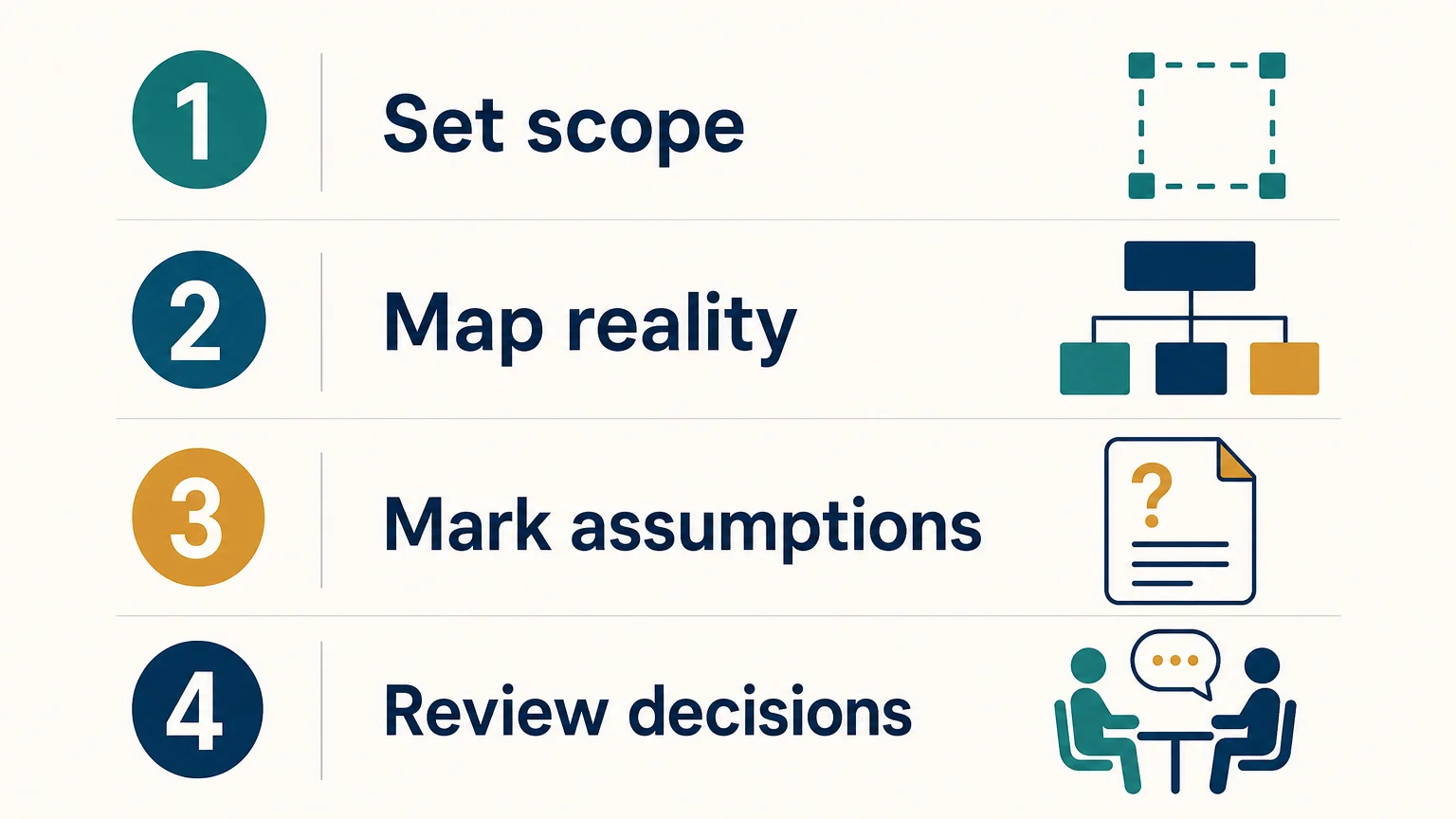
After the onboarding conversation, assign someone to maintain the canvas and record when it was last reviewed. Revisit it when important evidence, customer behavior, partnerships, or strategic choices change. A dated, updated view helps leaders tell whether they are discussing the current model or an earlier version.
Use a business model canvas template to make the model visible, but keep supporting detail elsewhere when it cannot fit clearly. Financial analyses, customer research, operating plans, and risk assessments can answer questions the one-page canvas raises. Our business model canvas template guide can help you consider the template’s role in that process.
Finally, connect discussion to decisions. Record which assumptions require validation, who will investigate them, and what the leadership team needs to decide. The canvas supports shared understanding; evidence and follow-up turn that understanding into useful next steps.
Make the canvas a starting point for alignment
The Business Model Canvas can help a newly appointed executive see how customers, value, delivery, and economics relate. Its value depends on a clear scope, an honest account of what is known, and a conversation that brings different leaders’ interpretations into view. Use it to orient executives around the business model, then pair it with role-specific onboarding and the evidence needed for decisions.
Make strategic thinking clearer to communicate
A shared canvas can help leaders understand a business model, but complex strategic choices may still be difficult to explain consistently. Clear visual structure can help you organize the discussion and make priorities easier for stakeholders to follow.
We bring strategy frameworks, structured storytelling, and refined presentation design together in visual strategic-thinking assets for executives, consultants, agencies, and business leaders. Our strategy guide covers more than 15 frameworks and includes a framework selection guide. Explore Deckadence’s visual strategic-thinking assets to find educational resources and presentation materials for communicating strategic ideas.
Frequently Asked Questions
What does the Business Model Canvas help a new executive understand?
It maps how a business creates, delivers, and captures value through nine connected blocks. This gives the executive a shared overview to discuss with colleagues, rather than a complete account of the organization.
Should an organization use one canvas for the whole company?
Not necessarily. If business units or customer groups operate differently, separate canvases can show those distinctions more clearly than one blended overview.
Is the canvas a substitute for executive onboarding?
No. It can support business-model orientation, but executives also need role-specific context, relationships, decision rights, and strategic priorities explained through other onboarding activities.
How can leaders keep the canvas credible?
Separate evidence from assumptions, define the model’s scope, and revise the canvas when meaningful changes occur. Keep supporting analysis available for questions that a one-page view cannot resolve.
What resources can help teams use the canvas?
Our strategy guide covers more than 15 frameworks and includes a framework selection guide, which can help you consider complementary tools. It is general strategy education, not a dedicated executive-onboarding service.