Innovation projects often stall for a reason that has little to do with the quality of the original idea. Marketing, product, engineering, finance, operations, and customer teams may support the same ambition while working from different assumptions. A clear visual strategy can expose those differences early, including the causes described in our guide to why large companies struggle to innovate.
The practical challenge is to create alignment without turning innovation into a rigid approval process. Teams need a common definition of success, but they also need enough autonomy to test assumptions, challenge priorities, and change direction when evidence demands it. Alignment should therefore connect strategy with action, not simply produce more meetings or status reports.
What does alignment mean in an innovation project?
Cross-functional alignment means that people from different functions share a working understanding of the problem, the intended outcome, the constraints, and the decisions that must be made. It does not mean that every participant has the same expertise or opinion. It means that differences are managed within a common operating frame.
For an innovation project, alignment should answer five questions:
- What customer or business problem are we trying to solve?
- What outcome would demonstrate meaningful progress?
- Which assumptions are most uncertain?
- Who owns each decision, dependency, and deliverable?
- When will the team review evidence and change course?
These questions matter because innovation work is usually uncertain by design. A functional team can optimise its own activity while the wider project loses direction. Engineering may focus on technical feasibility, marketing may focus on demand, and finance may focus on investment discipline. Each perspective is valid, but the project needs a shared basis for deciding how those perspectives fit together.
Research published by Deloitte's research found that 83% of digitally maturing organisations reported using cross-functional teams, compared with 55% of early-stage organisations in the study. The same research found that more than half of respondents identified team alignment and unsupportive culture as major barriers. The lesson is direct: assembling a cross-functional team is not the same as aligning one.
Why do cross-functional innovation teams lose alignment?
Consider a team developing a new customer service proposition. The product lead wants a differentiated experience, operations wants a process that can scale, finance wants evidence of commercial value, and legal wants acceptable risk. The project can move quickly only if these concerns are surfaced together.
Misalignment usually appears through a small number of recurring patterns:
- Different definitions of success: one function measures adoption, another measures revenue, and another measures delivery speed.
- Unclear project boundaries: participants disagree about which customer segment, market, or problem the project includes.
- Hidden dependencies: a decision depends on data, approval, technical work, or operational capacity that another team controls.
- Unresolved decision rights: people contribute to discussions without knowing who can make the final call.
- Conflicting incentives: team members are asked to support the project while their functional targets reward different behaviour.
- Unequal access to context: some participants see customer evidence or strategic assumptions that others never receive.
These issues are often mistaken for communication problems. Communication helps, but it cannot compensate for an undefined outcome or an unclear owner. A team may hold frequent meetings and still remain misaligned if each meeting repeats information without resolving the underlying choices.
The first corrective step is to make the project logic visible. Write down the problem, target user, intended value, constraints, assumptions, decision owners, and next evidence milestone. This creates a shared reference point that participants can challenge and improve.
How should you align the team around outcomes?

Outcome alignment begins by describing the change the project is expected to create, rather than listing everything the team plans to do. “Complete a prototype” is an activity. “Demonstrate that a defined customer group will use the solution to complete a priority task” is an outcome.
A useful outcome statement contains four elements:
- Target audience: identify the customer, employee, or stakeholder whose situation should improve.
- Desired change: describe what should become easier, faster, safer, more valuable, or more sustainable.
- Evidence: state what the team must learn or measure to judge progress.
- Time horizon: specify when the evidence will be reviewed.
For example, a team could define its first outcome as: “Within six weeks, validate whether mid-market customers will complete the proposed onboarding process without assisted support, while maintaining the agreed compliance requirements.” This statement does not prescribe the final solution. It gives the team a shared test.
It also creates a better basis for prioritisation. If a requested feature does not help the team test the outcome, it may belong in a later cycle. If a finance analysis, customer interview, or technical experiment reduces a critical uncertainty, it becomes part of the core work rather than an optional activity.
Use a small number of shared measures. Too many metrics encourage functional optimisation because each team starts defending its own dashboard. A compact set might include customer evidence, learning velocity, delivery confidence, risk exposure, and commercial potential. The measures should support decisions, not merely document effort.
When the project requires a broader strategic narrative, our guidance on facilitating strategic conversations with visuals can help you turn competing viewpoints into a clearer discussion. The value of visual structure is not decoration. It is the ability to show relationships, assumptions, trade-offs, and choices in one shared frame.
Which roles and decision rights should be explicit?
Alignment becomes fragile when everyone is responsible for the project but nobody is accountable for a decision. Innovation teams need collaboration, yet collaboration does not remove the need for ownership.
Start by distinguishing four types of responsibility:
- Outcome owner: accountable for whether the project creates the intended value.
- Decision owner: authorised to make a defined choice after considering the relevant evidence.
- Work owner: responsible for completing a task, experiment, or deliverable.
- Contributor: provides expertise, data, review, or operational support.
One person may hold more than one role, but the project should not leave these roles implicit. A simple responsibility map can identify who decides on customer scope, technical direction, budget, compliance, launch readiness, and continuation or termination.
Decision rights should also include a threshold. For example, the project lead may approve experiments within an agreed budget, while a steering group decides whether the project enters a commercial pilot. This prevents minor choices from escalating unnecessarily while preserving governance for consequential decisions.
Dependencies deserve the same clarity. Record each dependency with an owner, required input, expected date, and risk if it is delayed. A dependency is not merely a note that another team is involved. It is a condition that can affect the project outcome.
Make decisions visible immediately after they are made. Record the decision, evidence considered, owner, date, and implications for other functions. This reduces the risk that different teams continue working from earlier assumptions.
A concise roadmap can support this process when the project includes several workstreams, gates, or strategic choices. Our business roadmap template can help you structure priorities and dependencies so that the team sees how individual activities connect to broader direction.
How can alignment support innovation without suppressing disagreement?
Alignment is sometimes treated as complete agreement. That interpretation can weaken innovation because teams stop challenging assumptions once a dominant view emerges. Effective alignment creates shared direction while protecting the right to disagree about methods, evidence, and risks.
A 2025 study in a research study examined how team and organisational alignment affected exploratory innovation under competing goals. The study used multilevel data from a large energy company and found that alignment did not affect every form of goal conflict in the same way. In particular, alignment strengthened exploratory behaviour when innovation and safety goals were in tension, while its effect differed when innovation and revenue goals conflicted.
This nuance matters for project leaders. The answer to tension is not always to remove the tension. Some conflicts reveal important design constraints. A team that discusses innovation and safety together may create a more robust experiment than a team that treats safety as a late-stage approval concern.
Use structured disagreement rather than informal debate. Ask each function to state:
- What evidence supports the current direction?
- Which assumption creates the greatest risk?
- What would change your recommendation?
- What must be true for the next experiment to be worthwhile?
These questions separate a person from a position. They also help the team distinguish a factual disagreement from a difference in risk tolerance or strategic preference.
Psychological safety supports this process, but it should not be confused with comfort. A psychologically safe team can raise concerns, challenge senior participants, and admit uncertainty without fear of personal punishment. The project still needs rigorous standards for evidence and clear accountability for decisions.
What operating cadence keeps teams aligned?
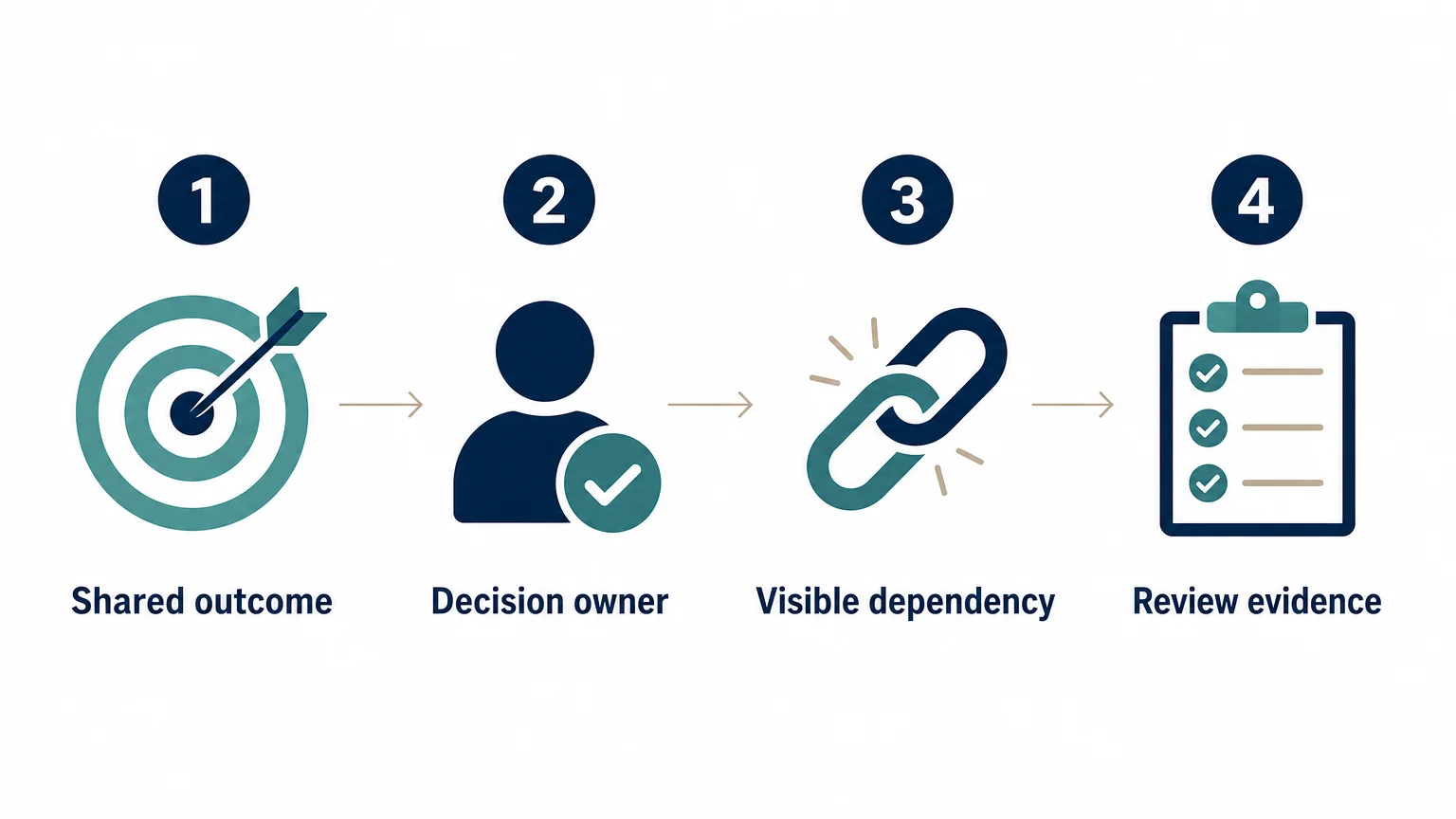
Alignment is maintained through a cadence, not achieved in a single kickoff meeting. The cadence should be light enough to preserve momentum and strong enough to expose risks before they become expensive.
A practical rhythm may include four recurring moments:
- Weekly progress review: examine movement against the shared outcome, not merely completed tasks.
- Dependency check: identify decisions, resources, or inputs that could block the next milestone.
- Evidence review: discuss what experiments, customer signals, or technical findings have changed.
- Retrospective: assess both project progress and the quality of cross-functional collaboration.
Meetings should have different purposes. A progress review is not a brainstorming session. An evidence review is not a status recital. A retrospective should not become a search for blame. When every meeting has the same format, participants may attend without making the decisions the project needs.
Short, frequent communication can improve visibility when it focuses on blockers and new information. A 2020 study of agile stage-gate management reported that teams used short daily cross-functional meetings to raise critical issues, improve transparency, and reduce surprises. The finding supports a simple principle: frequent alignment is useful when it changes action.
For distributed teams, document the essential information asynchronously. Each update should make clear what changed, what decision is needed, who is affected, and when a response is required. This reduces the pressure to schedule meetings merely to restore shared context.
Use escalation rules before conflict appears. For example, a dependency becomes an escalation when it threatens the next evidence milestone, requires a budget change, or creates a material customer or compliance risk. Clear rules help the team escalate early without treating every disagreement as a crisis.
How can visual strategy improve cross-functional alignment?
Visual thinking is especially useful when a project contains multiple perspectives, uncertain assumptions, and competing priorities. A well-structured visual can show the relationship between customer needs, strategic choices, experiments, dependencies, and measures of progress.
The objective is not to place every detail on one page. It is to create a shared view at the right level of abstraction. A project team may need one visual for the strategic logic, another for the experiment backlog, and another for decision ownership. Each view should answer a different question.
Useful visual formats include:
- Problem framing canvas: clarifies the customer problem, affected users, context, and evidence.
- Assumption map: separates facts, beliefs, risks, and questions requiring validation.
- Outcome roadmap: connects strategic intent with milestones, dependencies, and review points.
- Decision log: shows the choice, owner, evidence, date, and consequence.
- Experiment board: tracks hypotheses, tests, results, and next actions.
Visuals also support executive alignment. Leaders often need to understand the logic of a project before they review detailed execution. A clear narrative shows why the project matters, what has been learned, what remains uncertain, and which decision is required.
Keep the visual language consistent. Use action titles, concise messages, explicit evidence, and a clear distinction between current facts and future assumptions. When the presentation becomes crowded, move supporting detail into an appendix or working document.
The strongest visual framework does not replace discussion. It improves the quality of discussion by giving participants a common object to examine. That makes it easier to identify where the team agrees, where it differs, and what evidence would resolve the difference.
Conclusion: Make alignment a working system
Successful innovation depends on more than bringing different functions into the same project. It requires alignment as a working system, with shared outcomes, explicit decision rights, visible dependencies, productive disagreement, and a review cadence tied to evidence. This structure gives specialists enough clarity to coordinate and enough autonomy to learn.
Begin with one project and make its logic visible. Define the outcome, name the owners, document the dependencies, and establish when the team will review evidence. When alignment becomes part of how decisions are made, cross-functional collaboration can support innovation without adding unnecessary bureaucracy.
Take action with Deckadence
When an innovation project involves several functions, the quality of the strategic narrative affects how quickly stakeholders understand the opportunity and act on it. A clear visual structure can help your team connect evidence, priorities, dependencies, and decisions without reducing complex thinking to disconnected slides.
We publish premium slide decks, strategic-thinking templates, board-ready frameworks, narrative structures, and slide systems for consultants, executives, founders, and business leaders. Explore our innovation strategy resources to support clearer strategic communication, stronger stakeholder alignment, and more confident executive decisions.
Frequently Asked Questions
What is cross-functional alignment in an innovation project?
It is a shared understanding of the project outcome, priorities, constraints, responsibilities, and decision process across different functions. It allows people to contribute different expertise while working from the same strategic frame.
How do you align teams with conflicting priorities?
Define one shared outcome and connect each function's contribution to that outcome. When conflicts arise, compare the options against customer value, strategic importance, evidence, risk, and available resources.
What is the most important alignment document?
There is no single document for every project, but a concise project brief is a strong starting point. It should state the problem, target audience, desired outcome, assumptions, measures, decision owners, dependencies, and review milestones.
How often should a cross-functional innovation team meet?
The right cadence depends on project uncertainty and dependency levels. A weekly outcome review, frequent blocker checks, evidence reviews, and milestone retrospectives usually provide structure without creating unnecessary meetings.
Can visual strategy tools improve innovation team alignment?
Yes, visual tools can make assumptions, dependencies, priorities, and decisions easier to discuss. Our strategic-thinking templates and visual frameworks are designed to help teams turn complex ideas into clear, persuasive presentations.