A striking gap defines modern business. Roughly 84 percent of executives describe innovation as essential, yet only about 6 percent feel satisfied with their own results. This paradox explains why established corporations struggle to innovate despite deep pockets, talented teams, and decades of market knowledge. The obstacle is rarely a shortage of ideas. It is structural. Closing this gap often begins with disciplined tools, and our business model prototyping resources are designed for exactly that work.
The uncomfortable truth is that the very systems that make a company successful also make it resistant to reinvention. According to a McKinsey figure, the distance between ambition and satisfaction is vast. Efficiency, predictability, and shareholder pressure pull organizations toward doing what they already do slightly better, rather than inventing what comes next.
The core reason why large companies can't innovate
If you have ever wondered why large companies can't innovate even when they clearly see disruption coming, the answer lies in their design. A mature firm is engineered to execute a known and profitable model with discipline. It rewards operational efficiency, predictable earnings, and the satisfaction of existing customers. Those priorities are sensible, but they are the opposite of the messy, uncertain search that real innovation demands.
Success creates its own gravity. Once processes emerge to serve current customers, managers steer teams away from discovery and toward delivery. Understanding this distinction starts with a clear grasp of what is a business model, because executing one is a fundamentally different task from searching for a new one.
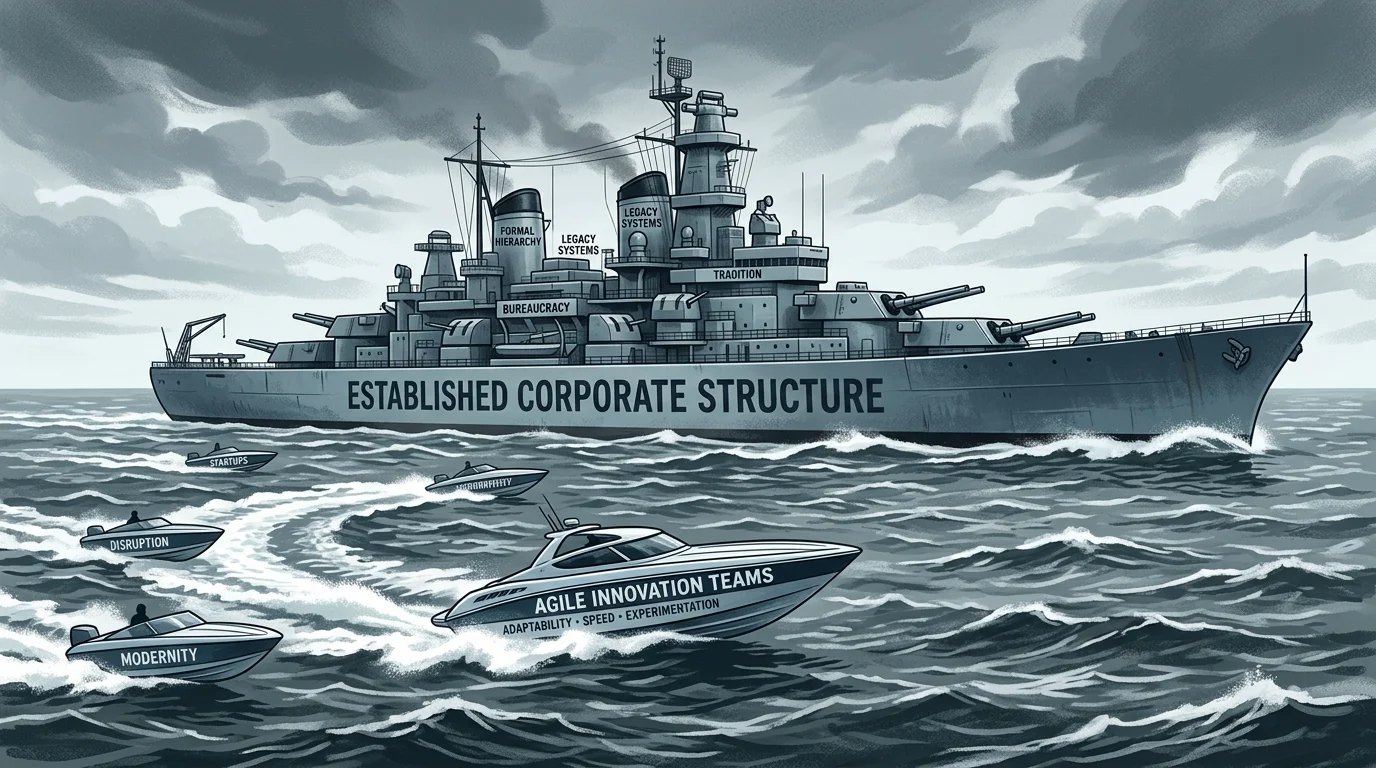
Execution engine versus innovation engine
Consider Kodak, Nokia, and Blockbuster. Each dominated its market, and each was trimmed to execute an established model until that model expired. The challenge is not choosing between execution and invention. It is running both at once. A strong execution engine extracts maximum value from a proven model, while an innovation engine tests new value propositions under uncertainty.
These two engines require different cultures, skills, processes, and incentives, which is precisely why blending them fails. When you force a discovery team through the same approval gates as an operations team, the discovery dies first. Framing this tension is easier when leaders explore approaches such as blue ocean strategy, which reframes competition around uncontested market space rather than incremental gains.
Risk aversion and the incentive problem
Business loves predictable growth, but innovation is inherently unpredictable. Discovering a viable new model is far more likely to fail than to succeed, so it needs a portfolio of small bets rather than one large one. Established firms tend to do the opposite. They demand that new ventures produce revenue on a reliable schedule, which paradoxically raises the odds of failure.
The scale of that risk is real. According to a corporate innovation analysis, up to 95 percent of new products fail. Rather than treating this as a reason to avoid experimentation, leading organizations treat it as a reason to experiment often and cheaply, so that failures stay small and learning compounds.
Culture, bureaucracy, and the experimentation gap
Even when large firms detect the right signals, they frequently cannot act on them. Cultural resistance ranks among the largest obstacles to innovation, and bureaucracy is repeatedly named as a primary killer of good ideas. When previous attempts have failed, skepticism hardens, and promising proposals are stopped before they ever begin.
The antidote is frequent, low-cost experimentation. Companies that innovate consistently run hundreds or even thousands of experiments per year, which reduces the consequences of any single failure. To defend an idea in a risk-averse room, teams need data-backed hypotheses and a clear plan. Structuring that journey is where a practical business roadmap template helps translate ambition into sequenced, testable steps.

The wrong people in the wrong roles
Who leads a new venture matters as much as its budget. The people best suited to search for new business models are rarely the managers who excel at running existing units. Internal entrepreneurs tend to question authority, dislike rigid rules, and tolerate failure well. Yet large companies often assign high-potential managers who are skilled at execution and easier to supervise.
This mismatch is subtle but decisive. You can fund a promising initiative generously and still starve it by staffing it with people trained to optimize rather than explore. Matching temperament to task is a quiet lever that many organizations overlook.
How large organizations can break the pattern
The most durable fix is structural separation. Fund small, agile teams to test new opportunities without disrupting the core, an approach some leaders describe as running "speedboats" alongside the "battleship." As one 2026 field service analysis notes, large incumbents hold advantages that startups cannot match, including revenue, partnerships, and scale, and the goal is to exploit those advantages rather than imitate a startup wholesale.
Protect these teams with distinct metrics, distinct incentives, and executive air cover. The threat is genuine: businesses that cannot compete effectively lose ground quickly, and business failure research attributes roughly 20 percent of company failures to an inability to compete against better-resourced or faster-moving rivals. A dual operating system, where execution and innovation run in concert, gives incumbents a fighting chance.
Turning structural limits into an advantage
Understanding why large companies fail to innovate reframes the problem entirely. The barrier is not vision or talent; it is a system built for efficiency being asked to do the work of discovery. Acknowledge that limit, then build a parallel engine with its own goals, its own people, and its own tolerance for failure. Start small, experiment often, and protect your speedboats from the gravity of the core. Innovation follows structure, not slogans.
Take action with Deckadence
Recognizing the structural barriers to innovation is the first step. Communicating a credible plan to skeptical boards and stakeholders is the next, and that is often where strong ideas stall. When you must defend a new venture under uncertainty, the clarity of your argument decides whether it advances or dies in the room.
We provide consulting-grade slide systems and strategy frameworks with board-ready design, combining proven methods, structured storytelling, and premium visuals for PowerPoint, Keynote, and Figma. If you are preparing to align stakeholders and accelerate decisions, explore our board-level strategy decks and framework library to turn complex ideas into persuasive, decision-ready presentations.
Frequently Asked Questions
Is it true that large companies cannot innovate at all?
No, the claim is a simplification. Large firms are structurally optimized for execution, which makes disruptive innovation harder, not impossible. Companies that build a separate innovation engine with different metrics and people can and do innovate successfully.
What is the single biggest barrier to corporate innovation?
The dominant barrier is that mature organizations are designed to execute a known business model efficiently. This creates risk aversion, bureaucratic gates, and incentives that reward incremental gains. These forces quietly suppress the uncertain search that real innovation requires.
Why do so many innovation projects fail inside big firms?
Many projects fail because they are held to the predictable revenue standards of the core business. Innovation is uncertain by nature, so it needs a portfolio of small, cheap experiments instead of a few large bets. Applying execution metrics to discovery work almost guarantees disappointment.
How can leaders make experimentation part of the culture?
Leaders should reduce the cost and stigma of failure so teams can test ideas frequently. Requiring data-backed hypotheses helps proposals get judged on merit rather than gut aversion. Protecting time, budget, and psychological safety turns experimentation into a repeatable habit.
How can presentations help secure support for innovation?
Clear, structured presentations help new ideas survive skeptical decision-makers. Framing a proposal with recognized strategy frameworks and a compelling narrative makes risks and opportunities easier to assess. Our board-level slide systems and framework library are built to support exactly this kind of persuasive, structured communication.