How to Build a Business Roadmap Template That Drives Results
Most strategies do not fail because the ideas are weak. They fail because execution drifts. Research suggests that our business strategy roadmap frameworks address a stubborn gap: teams often lose sight of how daily work connects to long-term direction. A single, shared visual can close that gap faster than another lengthy document.
This is precisely where a business roadmap template earns its place. According to a ClearPoint analysis, a large share of executives report that their planning processes fail to track the execution of strategic initiatives. A clear roadmap turns abstract objectives into a sequence of milestones that everyone can see, question, and act on.
What a business roadmap template is
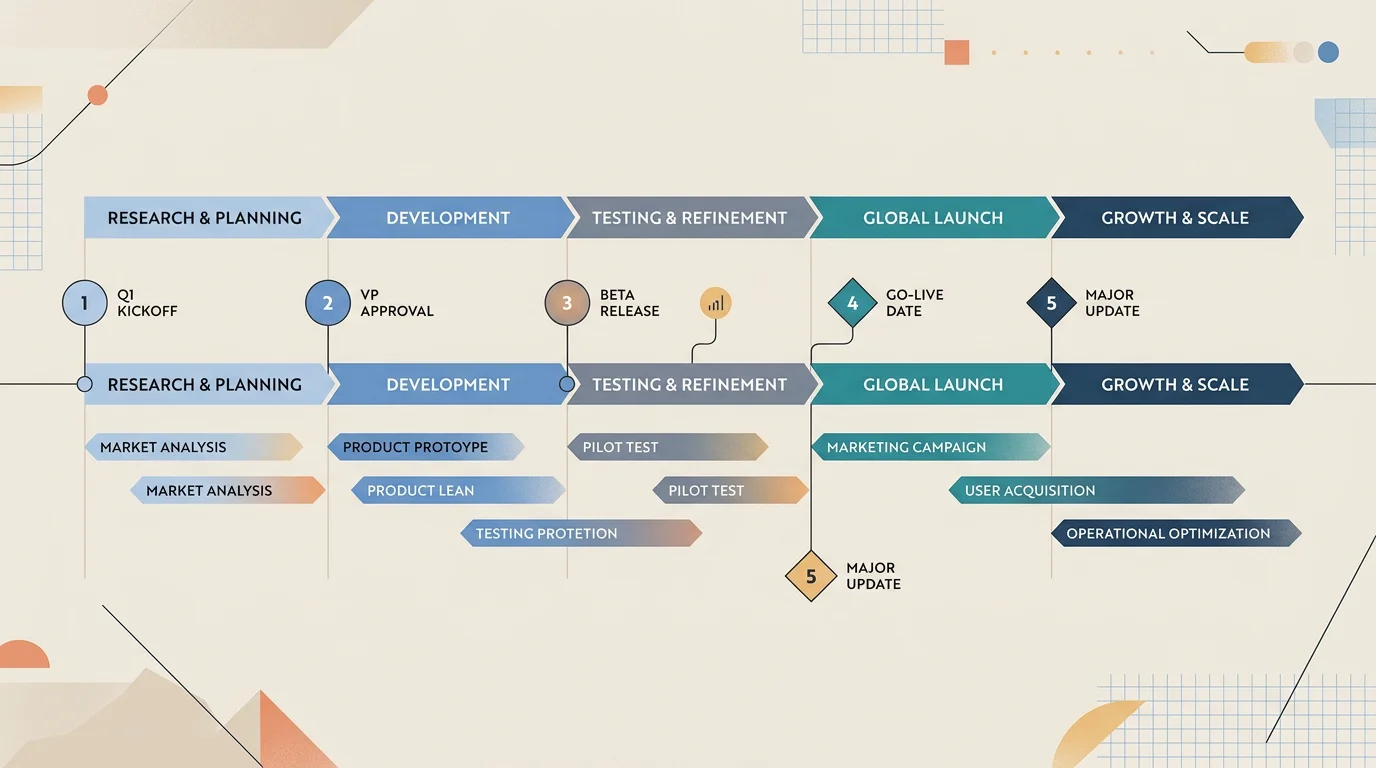
A roadmap template is a reusable framework that plots your strategic priorities across a timeline or a set of phases. It shows where the organization is going, the key initiatives that will get it there, and the milestones that mark progress along the way.
Unlike a detailed project plan, a roadmap stays deliberately high-level. It communicates direction and intent rather than every task, owner, or dependency. This distinction matters: a project plan guides daily execution, while a strategic roadmap gives leaders and stakeholders a clear view of overall direction and progress.
Think of it as the bridge between vision and action. The template provides the structure; your priorities and dates supply the content.
Why a structured roadmap matters
Consider the cost of misalignment. When departments work from different assumptions, priorities get lost in translation and resources are wasted. A roadmap creates a shared language for what matters and when.
The evidence favors disciplined planning. According to a 2025 AchieveIt report, 82% of organizations that evaluate their strategic plans annually see improved goal achievement, and 73% that consistently refine their execution processes report higher success rates. A roadmap is the artifact that makes those reviews possible, because it gives everyone a fixed reference point to measure against.
The upside is measurable, too. Findings from Planview's 2025 benchmark, drawn from more than 800 executives, indicate that strategy execution leaders exceeded their revenue goals by 12.1%, while laggards fell short. Systematic adaptability, supported by clear plans, separates the two groups.
Core components of an effective roadmap
Every strong roadmap shares a common backbone. Include these elements regardless of the format you choose:
- Strategic objectives: the outcomes the roadmap exists to deliver.
- Timeline or phases: quarters, months, or "now, next, later" horizons.
- Key initiatives: the major workstreams grouped into lanes or swimlanes.
- Milestones: the dates and decision points that mark real progress.
- Status indicators: color-coded signals showing what is on track, at risk, or complete.
- Ownership: the team or leader accountable for each stream.
When you assemble these into a single view, the roadmap becomes a decision tool rather than a static picture. If you are preparing board-level material, our business planning template guide shows how to structure the same information for an executive audience.
Common types of business roadmaps
No single format fits every purpose. The right template depends on your audience and time horizon. The comparison below summarizes the most common options and how our approach fits alongside them.
| Roadmap type | Best for | Time horizon | Board-ready design |
|---|---|---|---|
| Deckadence strategy roadmap | Executive and board presentations | Quarterly to multi-year | Yes, built for decision-makers |
| Project roadmap | Tracking milestones and phases | 6 months to 1 year | Varies |
| Product roadmap | Release planning and features | Quarterly | Varies |
| Portfolio roadmap | Multiple initiatives at once | Quarterly to annual | Varies |
| Multi-year strategic roadmap | Long-term direction | 2 to 3 years | Varies |
Choosing a type is less about labels and more about the question your audience needs answered. Executives want direction and trade-offs; delivery teams want sequencing and dependencies.

How to build your roadmap step by step
Start with the destination, not the timeline. A roadmap works only when the underlying strategy is clear.
- Define your objectives. Name the two or three outcomes the roadmap must deliver.
- Choose the horizon. Match the timeframe to the audience, from a single quarter to three years.
- Group initiatives into lanes. Cluster related work so the structure reads at a glance.
- Set milestones. Mark the dates and decision points that signal real movement.
- Add status and ownership. Assign accountability and a simple color key.
- Review and refine. Revisit the roadmap on a fixed cadence to keep it honest.
The final step matters most. A roadmap is a living document, and regular reviews are what convert a plan into results.
Mistakes to avoid
The most common error is overloading the roadmap with task-level detail. When a roadmap tries to double as a project plan, it becomes unreadable and stakeholders disengage.
A second pitfall is neglect. A roadmap built once and never revisited quickly loses credibility. This is not a small market concern: the strategic planning and execution software category was estimated at roughly $15 billion in 2025, according to one market analysis, reflecting how much organizations now invest in keeping plans current. A third mistake is designing for yourself rather than your audience. If the roadmap does not answer the questions your stakeholders actually ask, it will not move decisions.
Turning your roadmap into momentum
A well-built business roadmap is not a formality; it is the mechanism that keeps strategy visible and execution honest. Start with clear objectives, keep the view high-level, assign real ownership, and review on a fixed cadence. The template gives you structure, but the discipline of revisiting it is what produces results. Build it for your audience, and it will earn its place in every strategic conversation.
Take action with Deckadence
You now understand what separates a roadmap that gathers dust from one that drives decisions. The next challenge is presentation: translating your plan into visuals that command attention in the boardroom and align stakeholders around a single direction. That is where preparation meets persuasion.
We provide consulting-grade slide systems, strategy frameworks, and board-level templates for PowerPoint, Keynote, and Figma. Combining proven methods such as SWOT, PESTEL, and the Business Model Canvas with refined design, our board-ready strategy slide decks help you turn complex plans into clear, persuasive presentations that accelerate decisions.
Frequently Asked Questions
What is the difference between a roadmap and a project plan?
A roadmap shows the big picture of goals, initiatives, and milestones at a high level. A project plan manages the details, such as tasks, schedules, and budgets. The plan guides daily work, while the roadmap communicates overall direction.
How far ahead should a business roadmap look?
It depends on your audience and purpose. Operational roadmaps often cover six months to a year, while strategic roadmaps can span two to three years. Match the horizon to the decisions your stakeholders need to make.
Which format works best for executive presentations?
Executives respond well to concise, one-page or single-view roadmaps that emphasize direction and trade-offs. Board-ready visuals with clear color coding reduce cognitive load. Our strategy frameworks and slide systems are designed specifically for this level of audience.
How often should I update my roadmap?
Review your roadmap on a fixed cadence, typically monthly or quarterly. Organizations that evaluate their plans regularly see stronger goal achievement. Treat the roadmap as a living document rather than a one-time exercise.
Do I need special software to build a roadmap?
No, you can build effective roadmaps in familiar tools such as PowerPoint, Keynote, or Figma. What matters most is a clear structure and disciplined maintenance. A strong template removes most of the design effort so you can focus on content.