Business Model Design for Mission-Driven Organizations
What happens when an organization creates meaningful impact but cannot sustain delivery? Strong business model design for mission-driven organizations connects the promise of change to the people served, the stakeholders who enable delivery, and the resources that keep the work alive. When you need to turn assumptions into a visible, testable structure, our business model prototyping guidance can help you make the logic easier to examine.
Mission-driven organizations are not defined by revenue alone. They may combine grants, donations, contracts, earned income, public funding, volunteers, partnerships, and reserves. Their model must therefore answer two linked questions: how will the organization create meaningful impact, and how will it remain capable of delivering that impact over time?
What business model design means in a mission-driven context
A business model describes how an organization creates, delivers, and sustains value. For a mission-driven organization, value has at least two dimensions. The first is the benefit experienced by communities, beneficiaries, customers, or ecosystems. The second is the financial and operational structure that makes the benefit possible.
This creates an important distinction between a mission statement and a working model. A mission statement explains why the organization exists. A business model explains how that purpose becomes a repeatable system of activities, relationships, resources, funding, and outcomes.
A practical model should make the following logic visible:
- Mission achievement: What change must occur for the organization to consider its mission fulfilled?
- Beneficiaries: Who experiences the intended benefit, directly or indirectly?
- Stakeholders: Who funds, authorizes, influences, delivers, or depends on the work?
- Value proposition: What meaningful problem does the organization address?
- Funding logic: Where do the resources come from, and what conditions affect their reliability?
- Operating logic: Which activities, capabilities, partners, and systems deliver the work?
- Evidence: How will the organization know whether its activities produce useful outcomes?
The model becomes useful when these elements reinforce one another. If a program creates substantial value but requires funding that cannot support its true cost, the model is incomplete. If a funding opportunity encourages activities outside the mission, the model may be financially active but strategically weak.
Start with mission achievement, not revenue
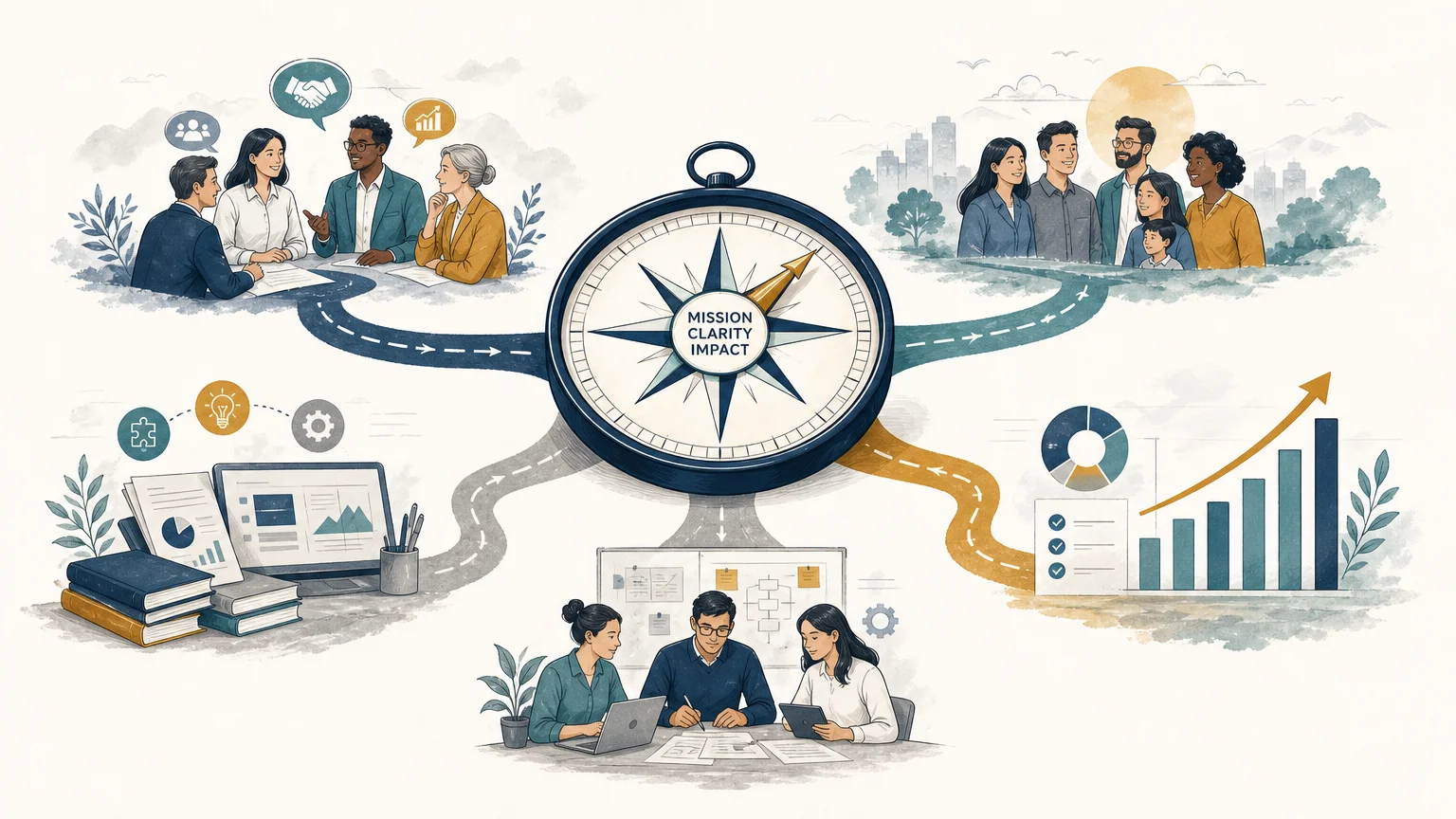
In a conventional business model, revenue often provides the clearest measure of viability. In a mission model, revenue remains important, but it is not the final outcome. The central question is whether the organization creates the intended public, social, cultural, or environmental value.
The Mission Model Canvas adapts the familiar Business Model Canvas for organizations whose primary measure of success is mission achievement. It changes several categories so that the model reflects the realities of public agencies, nonprofits, defense organizations, social enterprises, and other mission-focused entities.
- Revenue Streams become Mission Achievement: Define the impact that represents success, then identify credible indicators for it.
- Customer Segments become Beneficiaries: Map the people and groups who receive value, including indirect beneficiaries.
- Cost Structure becomes Mission Cost or Budget: Understand the resources required to deliver the mission, not only the expenses attached to individual activities.
- Channels become Deployment: Explain how the solution reaches the people, places, systems, or communities that need it.
- Customer Relationships become Buy-in and Support: Identify the stakeholders whose support is required for adoption, funding, implementation, and continuity.
This adaptation matters because the payer, user, beneficiary, decision-maker, and delivery partner may all be different parties. A public health program, for example, may serve patients, receive public funding, depend on clinical partners, require regulatory approval, and rely on community organizations for adoption.
A 2026 accounting study found that nonprofit mission metrics contain value-relevant information for donors and directors, particularly when those measures show improvement or decline. The finding supports a practical principle: impact measurement is not only a reporting exercise. It can influence resource allocation, governance, and confidence in the model. Read the findings in 2026 nonprofit research.
Map beneficiaries, stakeholders, and value exchange
Who benefits from the work, and who must support it? These questions should be answered separately because they often produce different groups.
Beneficiaries experience the intended change. They may be service users, households, patients, students, workers, residents, customers, or future generations. Stakeholders influence the organization’s ability to create that change. They may include funders, regulators, volunteers, employees, partner organizations, suppliers, board members, referral sources, community leaders, or public institutions.
Mapping these groups prevents a common design error: treating one audience as if it represents the entire system. A donor may value measurable outcomes and responsible stewardship. A beneficiary may value accessibility, dignity, safety, or convenience. A government partner may value compliance and population-level results. Each perspective affects the model differently.
For each important group, document four points:
- What problem or need does this group experience?
- What value does the organization promise to create?
- What behavior, resource, permission, or support does the organization need from the group?
- What evidence would show that the relationship is working?
This approach also improves the value proposition. Instead of describing activities, describe the meaningful change those activities are intended to produce. “We run workshops” describes an activity. “We help first-generation students navigate postsecondary enrollment” describes a more useful value proposition because it identifies the audience, the problem, and the intended result.
Stakeholder alignment also needs operational clarity. McKinsey’s 2025 operating-model research, based on a survey of 757 senior executives conducted in 2024, describes clarity, speed, skills, and commitment as important organizational outcomes. Its relevance to mission-driven design is direct: a compelling purpose still needs an operating system that helps people make decisions and deliver consistently. See the McKinsey operating model research for the broader framework.
Choose the right canvas for the decision
No single canvas answers every strategic question. The right choice depends on whether you are mapping an established organization, testing a new initiative, clarifying a social enterprise, or diagnosing a funding and delivery system.
The Mission Model Canvas is appropriate when mission achievement, beneficiaries, deployment, buy-in, and mission budgets are central to the discussion. It is particularly useful when the organization operates through multiple stakeholder layers and cannot treat revenue as the primary measure of success.
A standard Business Model Canvas remains useful when the organization has a clear commercial exchange. It can help a mission-driven business explain its customer segments, value proposition, channels, activities, resources, partners, costs, and revenue. Our Business Model Canvas template can support an initial mapping exercise when your team needs a structured one-page view.
A Lean Canvas is more focused on uncertainty and early validation. It is useful for a pilot, a new service, or a social venture that still needs to test its problem, solution, channels, customer groups, and key risks. It does not replace a mission model when the organization must map complex beneficiary and stakeholder relationships.
A Nonprofit Business Model Canvas usually adapts standard categories around funders, beneficiaries, programs, impact, infrastructure, and sustainability. It can be useful for board discussions and program planning, especially when the organization needs to connect financial structure with mission delivery.
A Social Business Model Canvas focuses on the relationship between community need, social value, sustainable revenue, stakeholders, costs, reach, and impact. It can help social enterprises examine the tension between mission and income without treating either dimension as optional.
Use the framework that matches the decision in front of you:
- Use the Mission Model Canvas to clarify mission achievement and stakeholder adoption.
- Use the Business Model Canvas to explain a commercial or hybrid value exchange.
- Use the Lean Canvas to test a new idea under conditions of uncertainty.
- Use a nonprofit or social business canvas to examine program sustainability and community value.
These frameworks are not mutually exclusive. A team may use a Mission Model Canvas for the organization, a Value Proposition Canvas for each beneficiary group, and a Lean Canvas for an experimental program.
Design funding and operations together
A funding plan cannot be separated from the operating model. Every funding source creates requirements, relationships, reporting obligations, and capacity needs. Government contracts, foundation grants, individual donations, membership income, service fees, sponsorships, and earned revenue do not operate in the same way.
For each funding stream, ask:
- What value does the funder or payer receive?
- What activities and outcomes does the funding support?
- How predictable is the funding cycle?
- What infrastructure is required to obtain and manage it?
- Which costs remain uncovered?
- Could the funding create mission drift or reduce access for beneficiaries?
Revenue diversification is not automatically a strength. Each new revenue stream may require new systems, expertise, relationships, compliance processes, and management attention. A smaller number of well-supported funding mechanisms can be more sustainable than a fragmented portfolio that the organization cannot administer effectively.
Program cost also needs careful treatment. Direct delivery costs are only part of the picture. Technology, occupancy, leadership, finance, human resources, communications, evaluation, safeguarding, and administration may all contribute to program delivery. If these costs are ignored, the organization may underprice services, accept underfunded contracts, or expand programs that consume more capacity than expected.
Capital structure matters as well. Restricted funds, buildings, long-term obligations, reserves, and unrestricted working capital affect the organization’s ability to invest in new capabilities. A model that appears profitable or well-funded on paper may still be vulnerable if cash is restricted or liabilities reduce flexibility.
Benevity’s 2026 research illustrates why this design work is becoming more demanding. In the report, 42% of nonprofits said requests for custom impact metrics had increased, while 44% reported more custom storytelling requests. These figures show why organizations should build measurement and communication capacity into the model rather than treating them as occasional administrative tasks. Review Benevity's 2026 report for the wider context.
To compare alternative funding and operating configurations, our business model portfolio resource can help you examine multiple models together instead of evaluating each initiative in isolation.
Test assumptions before scaling impact
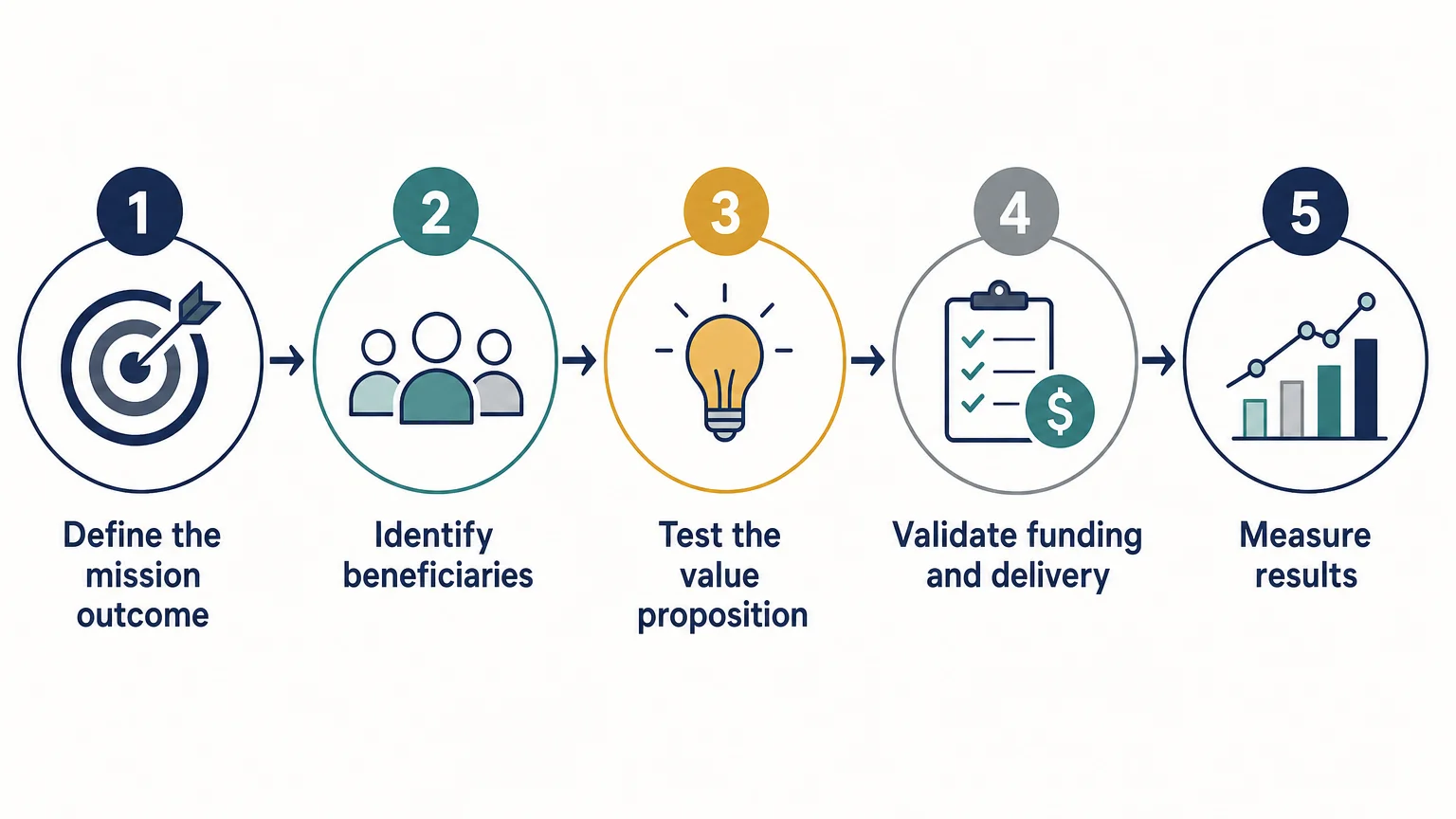
Scaling should follow learning, not enthusiasm. Before expanding a program, test the assumptions that could make the model fail.
Begin with the problem. Confirm that the need is significant, clearly understood, and not already addressed more effectively by an existing organization. Community consultation, user interviews, referral data, service records, and small pilots can reveal whether the proposed solution matches the reality experienced by beneficiaries.
Next, test the value proposition. Beneficiaries may say that a service is useful, but that does not prove they can access it, use it consistently, or achieve the intended outcome. Funders may support the mission but lack the budget or time horizon required for the model. Partners may express interest but lack the operational capacity to participate.
Then test delivery. A pilot should reveal which people, capabilities, systems, partnerships, and processes are required. It should also show where handoffs fail, where demand exceeds capacity, and where the organization depends on informal effort that cannot be sustained.
A useful testing cycle includes:
- Frame the assumption: State what must be true for the model to work.
- Choose an observable signal: Define what behavior or result would support the assumption.
- Run a small test: Use a pilot, interview, prototype, or limited deployment.
- Capture evidence: Record what happened, for whom, and under which conditions.
- Decide: Continue, adapt, pause, or stop the activity.
Testing is especially important when the model combines earned income and mission delivery. A commercial activity may generate revenue but distract staff, weaken access, or create reputational risks. Conversely, a subsidized program may produce strong impact but require a funding structure that cannot support expansion.
Measure impact without losing the human outcome
What should you measure? The answer is not every available activity count. Measurement should help the organization make better decisions and explain whether its model is producing meaningful change.
Start with a simple chain:
- Inputs: Funding, people, time, assets, expertise, and partnerships.
- Activities: The work performed with those inputs.
- Outputs: The immediate products or services delivered.
- Outcomes: The changes experienced by beneficiaries.
- Mission achievement: The broader contribution to the organization’s purpose.
Outputs are often easier to measure than outcomes. Counting workshops, meals, consultations, applications, or participants can show reach. It does not necessarily show whether people became safer, healthier, more financially secure, better educated, or more able to influence their circumstances.
Use a balanced set of indicators. Include measures of reach, quality, equity, beneficiary experience, short-term change, long-term change, cost, and organizational capacity. Avoid choosing indicators only because they are easy to collect.
In 2026, Cambridge research argued that sustainability assessment and reporting can help nonprofit organizations account for their environmental, cultural, economic, and social impacts. It also presented sustainability reporting as a practical way to integrate accountability into mission and organizational models, rather than treating it as a separate exercise. The Cambridge research provides useful context for this approach.
Measurement should also respect the people represented by the data. A numerical improvement may hide unequal access, unintended harm, or a decline in trust. Include qualitative feedback and disaggregated results where appropriate, especially when the organization serves communities with different needs or experiences.
Turn the model into a decision tool
A canvas is valuable because it creates a shared view, not because it produces a final answer. The next step is to use it in real decisions.
Boards can use the model to evaluate whether growth supports the mission. Leadership teams can use it to compare programs, funding options, and operational priorities. Staff can use it to understand how their work contributes to outcomes. Funders and partners can use it to identify assumptions that require clarification.
To make the model decision-ready, connect each major block to a question:
- Does this activity serve a clearly defined beneficiary need?
- Does the funding support the true cost of delivery?
- Does the operating structure protect quality as demand grows?
- Does each critical stakeholder understand its role?
- Can the organization measure progress without creating excessive reporting burden?
- What would cause the model to change?
Keep the first version concise. A one-page model encourages prioritization and exposes contradictions quickly. Supporting detail can then sit behind the canvas in budgets, program plans, evidence files, risk registers, and implementation roadmaps.
Our Business Model Canvas resource can help you present the logic clearly when the model must support stakeholder alignment, strategic discussion, or executive decision-making. The objective is not to make the organization appear more sophisticated. It is to make the choices, dependencies, and trade-offs easier to understand.
Build for impact and staying power
Effective business model design for mission-driven organizations connects purpose with practical capacity. Start with mission achievement, map beneficiaries and stakeholders separately, understand the full cost of delivery, test assumptions before scaling, and measure outcomes that matter to the people you serve. A strong model does not treat financial sustainability as a distraction from impact. It treats sustainability as one of the conditions that allows impact to continue.
Make Your Mission Model Decision-Ready
Mission-driven strategies often fail to gain support because their logic remains difficult to see. Clear frameworks, structured storytelling, and well-organized visual thinking can help your team explain how impact, resources, stakeholders, and delivery fit together.
We bring together strategy education, framework references, presentation-ready systems, and visual strategic-thinking assets for leaders who need to clarify complex choices. Explore our strategy resources to support clearer analysis, stronger stakeholder communication, and more confident decisions.
Frequently Asked Questions
What is business model design for a mission-driven organization?
It is the process of defining how an organization creates impact, delivers value, secures resources, and sustains its operations. Unlike a purely commercial model, it treats mission achievement and beneficiary outcomes as central measures of success.
What replaces revenue in a Mission Model Canvas?
Mission achievement replaces revenue as the primary measure of value created. Funding and budget logic still matter, but they support the broader question of whether the organization is producing meaningful outcomes for its beneficiaries.
Should a nonprofit diversify its revenue streams?
Diversification can reduce dependence on one funder, but every new revenue stream creates management, infrastructure, and relationship requirements. The right mix depends on mission fit, true operating capacity, funding reliability, and the cost of managing each source.
How can a mission-driven organization measure impact?
Begin with a clear outcome chain from inputs and activities to outputs, outcomes, and mission achievement. Combine quantitative indicators with beneficiary feedback, equity considerations, quality measures, and evidence about unintended effects.
How can Deckadence support this work?
Our strategy guide, visual strategic-thinking assets, and presentation-ready frameworks can help you organize complex business model logic and communicate it clearly. They are designed to support strategic analysis, stakeholder alignment, and executive or board-level communication.