How many growth bets can your organization fund before complexity becomes a liability? A business model portfolio gives you a way to view existing revenue engines and emerging models together, rather than treating every initiative as an isolated project. Before mapping the portfolio, clarify the logic behind each model with our business model prototyping resources.
The concept matters because organizations rarely depend on one business model indefinitely. A 2026 review of business model diversification identifies the business model portfolio as a recurring theme in research on growth, interrelated models, and organizational tensions. The practical question is not whether to diversify, but how to manage the relationships, risks, and resource demands across the portfolio.
What is a business model portfolio?
A business model portfolio is the coordinated collection of business models that an organization operates, develops, tests, or considers for future growth. Each model describes a distinct way to serve customers and capture value. One model may rely on product sales, another on recurring services, and a third on partnerships, licensing, subscriptions, or a platform approach.
The portfolio perspective adds an important layer above the individual model. It asks how the models interact, where they share capabilities, which ones compete for resources, and whether the overall mix supports the organization’s strategic direction. A profitable model can fund experimentation, while a newer model may protect the organization from future disruption.
This is different from a group of unrelated projects. A portfolio should have an explicit logic. It may combine models that serve the same customers, use shared infrastructure, extend an existing capability, or create options in a new market. Without that logic, diversification can produce unnecessary complexity instead of resilience.
If the underlying model is unclear, portfolio analysis becomes unreliable. Our guide to what is a business model helps establish the basic structure before you compare multiple models at the portfolio level.
Do not confuse business and investment portfolios
The phrase “model portfolio” is also used in financial services. In that context, it usually means an investment blueprint that advisers can follow for clients. For example, Morningstar research reported $943 billion in third-party model portfolio assets as of March 2026.
A business model portfolio concerns how an organization creates and captures value. An investment model portfolio concerns how capital is allocated across financial assets. The two may use similar language about balance and risk, but they answer different strategic questions.
Why manage multiple business models together?
Imagine a company with a strong core product, a developing service offer, and several untested digital concepts. If each initiative is reviewed separately, leadership may miss the relationship between them. The service could increase the value of the core product, while the digital concepts might prepare the organization for a change in customer behavior.
A portfolio view helps you make five decisions more deliberately:
- Protect the core: improve the models that currently generate reliable revenue and customer value.
- Fund growth: identify emerging models with credible potential and a path toward scale.
- Manage exposure: reveal dependence on vulnerable markets, technologies, channels, or customer groups.
- Share capabilities: determine which models can use common data, talent, infrastructure, or distribution.
- Release resources: stop or redesign initiatives that no longer justify their investment.
The benefit is not simply a larger number of revenue streams. It is better coordination between today’s performance and tomorrow’s options. A portfolio can improve resilience when its models are sufficiently diverse, but it can also reduce performance when leadership adds models without clear ownership, governance, or strategic fit.
A 2026 study of business model portfolio expansion in a manufacturing setting examined how an incumbent added a new digital model through structural separation. The study highlights a practical issue: a new model may require different processes, incentives, capabilities, and decision criteria from the established business.
That does not mean every emerging model must operate independently. It means you should decide deliberately which elements to share and which to protect. Shared infrastructure can create efficiency, while separate teams or governance can protect an experimental model from the priorities of the core business.
How the Execution Engine and Innovation Engine work

One practical way to understand a business model portfolio is to separate the work of improving existing businesses from the work of discovering new ones. The Portfolio Map approach commonly describes these as the Execution Engine and the Innovation Engine.
The Execution Engine, exploit and improve
The Execution Engine contains established business models. These models have customers, operating processes, and a measurable contribution to revenue or profit. Their immediate priorities are usually execution, improvement, efficiency, customer retention, and protection from disruption.
Two questions are particularly useful. First, how profitable is the model today? Second, how sustainable is it against technological, market, competitive, or regulatory change? A model with strong returns but high disruption risk deserves attention. It may need renovation, repositioning, or a new supporting capability before its performance declines.
The objective is not to preserve every existing model indefinitely. It is to understand which models should receive continued investment, which should be improved, and which should gradually release resources to other parts of the portfolio.
The Innovation Engine, explore and invent
The Innovation Engine contains new business models, growth initiatives, and experiments. Most have limited evidence at the beginning. Their expected return may be attractive, but their desirability, feasibility, viability, or scalability remains uncertain.
Early-stage initiatives should therefore be evaluated differently from mature businesses. Revenue and margin are often inappropriate first measures. Instead, you may examine customer evidence, validated assumptions, prototype performance, willingness to pay, technical feasibility, and the cost of learning.
The goal is to move promising initiatives from speculation toward evidence. Some will be stopped. Others may be redesigned, transferred into the established business, or developed as separate ventures. A healthy innovation pipeline expects learning and does not treat every stopped experiment as a management failure.
Our Business Model Canvas guide can support this work by giving teams a shared visual structure for comparing customer segments, value propositions, channels, capabilities, partners, costs, and revenue logic across models.
Which criteria should you use to assess the portfolio?
A portfolio map is only useful when its criteria support real decisions. The exact dimensions can vary by industry, but most assessments should include the following categories.
1. Current contribution
Measure how each established model contributes to revenue, profit, cash flow, customer retention, strategic access, or important capabilities. Financial contribution matters, but it should not be the only measure. A model with moderate profit may provide data, distribution, relationships, or infrastructure that strengthens several other models.
2. Future potential
Assess the size and quality of the opportunity. Consider customer demand, market attractiveness, pricing power, scalability, competitive intensity, and the organization’s right to win. Future potential should remain a hypothesis until supported by evidence.
3. Disruption risk
Examine how exposed each model is to changes in technology, regulation, customer behavior, supply chains, or competitor economics. A mature model can still be strategically fragile if its customer need is shifting or its cost structure is becoming unattractive.
4. Innovation risk
For emerging models, assess how much uncertainty remains. A concept supported only by internal enthusiasm has higher innovation risk than one tested with customers, validated through a prototype, and supported by evidence of willingness to pay.
5. Strategic fit
Ask whether the model advances the organization’s chosen direction. It may be attractive in isolation but still distract from the capabilities, markets, or customer problems that matter most. Strategic fit helps prevent a portfolio from becoming a collection of disconnected opportunities.
6. Resource requirements
Estimate the people, capital, time, technology, partnerships, and leadership attention required to operate or develop each model. A portfolio may appear balanced by project count while remaining heavily concentrated by investment or talent.
These criteria create a common language for leadership discussions. They also make trade-offs more visible. For example, a high-potential initiative may not deserve immediate scale if its evidence is weak, while a lower-growth model may merit protection because it funds the organization’s future options.
How do you build a business model portfolio map?
Start with an honest inventory. Include established business units, service lines, digital offers, experiments, partnerships, acquisitions under consideration, and informal initiatives that may not appear in official planning documents.
- Describe each model: summarize its customer, offer, delivery system, revenue logic, cost structure, and key capabilities.
- Separate operating and emerging models: distinguish models with current market evidence from models that are still being tested.
- Choose assessment dimensions: use return, potential, disruption risk, innovation risk, strategic fit, and resource demand.
- Plot the portfolio: use a simple visual map that leaders can understand quickly and challenge constructively.
- Identify imbalances: look for overdependence on one model, too little future exploration, duplicated initiatives, or excessive complexity.
- Define portfolio actions: decide which models to improve, scale, separate, combine, pause, acquire, or exit.
- Review regularly: update the map when evidence, market conditions, or strategic priorities change.
Keep the map simple enough to support a decision. If every model requires a dense dashboard, the framework may be obscuring rather than clarifying the strategic choices. Use supporting analysis behind the map, but preserve a single visual view for leadership discussions.
Our business framework model resources can help you turn complex strategic criteria into a more structured, presentation-ready decision framework. The value is not visual polish alone. A clear structure helps stakeholders understand why a model is receiving investment, protection, or scrutiny.
What are the main risks of portfolio management?
The first risk is strategic dilution. Organizations sometimes add business models because they appear attractive, without deciding how they fit the existing strategy. Over time, leaders must manage more customers, systems, processes, metrics, and priorities without a corresponding increase in value.
The second risk is internal conflict. A new model may compete with the established business for customers, talent, channels, or capital. The core business may also have incentives to protect its current revenue, even when the emerging model could become strategically important.
The third risk is false balance. A portfolio can contain several initiatives while remaining heavily concentrated in one market, capability, technology, or customer segment. Count the investment and exposure, not only the number of models.
The fourth risk is premature scaling. An emerging model may look promising but still lack evidence about demand, economics, operational feasibility, or repeatability. Scaling too early increases the cost of failure and can make it harder to change the model.
The fifth risk is delayed exit. Leaders may continue funding a weak model because of sunk costs, internal politics, or fear of admitting that an assumption was wrong. Clear review gates and pre-agreed decision criteria can reduce this bias.
A 2026 field study on adding a digital business model to an established B2B firm reinforces the importance of structure when new and established models coexist. Separation can protect the emerging model, but coordination remains necessary for capabilities, governance, and strategic alignment.
How should leaders allocate resources across the portfolio?
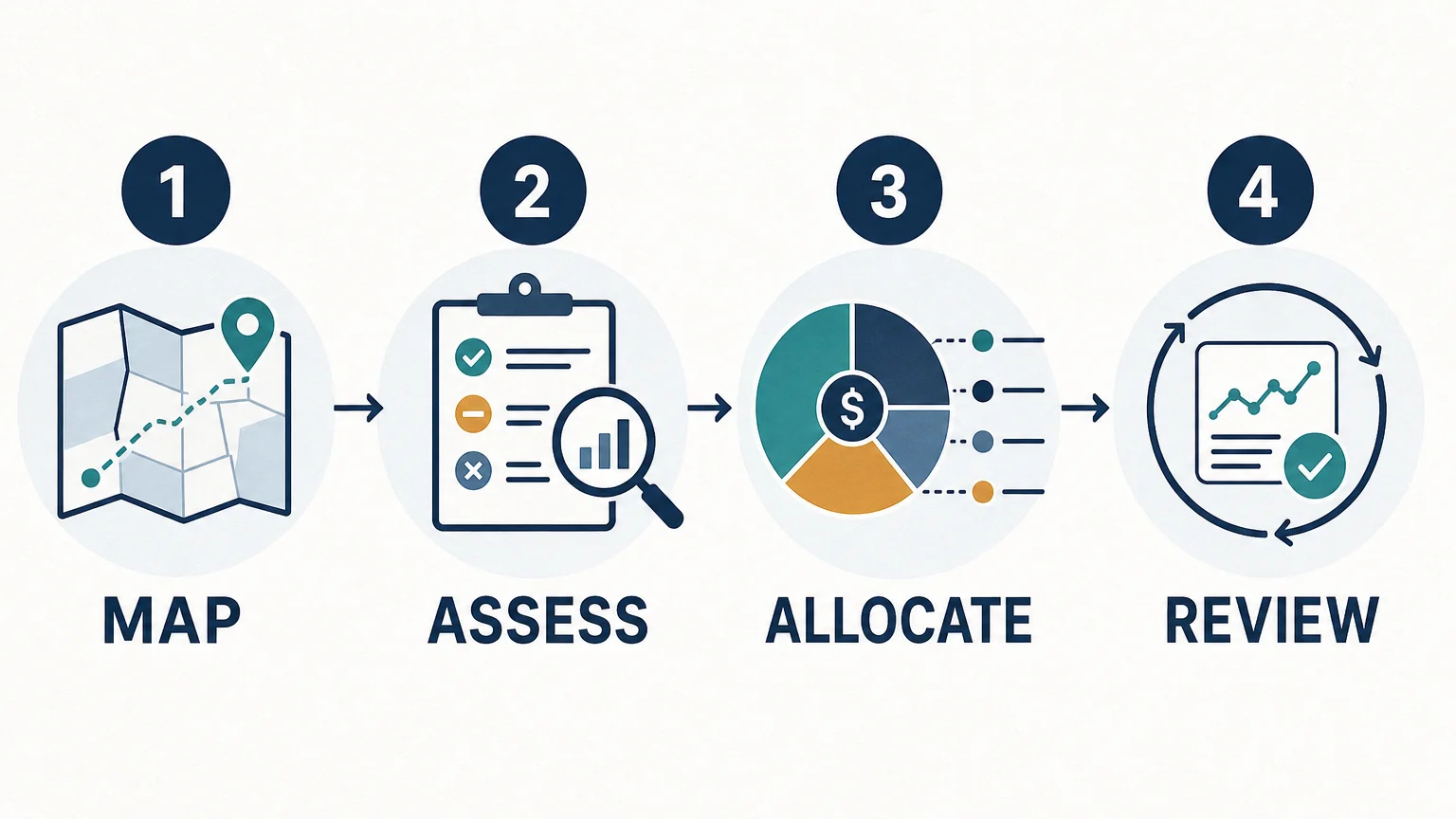
Resource allocation should follow the role each model plays in the portfolio. Established models may need investment in efficiency, customer experience, resilience, or defense. Emerging models may need smaller, staged investments that increase only when evidence improves.
A useful approach is to link funding to evidence rather than enthusiasm. Early investment can support customer research, prototypes, experiments, or capability discovery. Later investment can depend on validated demand, viable economics, technical readiness, and a clear route to market.
Do not assume that a universal ratio will fit every organization. A capital-intensive manufacturer, a software company, and a regulated service provider face different testing costs, time horizons, and failure consequences. The right allocation depends on strategic ambition, disruption pressure, available resources, and the maturity of each model.
Review the portfolio at three levels. At the initiative level, ask whether the team is learning and reducing uncertainty. At the business model level, ask whether the model is becoming more viable and scalable. At the portfolio level, ask whether the overall mix remains aligned with the organization’s future direction.
Strong governance also gives emerging initiatives different performance expectations from mature operations. A mature model may be judged by profit, retention, productivity, or cash generation. An emerging model may be judged by validated assumptions, customer commitments, prototype results, or progress toward a defined decision gate.
Build a portfolio that supports deliberate choices
A business model portfolio is not a list of ventures or a collection of attractive ideas. It is a management system for balancing current performance with future options. By assessing contribution, potential, disruption risk, innovation risk, strategic fit, and resource demand, you can see where the organization is strong, exposed, overextended, or underprepared.
The most useful portfolio is not necessarily the largest or most diversified. It is the one that makes strategic choices visible and turns those choices into action. Improve the models that deserve protection, test emerging models with discipline, separate them when their needs differ, and release resources when the evidence no longer supports continued investment.
Take action with Deckadence
Portfolio decisions become easier to communicate when the underlying logic is clear. Whether you are presenting a growth strategy, comparing business models, or preparing an executive discussion, you need a narrative that connects evidence, choices, resources, and expected outcomes.

At Deckadence, we combine consulting-grade strategic structure with refined, presentation-ready design. Our slide systems, strategic frameworks, narrative structures, and board-ready visuals help you turn complex thinking into clear communication for leadership teams and decision-makers. Explore our business strategy services to support a more focused and persuasive strategic presentation.
Frequently Asked Questions
What is the purpose of a business model portfolio?
Its purpose is to help leaders manage several business models as a coordinated system. It clarifies how current models generate value, how emerging models could create future growth, and how resources should move between them.
How is a business model portfolio different from a product portfolio?
A product portfolio groups products or services, while a business model portfolio examines how value is created, delivered, and captured. One business model can support several products, and one product can sometimes be delivered through different business models.
What should you measure in an emerging business model?
Measure evidence that reduces uncertainty, such as customer demand, willingness to pay, prototype performance, technical feasibility, operating costs, and repeatability. Early initiatives should not be judged only by mature-business metrics such as revenue or profit.
Should every emerging business model be separated from the core business?
No. Separation is useful when the emerging model requires different incentives, capabilities, processes, or performance measures. If the model shares customers, infrastructure, and priorities with the core, closer integration may create greater value.
Can Deckadence help present a business model portfolio?
Yes. Our strategic-thinking templates, narrative structures, and presentation systems are designed to help consultants, executives, founders, and business leaders explain complex strategic choices clearly. They can support board-level communication, business model analysis, and decision-oriented storytelling.