A promising idea can still fail if its customers, costs, channels, and revenue logic do not fit together. A blank business model canvas gives you a structured space to examine those relationships before they become expensive assumptions. If you want a ready starting point, our Business Model Canvas template can help you organize the framework in a presentation-ready format.
The canvas is more useful when you treat it as a shared thinking tool rather than a form to complete once. The Open University describes the nine areas as an integrated way of examining and improving a business model, including professional goals and the relationships required to achieve them.
What is a blank business model canvas?
A blank business model canvas is an empty visual framework divided into nine connected sections. Each section represents a major part of how an organization operates, serves customers, and generates income.
The framework helps you move from a broad idea to a clearer business model framework. Instead of writing a long business plan immediately, you can place the most important assumptions on one page. This makes gaps, contradictions, and dependencies easier to discuss with co-founders, colleagues, advisors, or investors.
The canvas is especially useful when you are exploring a new venture, reviewing an existing offer, or considering a strategic change. You can create several versions and compare them. For example, one version might target enterprise buyers, while another focuses on individual users with a self-service offer.
It is important to understand what the canvas does not do. It does not prove that customers will buy, calculate every financial outcome, or replace market research. It gives you a structured hypothesis that should be tested against evidence.
What are the nine sections of the canvas?
The familiar format uses nine building blocks that cover customers, operations, value creation, and finances. A community business resource describes the blank format as a one-page template covering these same nine areas. See the blank canvas reference for an example of the layout.
- Customer segments: Identify the specific groups or organizations you intend to serve. Describe their needs, behaviors, context, and willingness to pay.
- Value propositions: State the problem you solve and the value customers receive. This may involve convenience, performance, lower risk, better access, or a distinctive experience.
- Channels: Explain how customers discover, evaluate, purchase, receive, and use your offer. Channels may include direct sales, a website, partners, retail, or professional networks.
- Customer relationships: Define how you attract, support, retain, and expand customer relationships. Possible approaches include personal assistance, self-service, communities, or automated support.
- Revenue streams: Describe how the organization earns money from each customer segment. Revenue may come from direct sales, subscriptions, licensing, usage fees, commissions, or other mechanisms.
- Key resources: List the assets required to operate the model. These may include people, intellectual property, technology, data, facilities, capital, or trusted relationships.
- Key activities: Identify the most important work required to deliver the value proposition. Activities could include product development, marketing, manufacturing, research, distribution, or customer service.
- Key partnerships: Record suppliers, distributors, technology providers, strategic partners, and other organizations that support the model.
- Cost structure: Outline the major costs created by your resources, activities, channels, and partnerships. Separate fixed, variable, acquisition, delivery, and support costs where useful.
The blocks are not independent checkboxes. A premium value proposition may require skilled employees, strong service, and higher acquisition costs. A low-price proposition may depend on automation, scale, efficient channels, or tightly controlled operations.
For that reason, the best canvas entries are specific enough to reveal relationships. “Customers” is weak as a description. “Operations directors at mid-sized manufacturers who need to reduce equipment downtime” gives you a more useful starting point.
How do you fill in a blank business model canvas?
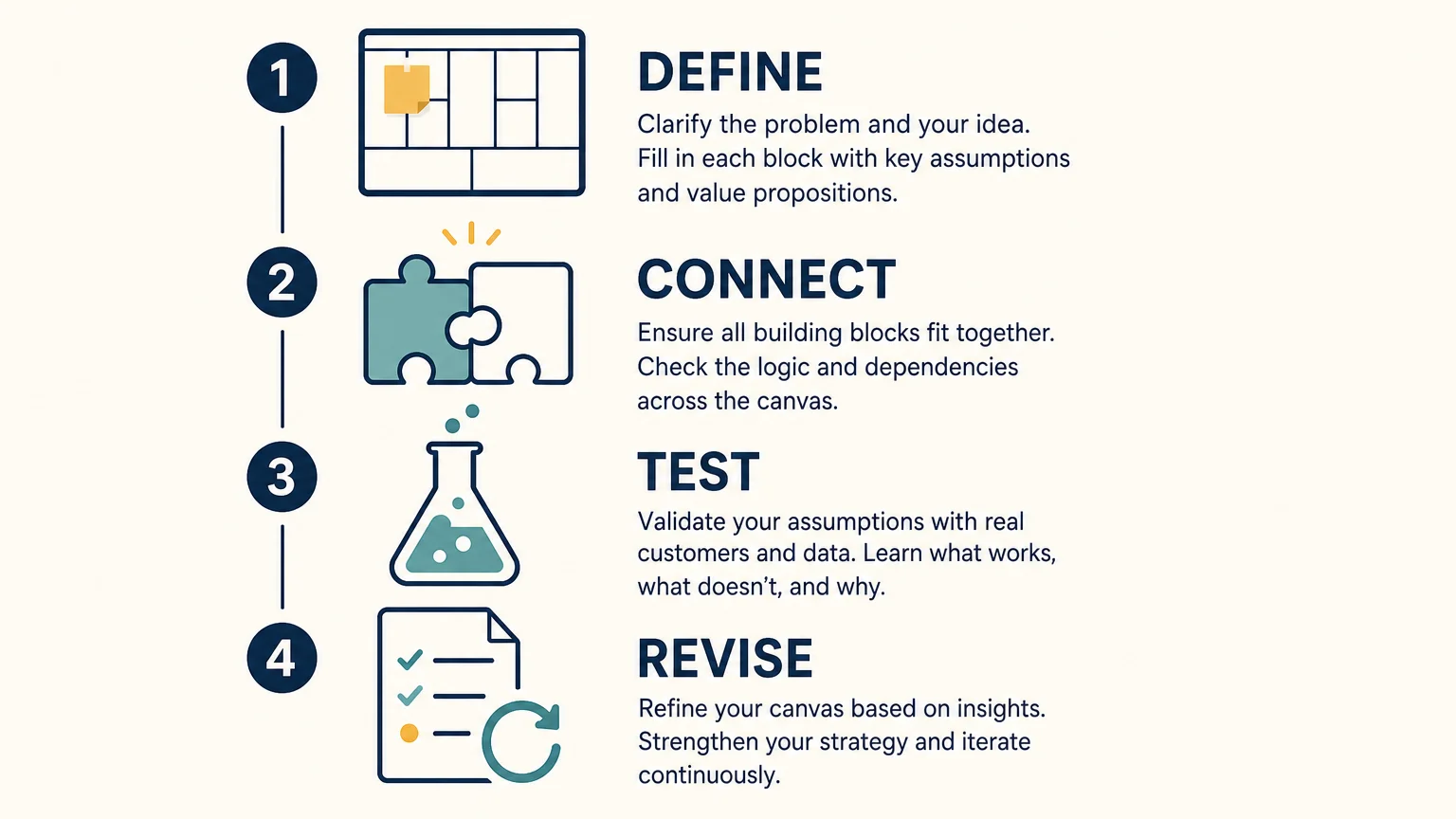
Imagine that you are evaluating a new service with limited information and a small budget. You should not begin by trying to make every box sound complete. Begin with the assumptions that most influence whether the model could work.
- Define the customer: Choose a focused segment and describe the situation that creates demand.
- Clarify the problem: Identify what customers are trying to achieve, avoid, improve, or understand.
- Write the value proposition: Explain why your offer is relevant to that customer and situation.
- Map delivery: Select the channels, relationships, activities, resources, and partners needed to deliver the value.
- Check the economics: Connect revenue streams to customer value, then compare expected income with the costs required to operate.
- Mark uncertainty: Highlight the claims that are opinions rather than verified facts.
Use short phrases instead of dense paragraphs. A canvas should remain easy to scan during a discussion. You can add supporting evidence in a separate document, but the canvas itself should show the logic of the model.
It is also useful to create more than one version. You might compare two customer segments, two pricing approaches, or two distribution channels. The purpose is not to make the first canvas perfect. The purpose is to make the alternatives visible.
For a more structured explanation of the framework, our Business Model Canvas guide can support the move from individual boxes to a coherent strategic story. This is particularly helpful when the canvas will inform an executive presentation or a broader planning process.
Is the Blank Business Model Canvas different from a blank template?

Usually, the phrase refers to an empty version of the familiar nine-block framework. However, recent research uses “Blank Business Model Canvas” as the name of a proposed approach that responds to perceived limitations in the traditional canvas.
A 2025 publication from University Colleges Knowledge describes this newer concept as a framework connected to mindful organizing and sensemaking. It argues that business model work should account for uncertainty, interpretation, creativity, and continuous adaptation rather than treating the canvas as a fixed snapshot.
This distinction matters when you search for a template. If you need a printable or editable worksheet, you are probably looking for a blank version of the standard canvas. If you are studying business model innovation, you may be looking for the newer research concept.
The practical ideas can still complement each other. You can use the standard nine blocks to create a clear structure, then apply a more reflective process by asking how your assumptions change as you learn. Instead of writing “the customer wants this,” ask what evidence supports that belief and what would change your view.
This approach turns the canvas into an assumption testing tool. Each box becomes a question about evidence, not merely a place to insert a confident statement. That makes the framework more useful in uncertain markets, early ventures, transformation programs, and innovation projects.
How can you use the canvas for better decisions?
A canvas becomes valuable when it changes a decision. Use it to compare alternatives, identify risks, and decide what to test before investing heavily.
For example, suppose a company is considering a subscription service. The canvas can expose several questions:
- Which customer group has a recurring problem rather than a one-time need?
- What ongoing value justifies repeated payment?
- Which activities are required to maintain the service?
- What costs increase as the customer base grows?
- Which customer relationships support retention?
- What evidence would show that the model is worth developing?
These questions connect the attractive part of an idea with its operating requirements. They also prevent a common mistake: focusing on the value proposition while leaving delivery and economics vague.
The canvas can support several decision types. Founders may use it to choose a target segment. Product teams may use it to compare monetization options. Executives may use it to evaluate a new growth platform. Consultants may use it to align stakeholders around a strategic hypothesis.
When a startup needs a more focused planning structure, our Startup Business Canvas can help connect early-stage assumptions with a clearer strategic narrative. The appropriate format depends on the maturity of the organization and the decision you need to make.
Research on business model innovation also highlights a limitation of treating the canvas as static. A 2024 peer-reviewed article argues that the traditional framework can be rigid during uncertain phases and proposes greater attention to adaptation and sensemaking. The 2024 research paper provides that critique.
What mistakes should you avoid?
Many canvases look complete but remain strategically weak. The problem is usually not the format. It is the quality of the assumptions placed inside it.
Using broad customer descriptions
“Everyone,” “small businesses,” or “online shoppers” rarely provides enough direction. A useful customer segment includes a recognizable group, a relevant situation, and a meaningful need.
Confusing features with value
A feature describes what you provide. A value proposition explains why it matters. “Analytics dashboard” is a feature, while “helps finance leaders identify cash flow risks earlier” expresses a customer outcome.
If the central promise remains unclear, our Business Model Canvas value proposition guide can help you connect customer needs with a sharper strategic message.
Ignoring the cost of delivery
Some ideas appear profitable because they describe revenue without showing the work required to deliver the offer. Include acquisition, production, technology, support, partner, and compliance costs where relevant.
Writing a forecast instead of a hypothesis
A number in the revenue block does not become reliable merely because it is precise. Record the basis for the estimate, identify the uncertainty, and define the evidence that would confirm or challenge it.
Failing to revisit the canvas
Customer needs, competitors, costs, technologies, and regulations can change. Set a review point after interviews, experiments, launches, or major strategic decisions. A revised canvas can show whether the model has improved or simply become more complicated.
Make the canvas a working strategic tool
A blank business model canvas is most useful when it helps you see the complete logic of an organization. Map the nine blocks, connect the assumptions, identify the evidence you need, and revise the model as you learn. The goal is not a polished page that creates false confidence. It is a shared view of how the business might create, deliver, and capture value, together with a practical basis for better decisions.
Take action with Deckadence
Once your canvas is clear, the next challenge is communicating its logic to the people who must evaluate, fund, approve, or execute it. A strong strategic presentation should make the customer need, value proposition, operating model, and financial logic easy to understand.
Deckadence brings together premium slide decks, strategic thinking templates, board-ready frameworks, narrative structures, and presentation systems for consultants, founders, executives, agencies, and business leaders. Explore our visual strategic thinking resources when you need to turn a business model into a clear, persuasive presentation for stakeholders and decision-makers.
Frequently Asked Questions
What is the purpose of a blank business model canvas?
It provides a structured starting point for mapping how an organization creates, delivers, and captures value. You can use it to clarify an idea, compare alternatives, expose assumptions, and support strategic discussion.
What should you write first on the canvas?
Start with the customer segment and the problem or need you want to address. You can then define the value proposition before mapping the activities, resources, channels, costs, and revenue required to deliver it.
Is a business model canvas the same as a business plan?
No. A canvas is a concise visual model of the relationships within a business, while a business plan usually provides more detail about execution, research, financial projections, risks, and milestones.
How often should you update the canvas?
Update it whenever you gain meaningful evidence or make a significant change to the offer, customer segment, channel, operating model, or revenue logic. Many teams review it after interviews, experiments, launches, and major planning cycles.
Can Deckadence help present a completed canvas?
Yes. Deckadence provides premium slide decks, strategic thinking templates, narrative structures, and board-ready frameworks designed to help professionals communicate complex strategic ideas clearly. These resources can support the conversion of a completed canvas into a persuasive presentation.