Should your presentation open with the recommendation, the problem, or the evidence? The right sequence depends on what your audience must understand and decide. A strong narrative makes that path visible, not theatrical. If you are shaping an executive or consulting deck, our consulting presentation structure resource connects the storyline to a clear decision and action.
In business, presentation narrative structures are ways to arrange context, evidence, and implications so an audience can follow your reasoning. A 2026 Temple study covered by Poynter’s research report tested more than 500 readers and found that engagement depended on how story features interacted, not on one device alone. It examined news articles, not business presentations, but reinforces a useful caution: a familiar story arc is not a universal formula.
Treat narrative as decision architecture, not decoration
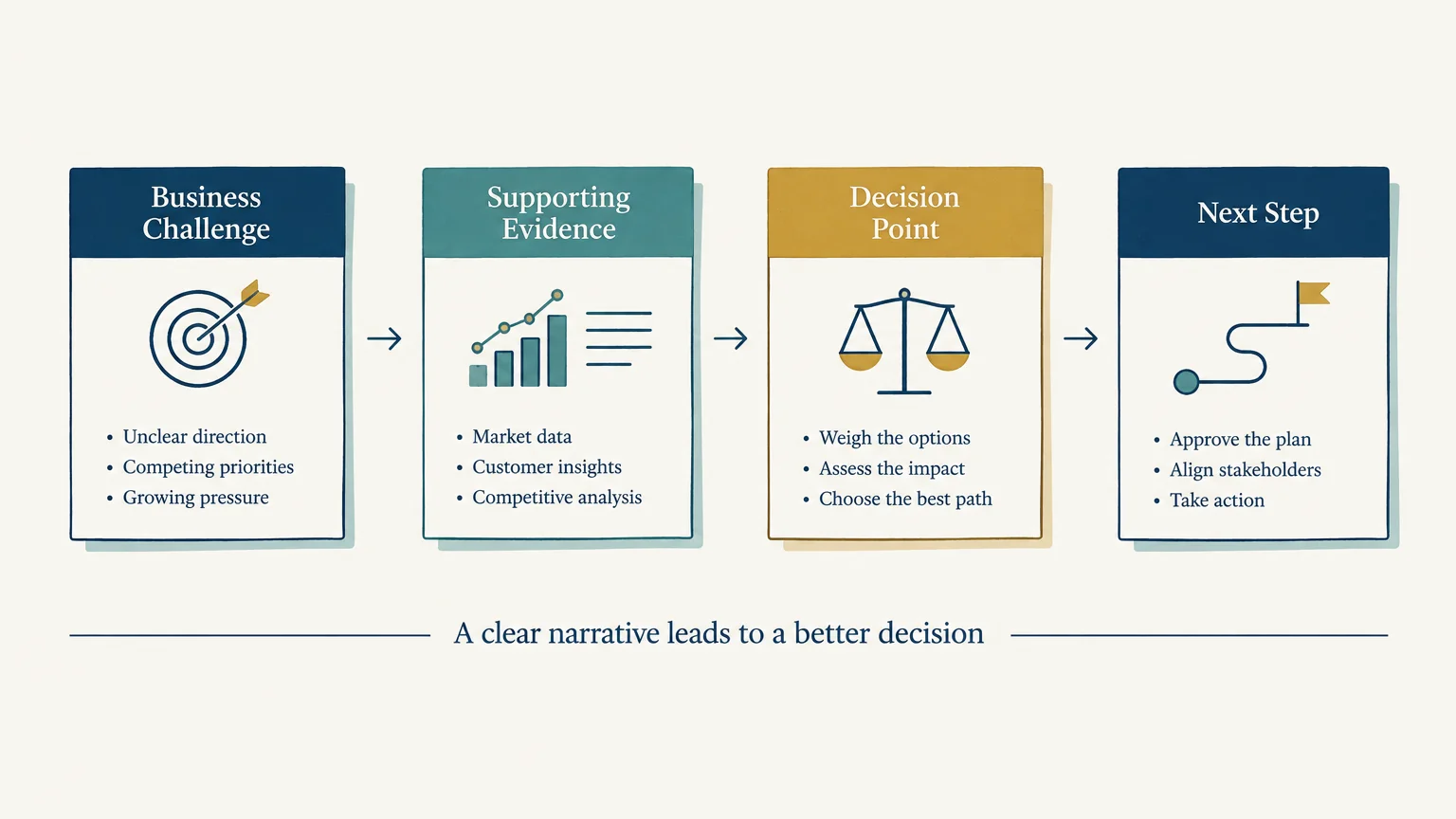
Imagine presenting an investment recommendation to a leadership team. If you begin with background details, decision-makers must work to find the point. If you begin with the choice and its rationale, they can listen for the evidence that supports it.
Start by defining the audience’s task. Do they need to understand a situation, compare options, approve a proposal, or learn a process? Then write one sentence describing the takeaway you want them to remember. That sentence becomes the test for every section: does it establish context, support the reasoning, or clarify what should happen next?
This approach treats the audience as a decision-maker rather than a passive viewer. A narrative does not require a fictional protagonist or dramatic personal story. In a business deck, the central movement is often from current state to a decision, supported by evidence and a credible explanation of what changes.
Five presentation narrative structures and when to use them
A useful structure follows the material instead of forcing every topic into the same plot. Consider these five models as adaptable sequences, not fixed scripts.
1. Problem, solution, action
Define the issue, explain its consequences, present the solution, and state the action required. This sequence suits proposals, sales presentations, and change requests when the audience already recognizes the problem or needs a clear case for addressing it.
The main risk is oversimplifying a complicated issue. Show enough evidence to establish why the problem matters, and address significant trade-offs before recommending action.
2. Situation, complication, resolution
Establish the current situation, introduce a meaningful change or obstacle, then explain how to respond. This model works well for executive updates because it moves from shared context to the reason the audience should reconsider its assumptions.
For example, a market update could begin with current customer behavior, reveal a shift in demand, and end with the strategic response. Keep the complication specific; a vague claim that “the market is changing” creates little reason to act.
3. Current state versus desired future
Contrast what is happening now with what could happen under a different choice. Use this when you need to show a gap, such as the difference between current service performance and a target experience.
This structure is persuasive when both sides of the comparison are supported. Make the desired future concrete, and disclose the assumptions behind it rather than presenting aspiration as a forecast.
4. Chronological or process sequence
Arrange events or steps in time order when timing, dependencies, or causality matter. This structure suits project reviews, incident explanations, implementation plans, and process training.
Chronology alone does not explain significance. At each turning point, clarify what changed and why the audience should care. Otherwise, the deck can become a timeline without a conclusion.
5. Question, evidence, implication
Pose a specific question, present the evidence that answers it, and explain the implication. This model fits data-led presentations, research briefings, and analytical explanations where the audience needs to understand how a conclusion follows from the findings.
A 2021 meta-analysis of more than 75 samples and 33,000 participants found narrative texts were generally better understood and recalled than expository texts. The meta-analysis of narrative texts studied reading and comprehension, not business slide decks, so use it as context rather than proof that every presentation needs a story arc.
For teams building recurring strategic decks, our presentation slide systems offer a way to bring consistent structure to slide sequences while keeping the content specific to each decision.
Match the structure to your purpose and evidence
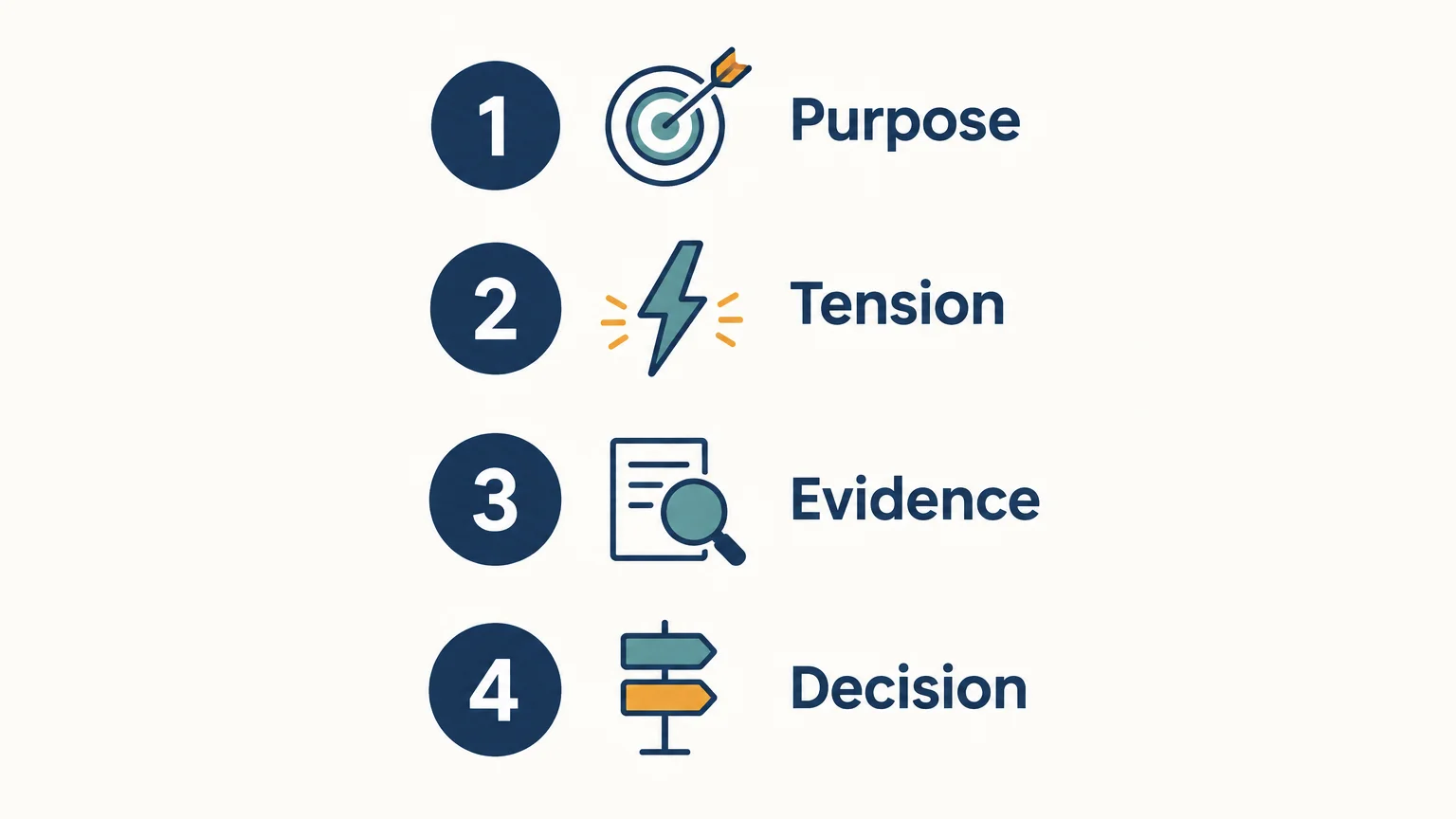
Before selecting a model, check what the presentation must accomplish and what evidence you actually have. A persuasive proposal and a neutral performance update might cover similar material, but they need different emphasis and sequencing.
- Purpose: Name the audience’s decision, question, or learning need.
- Tension: Identify what has changed, what is uncertain, or what needs resolving.
- Evidence: Select the facts that answer the central question or support the recommendation.
- Decision: State the implication, action, or next step that follows.
For a recommendation backed by strong comparative data, lead with the decision and organize the evidence around the criteria that matter. For an exploratory briefing, begin with the question and let the analysis reveal the implications. For a training session, a chronological or process sequence often makes dependencies easier to follow.
Keep the claim proportional to the evidence. If the data show a correlation, do not describe it as proof of cause. If several options remain viable, present the trade-offs instead of manufacturing a single dramatic answer.
Turn the narrative into a clear slide sequence
Consider a presentation proposing a change to a customer onboarding process. One possible sequence is: the business objective, the current friction, evidence of its effect, the proposed change, implementation considerations, and the decision required.
Give each slide one job in that sequence. A slide title should communicate the point, not merely name the topic. For example, replace “Customer feedback” with a title that states what the feedback indicates, then use the slide to support that conclusion with relevant examples or data.
Our guide to action titles in PowerPoint explores how to make slide headings express the takeaway. For a starting point that connects strategic frameworks with narrative and slide design, our evidence-based presentation templates provide presentation materials built for structured, evidence-driven storytelling.
Transitions should explain the logic between sections. A concise line such as “The current process creates a delay; the next section shows where it occurs” tells the audience why the next evidence matters. When a team presents together, make the handoff explain how one speaker’s point leads to the next.
Check for common narrative problems before presenting
A well-ordered deck can still lose its audience if the sequence hides the point, overstates the evidence, or makes the proposed action unclear. Review it from the perspective of someone who has not followed your analysis.
- Late central message: If the audience needs an early decision, state the recommendation or purpose near the beginning.
- Unsupported tension: Do not exaggerate a risk or obstacle just to make the story dramatic.
- Disconnected evidence: Explain how each chart or example supports the conclusion.
- Overloaded sequence: Remove material that does not help the audience understand, evaluate, or act.
- Abrupt ending: Close by stating the implication and the specific next step.
Adapt the amount of context to the room. A specialist audience may need the assumptions and method behind a finding. Senior decision-makers may need the decision, its implications, and the evidence that changes their view. In either case, preserve the reasoning that makes the conclusion credible.
A 2026 conference study on data storytelling found that communication medium, topic familiarity, and audience data literacy shaped outcomes. The data storytelling study also cautions against assuming that narrative framing produces the same effect for every audience or purpose.
Choose a structure that makes the reasoning clear
The most useful presentation narrative structure is the one that connects your audience’s need to relevant evidence and a clear implication. Select a sequence that suits the task, make each slide advance the reasoning, and end with the choice or next step your audience needs to consider.
Make strategic thinking clear on slides
When a presentation must do more than report information, its sequence should help people understand the choices and evidence behind a recommendation. A deliberate structure gives each slide a role and helps the audience follow the reasoning without unnecessary detours.

Our visual strategic-thinking assets combine structured storytelling, strategic frameworks, action titles, and presentation-ready slide systems. They are built for PowerPoint, Keynote, Figma, and more, for teams communicating complex ideas or supporting executive decisions. Explore our visual strategic-thinking assets to see materials for organizing analysis and presenting decisions with clarity.
Frequently Asked Questions
What is a presentation narrative structure?
It is the sequence used to connect context, supporting points, and a conclusion or action. In a business presentation, the structure should make the reasoning easy for the audience to follow.
Which narrative structure works best for a business presentation?
Choose according to the audience’s task and the evidence available. Problem-solution-action suits a proposal, while question-evidence-implication suits an analytical briefing.
Does every business presentation need storytelling?
No. Some presentations are clearer as a direct explanation, process sequence, or evidence-led answer. Use narrative techniques when they clarify the relationship between the information and the decision.
How do you structure a data presentation?
Start with the question the data should answer, show the relevant findings, and explain their implications. State assumptions and limitations so the conclusion stays proportionate to the evidence.
How can Deckadence support a strategic presentation?
Deckadence’s presentation assets include strategic frameworks, narrative structures, action titles, and slide systems. Its strategy guide also covers more than 15 frameworks and includes a framework selection guide.