Board Presentation Frameworks for Clearer Board Decisions
A board presentation succeeds when directors can see what changed, why it matters, and what decision you need. The right board presentation frameworks make that logic visible without forcing every issue into the same format. If you are preparing a startup board deck, our board presentation templates for startups are a focused starting point for choosing a suitable presentation format.
Board members need more than a progress report. They need enough context to assess performance, understand important risks, and contribute to decisions. A useful framework connects the evidence to those needs, while leaving room for discussion and questions. It should clarify the story, not dictate a rigid slide sequence.
Start with the decision, then select a framework

What should the board understand or decide by the end of the discussion? Begin with that question, then select a framework that helps answer it. A request for approval needs a clear recommendation and options. A strategic discussion needs context, evidence, trade-offs, and questions for directors.
Make the meeting purpose visible. Mark agenda items as for decision, for discussion, or for information. Then give each item only the evidence needed for that purpose. This prevents a routine update from taking up the time needed for a significant decision.
A 2026 report from the Society for Corporate Governance and Board Intelligence recommends reducing unnecessary material, using executive summaries, and focusing meeting time on discussion. That guidance supports a practical principle: use a framework to focus attention, not to fill slides.
Keep the audience in view as you choose. Directors may know the company well but have limited time to revisit operational detail. Define unfamiliar terms, explain meaningful changes, and connect metrics to business consequences. Put supporting detail in a pre-read or appendix when it does not need discussion.
Use the Pyramid Principle to lead with your answer
Imagine the board has only a few minutes to review your central recommendation. The Pyramid Principle puts that answer first, followed by the main reasons and then the evidence that supports them. This makes the argument easier to scan before the meeting and easier to discuss during it.
For example, lead with “Approve the second distribution partner to protect next quarter’s launch.” Follow with two or three reasons, such as capacity, timing, and expected cost. Then show the relevant data, assumptions, risks, and alternatives. The recommendation should be clear, but the evidence should also let directors test it.
Use action titles to make the logic visible slide by slide. “Customer retention” labels a topic; “Renewal rates fell after onboarding delays” states a finding. A sequence of takeaway titles should let a reader follow your argument without relying on spoken narration.
If you are shaping a broader consulting or executive narrative, our consulting presentation structure offers a related way to organize the story around a clear argument.
Use SCQA or SCR to frame the issue
When directors need context before considering a recommendation, use SCQA: Situation, Complication, Question, Answer. State the shared starting point, explain what has changed, pose the question that follows, and then give your answer.
For example, a company may have met its growth target for several quarters. Customer acquisition costs have now risen, creating uncertainty about whether the existing plan remains viable. The board’s question is how to sustain growth without weakening margins. Your answer might be to shift investment toward two channels with stronger retention.
SCR, or Situation, Complication, Resolution, can condense the same logic into an executive summary. Use it when a brief opening needs to establish the context, identify the issue, and present the response. SCQA makes the question explicit; SCR moves from the issue to the proposed resolution.
Do not make the opening a long history of the company. Include only the context directors need to understand the current issue. Keep the detailed timeline, methodology, and supporting data in the body or appendix, where they can be reviewed if questions arise.
Use MECE to organize evidence and options
Suppose your recommendation depends on several causes or risks. The MECE framework, meaning mutually exclusive and collectively exhaustive, is a useful test for organizing those points. The categories should not overlap, and together they should cover the relevant scope.
For a margin decline, you might separate price, volume, and cost effects. For a project decision, you might group risks into market, operational, and financial categories. Explain the boundaries of each category so directors can see what belongs where and what falls outside the analysis.
MECE is a tool for structuring analysis, not a requirement to make every board discussion fit into fixed categories. A June 2026 Board Value Index survey found that 86% of surveyed directors, CEOs, and CFOs said rigid or inconsistent decision frameworks had contributed to a delayed, rushed, or poor decision in the previous six months. The survey concerned board decision processes, not slide formats. Its practical lesson here is to keep your presentation structure clear without mistaking it for a decision policy.
Check the categories against the decision you are asking directors to make. If an option is missing, a risk appears in two places, or a category is too broad to evaluate, revise the structure before building the slides.
Build the deck around the discussion
A recurring quarterly deck benefits from a consistent sequence, but each meeting still needs to reflect its agenda. Start with the purpose and summary, then show performance against plan, explain important changes, and present risks or strategic topics that need attention.
Give each decision its own focused section. State the question, compare realistic options using the same criteria, explain your recommendation, and make the requested approval or input explicit. Put supporting calculations or detailed analyses in the appendix rather than hiding the decision among general updates.
Separate material directors should read in advance from the slides you plan to discuss live. A pre-read can include fuller explanations and supporting detail. In the meeting, focus on the implications, unresolved choices, and questions where directors can add value.
In 2026, the Society for Corporate Governance and Board Intelligence also emphasized that board materials should support discussion rather than merely present information. A consistent structure helps directors find recurring topics, while a focused meeting deck gives more room to examine what has changed and what needs a decision.
Review the framework against board needs
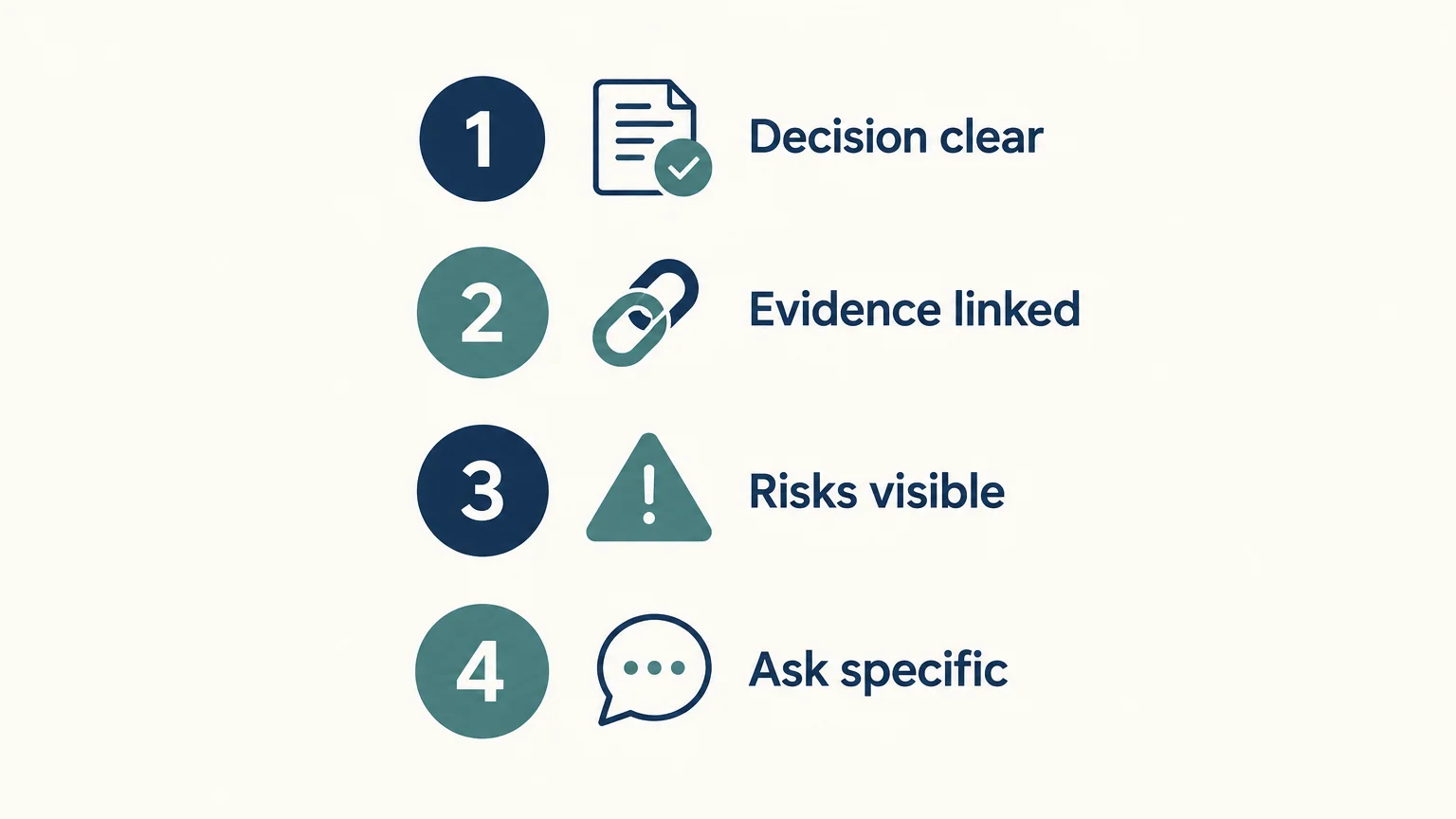
Before you send the board pack, test whether each section earns its place. PwC’s 2026 directors survey found that 82% of directors saw opportunities to improve board materials. Treat the finding as a reason to review clarity and usefulness, not as evidence that one presentation framework suits every board.
- Decision clear: Can directors identify whether the item asks for approval, discussion, or awareness?
- Evidence linked: Does each major claim have relevant evidence, context, and a clearly stated period?
- Risks visible: Have you described material uncertainties, dependencies, and the response?
- Ask specific: Have you stated what input or action you need, and when it is required?
Review the deck from the perspective of a director who has not followed the work day to day. Define specialist terms, check that the recommendation follows from the evidence, and remove slides that repeat information without advancing the decision.
Our strategy guide covers more than 15 frameworks and includes a framework selection guide. That educational reference is separate from our presentation assets, which bring strategic thinking, narrative structures, and board-ready slide systems together.
Choose a framework that serves the decision
The clearest board presentation structure starts with the board’s purpose, then uses a framework suited to the argument. Lead with the recommendation when a decision is needed, use SCQA or SCR when context matters, and apply MECE to organize supporting evidence. Keep the structure flexible, make risks visible, and state the board’s ask plainly.
Explore board presentation decks
Once your argument is clear, the slides should make its logic easy to follow. A consistent visual system helps you distinguish the recommendation, evidence, risks, and decisions without turning the meeting into a dense report.

Our library includes premium slide decks, strategic-thinking templates, board-ready frameworks, narrative structures, and slide systems built for PowerPoint, Keynote, Figma, and more. Explore our board presentation decks to find presentation materials suited to executive and board-level communication.
Frequently Asked Questions
What is the best framework for a board presentation?
Choose according to the meeting’s purpose. The Pyramid Principle suits recommendation-led arguments, while SCQA or SCR helps establish context before presenting an answer.
How do SCQA and SCR differ?
SCQA includes an explicit Question between the Complication and Answer. SCR moves from Situation and Complication directly to Resolution, making it useful for a concise summary.
When should you use MECE in a board deck?
Use MECE to organize categories such as causes, options, or risks when overlap or omissions would make the argument harder to assess. Define the scope clearly, and do not force unrelated points into artificial categories.
Should you present the full board pack during the meeting?
Not necessarily. Use pre-read materials for supporting detail, then focus live discussion on key changes, risks, strategic questions, and decisions.
Where can you learn about choosing strategy frameworks?
Our strategy guide covers more than 15 frameworks and includes a framework selection guide. It is educational reference content, while our presentation assets provide board-ready frameworks, narrative structures, and slide systems.