Best Strategic Thinking Templates for 2026: A Practical Guide
Which framework will sharpen the decision, rather than simply decorate a planning session? The best strategic thinking templates for 2026 make the question, evidence, trade-off, and next move visible. If you need to present the result, our strategic planning presentation templates provide a visual route from analysis to a decision-ready narrative.
Strategic leaders face a planning tension: confidence in their organizations does not always match confidence in the wider economy. Deloitte’s 2026 Global Chief Strategy Officer Survey found that 72% of respondents were optimistic about their organization’s prospects, compared with 24% who were optimistic about the global economy. A useful canvas should surface assumptions and what could change your choice.
Which decision should the template help you make?
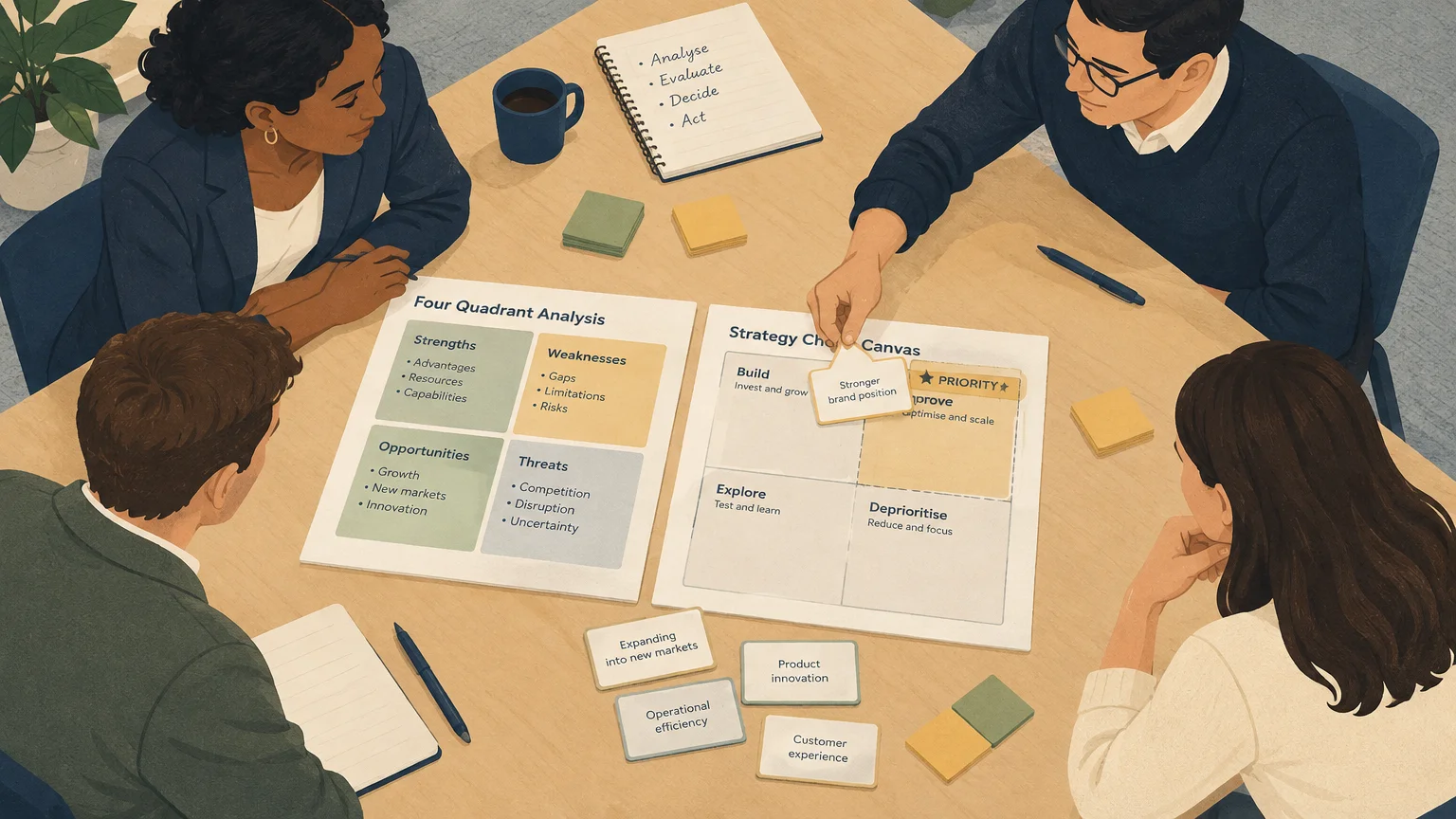
Suppose your leadership team sees falling retention but disagrees about the cause. A growth template would be premature; first, you need a diagnostic framework that separates internal issues from external pressures.
Strategic-thinking templates serve different jobs. Some structure evidence, some compare choices, and others translate priorities into plans or presentations. Start by writing one question in plain language, such as “Which customer segment should we prioritize?” Then choose the framework whose sections help answer it.
This distinction keeps a template from becoming paperwork. A framework supports analysis or choice; a strategic plan records priorities and actions; a presentation communicates the reasoning to an audience. Select the format that matches the work you need to complete now.
Which template fits each strategic question?
A market diagnosis needs different prompts from a growth decision or an execution review. Use the question below each framework to choose a useful starting point.
SWOT and PESTLE for diagnosis
Use SWOT analysis to organize internal strengths and weaknesses alongside external opportunities and threats. It gives a team a shared view of its position, but the grid does not rank priorities by itself. Add evidence and discuss which relationships between the four areas matter strategically.
Use PESTLE analysis when external forces need a closer examination. Its political, economic, social, technological, legal, and environmental prompts help teams scan context. It is especially useful when a decision depends on regulation, customer shifts, or conditions across several regions.
Porter’s Five Forces for industry structure
Ask whether industry economics leave room for a defensible position. A Five Forces canvas examines rivalry, new entrants, substitutes, and the bargaining power of buyers and suppliers. It is useful for market-entry and positioning discussions, but it focuses on industry pressures rather than your whole operating model.
Strategy Diamond for strategic choices
When your team needs to make its choices explicit, a Strategy Diamond canvas can connect five questions: where to play, how to get there, how to win, what sequence to follow, and how the economics work. It makes gaps between choices easier to spot, especially when a proposed advantage lacks a clear route or economic logic.
Ansoff Matrix and BCG Matrix for growth priorities
Use the Ansoff Matrix to compare growth directions across existing or new products and markets. Its four options help frame the decision, from selling more to current customers to entering new markets. The BCG Matrix instead compares products or business units by market growth and relative share, helping teams discuss portfolio investment.
Neither matrix supplies the evidence needed to choose an option. Treat its categories as prompts for analysis, then test assumptions about customers, capabilities, investment, and risk.
Business Model Canvas for how a business creates value
Choose a Business Model Canvas when the question concerns how the organization creates, delivers, and captures value. Its linked areas cover customers, value propositions, channels, activities, resources, partners, costs, and revenue. For an early-stage idea, a Lean Canvas shifts attention toward the problem, solution, customer segments, and key measures.
Scenario Planning and Three Horizons for uncertainty
Use scenario planning when the decision depends on uncertain external conditions. Map a small number of plausible futures, identify what changes in each, and test which strategic moves remain useful across them. A Three Horizons canvas serves a different purpose: it separates attention across the current business, emerging opportunities, and longer-term possibilities.
OKRs and Balanced Scorecard for tracking priorities
Use OKRs to connect a small set of objectives to measurable results. A Balanced Scorecard provides a broader view across financial, customer, internal-process, and learning perspectives. Both help make priorities and progress visible, but they work best after the strategic choices are clear.
How do you connect analysis to action?
Imagine a SWOT discussion surfaces a risk from new regulation. The next step is not to add every framework to the same document. Choose a complementary tool that answers the next question, such as scenario planning to test possible regulatory outcomes or a strategy choice canvas to clarify the response.
For uncertain futures, the 2026 UNDP foresight toolkit covers methods including horizon scanning, scenarios, visioning, backcasting, and stress testing. These methods help teams explore possible futures before settling on actions.
A practical sequence is: diagnose the situation, define the choice, compare options, then assign priorities and measures. Keep each framework’s output distinct, but carry forward its evidence. This makes the logic traceable without forcing every question into one overloaded canvas.
Once strategic choices are settled, record initiatives, measures, and owners in a plan. Our strategic plan template is relevant when you need to organize those choices into a clear planning structure.
What makes a strategic-thinking template usable?
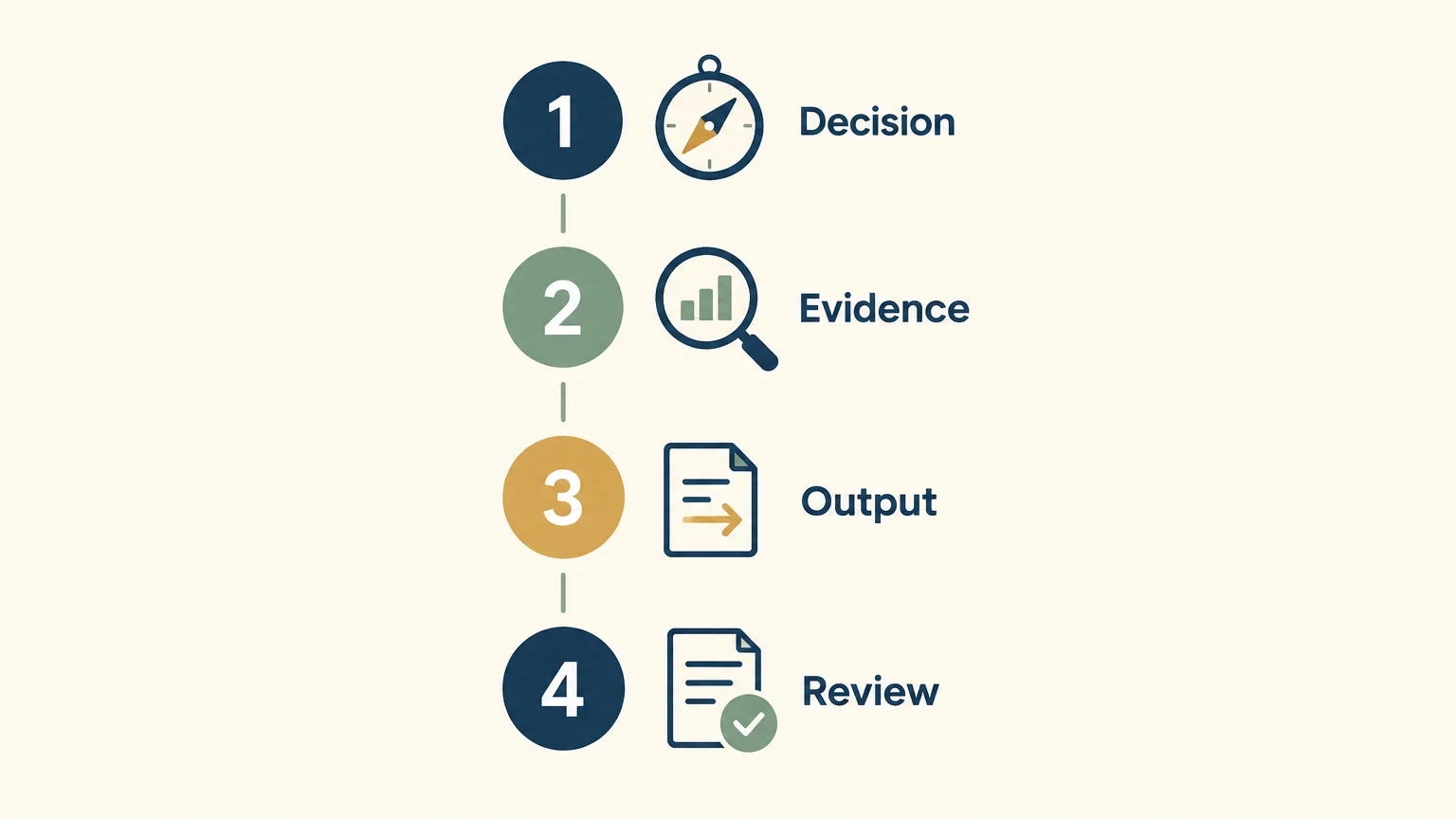
In 2026, a template should do more than offer a familiar layout. Check whether it supports a real decision, makes evidence visible, and produces an output your team can use. Apply these four tests before you commit:
- Decision: Does the template state the strategic question it is designed to clarify?
- Evidence: Does it prompt you to separate facts, assumptions, and unanswered questions?
- Output: Does it lead to a choice, a set of priorities, or a measurable plan?
- Review: Does it give the team a way to revisit progress or update assumptions?
Format also matters. A shared canvas suits group analysis; a concise plan suits ownership and follow-up; slides suit executive or board discussion. Central Banking’s 2026 benchmarking coverage highlights digital platforms and AI among topics in central-bank strategic planning, a reminder that sector context should shape the questions in your template.
When the result must support a high-stakes presentation, the story needs to make the analysis and the decision easy to follow. Our presentation materials combine strategic frameworks with structured storytelling, action titles, concise messaging, and board-level visuals. They are built for PowerPoint, Keynote, Figma, and more. For that communication task, explore our best consulting presentation templates for 2026.
Choose a template by the decision, not the trend
The right strategic-thinking template fits the question, makes the supporting evidence visible, and leads to an output your team can act on. Start with one framework, add another only when it answers a distinct next question, and choose a format suited to the people who will use the result. That discipline keeps analysis focused and makes strategic choices easier to explain.
Turn strategic thinking into a clear presentation
A useful framework should clarify the analysis and the choice it supports. When your next step is to align executives, clients, or board members, the presentation needs a clear narrative as well as a sound strategic structure.
Our visual strategic-thinking assets combine strategic frameworks, structured storytelling, concise messaging, and board-level visuals in presentation-ready systems. They are built for PowerPoint, Keynote, Figma, and more; check the specific asset for platform requirements. Explore our visual strategic-thinking assets to make complex ideas clearer and more persuasive.
Frequently Asked Questions
What is the best template to start strategic thinking?
Start with the framework that matches your question. SWOT is a practical diagnostic starting point, while PESTLE focuses on external conditions and the Strategy Diamond helps make strategic choices explicit.
Can you combine more than one strategy framework?
Yes, when each framework has a distinct job. For example, use SWOT to structure diagnosis, then use scenario planning to test how a choice holds up under uncertainty.
What is the difference between a framework and a strategic plan?
A framework structures analysis or decision-making. A strategic plan records the selected priorities, initiatives, measures, and responsibilities that follow from those choices.
How do you choose a template for executive presentations?
Choose a format that connects evidence to the decision and makes trade-offs easy to follow. Our presentation materials combine strategic frameworks with structured storytelling and board-level visuals.
Should strategic-thinking templates be digital or presentation-based?
Use a collaborative canvas for group analysis, a plan format for tracking priorities, and slides for communicating a decision. Our presentation assets are built for PowerPoint, Keynote, Figma, and more.