Roughly nine in ten organizations struggle to turn their strategy into reality, a gap that quietly drains budgets and stalls growth. The problem is rarely a shortage of ideas; it is the absence of a repeatable structure that carries an idea from ambition to execution. A well-built business roadmap template that drives results closes that gap by giving every planning cycle the same reliable backbone.
That is precisely what a strategic plan template delivers. According to Harvard Business School, around 90 percent of organizations fail to execute their strategies successfully, and the difference between the winners and the rest is almost always disciplined structure. This guide walks you through the components, the format choices, and the practices that make a template genuinely useful.
Why a strategic plan template matters
Consider two teams entering their annual planning session. One starts from a blank document and debates format for hours. The other opens a proven strategic planning framework and moves straight to substance. The second team is not smarter; it is simply structured. A template removes the recurring cost of reinventing the process every cycle.
The stakes are high. According to the Corporate Finance Institute, only 5 percent of employees understand their company's strategy, which means the vast majority make daily decisions without strategic context. A shared template makes direction visible and repeatable, so priorities do not live only in a leader's head. When you need to communicate that direction persuasively, our strategy page for planning context offers structured methods for framing choices under uncertainty.

The core components every template should include
What separates a functional template from a decorative one is coverage of the essential building blocks. Most credible frameworks converge on a similar set of sections, each answering a distinct question about direction and delivery.
- Executive summary: a concise overview written last, giving decision-makers instant context.
- Vision and mission: where the organization is heading and why it exists.
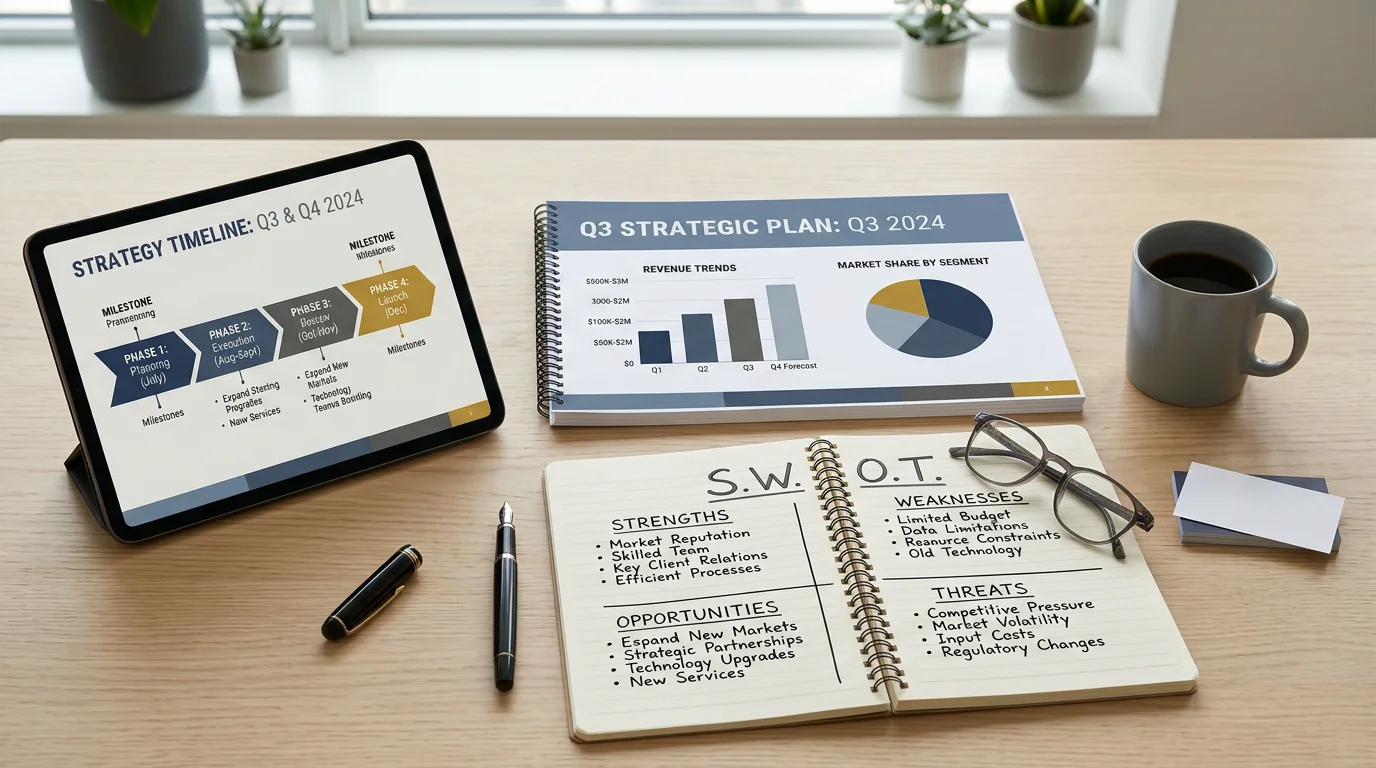
- Situation analysis: a SWOT analysis or environmental scan to ground decisions in reality.
- Strategic objectives: specific, measurable outcomes that translate vision into intent.
- Key initiatives: the major projects that will move each objective forward.
- Key performance indicators: the metrics that reveal whether the plan is working.
- Roles and timelines: clear ownership and milestones so nothing drifts.
Omitting any of these creates a predictable weak point. A plan without KPIs cannot be measured; a plan without owners cannot be executed. The value of a template is that it forces you to complete each section deliberately.
Choosing the right type of strategic plan
Not every planning need is identical, and a good template adapts to context rather than forcing one shape onto every situation. A corporate plan sets company-wide direction, while a departmental plan aligns a single function such as marketing or operations with those broader goals.
Growth plans target expansion into new products or markets and demand rigorous analysis of risk and opportunity. Operational plans concentrate on efficiency and process improvement. Selecting the correct type before you begin prevents a common failure: producing a document that looks complete but answers the wrong question. Match the template to the decision you actually need to make.
Comparing common strategic planning formats
The format you choose shapes how a plan is created, shared, and maintained. Spreadsheets, generic document templates, and purpose-built slide systems each serve different needs. The table below compares them against the criteria that matter most for board-level communication.
| Approach | Board-ready visuals | Built-in frameworks | Best suited for |
|---|---|---|---|
| Spreadsheet template | Limited | Minimal | Tracking metrics and timelines |
| Generic document template | Basic | Partial | Internal drafting and notes |
| Our strategy frameworks and slide systems | Yes, board-level | Yes (SWOT, PESTEL, Porter's Five Forces) | Presenting strategy to decision-makers |
Spreadsheets excel at calculation but rarely persuade a boardroom. Document templates capture thinking but seldom command a room. When the objective is to align stakeholders and accelerate decisions, we provide consulting-grade frameworks and slide systems built for PowerPoint, Keynote, and Figma, so the thinking shows as clearly as it reads.
How to fill in your template step by step
A template only creates value when it is completed with discipline. Begin by reviewing recent performance and summarizing the lessons that inform your direction. This grounds the plan in evidence rather than aspiration.
Next, analyze your landscape: map competitor strengths and weaknesses, then prioritize your target audiences. Translate the resulting insight into objectives using the SMART criteria, ensuring each goal is specific, measurable, achievable, relevant, and time-bound. Assign an owner to every initiative and set clear milestones. Finally, schedule regular reviews; quarterly check-ins typically balance stability with the ability to adapt as conditions shift.
Execution discipline is where most plans falter. According to the Balanced Scorecard Institute, undisciplined schedules and weak commitment to strategic priorities are among the leading causes of stalled initiatives. A template that builds in ownership and review cadence directly counters that risk.
Turning a plan into a persuasive presentation
A brilliant strategy that no one understands rarely survives contact with a boardroom. The final step is translating your completed template into a narrative that decision-makers can absorb quickly and act upon. Structure matters as much as content here.
Lead with the vision, present the analysis, prioritize the goals, and close with a clear execution plan. When you need a proven visual language for this, our McKinsey-style presentation template helps you turn dense analysis into clear, board-ready slides. The goal is not decoration; it is comprehension that moves people to decide.
Bringing your strategic plan to life
A well-constructed strategic plan template is less a document than a discipline. It gives every planning cycle the same reliable structure, forces you to address vision, objectives, metrics, and ownership, and keeps direction visible to the people who must execute it. The organizations that close the notorious execution gap are rarely those with the boldest ideas; they are those that pair sound thinking with a consistent, measurable framework. Choose the plan type that fits your decision, complete each section deliberately, and revisit it on a regular cadence so strategy stays connected to daily work.
Take action with Deckadence
You have the structure; now you need it to command the room. Whether you are preparing a board presentation, aligning stakeholders, or communicating strategy under uncertainty, the difference between a plan that stalls and one that drives decisions often comes down to how clearly the thinking is presented.
We provide premium, board-level slide decks and strategic-thinking templates and framework library that combine proven methods such as SWOT, PESTEL, and Porter's Five Forces with refined design for PowerPoint, Keynote, and Figma. The result is a set of consulting-grade tools that turn complex ideas into persuasive, decision-ready presentations, helping you align stakeholders and accelerate the choices that matter.
Frequently Asked Questions
What is a strategic plan template?
A strategic plan template is a reusable, structured framework that guides you through defining your vision, objectives, initiatives, and performance indicators. It streamlines planning by providing consistent sections and best practices, so teams do not start from a blank page each cycle. This ensures alignment and reduces the risk of omitting essential elements.
What are the essential sections of a strategic plan?
Most effective plans include an executive summary, a vision and mission, a situation analysis such as a SWOT, measurable objectives, key initiatives, KPIs, and clearly assigned roles with timelines. Each section answers a distinct question about direction or delivery. Omitting any one creates a predictable weakness in execution.
How often should a strategic plan be reviewed?
A strategic plan should be developed comprehensively each year and revisited on a regular cadence as results come in. Quarterly reviews typically provide the right balance between stability and adaptability. Frequent check-ins allow you to make course corrections before minor issues become major setbacks.
What is the difference between a strategic plan and an operational plan?
A strategic plan defines your organization's long-term direction, priorities, and desired outcomes over a set timeframe. An operational plan concentrates on the internal processes and efficiency needed to deliver on those priorities day to day. The two work together, with the operational plan executing the strategy.
Which tools help present a strategic plan to decision-makers?
Presenting strategy effectively requires board-ready visuals and structured narratives, not just data tables. Our strategic-thinking templates and slide systems combine established frameworks with refined design for PowerPoint, Keynote, and Figma. This helps you translate a completed plan into a presentation that aligns stakeholders and supports faster decisions.