A board deck can be full of analysis yet leave directors unsure what they are being asked to decide. The best frameworks for board presentations in 2026 make the decision, supporting logic, risks, and next steps easy to follow. For startup leaders preparing recurring updates, our board presentation templates for startups offer a relevant starting point for organizing board-level material.
Choose a framework to serve the agenda item, not to decorate the slides. An approval request, a strategic direction discussion, and a risk review need different evidence and different levels of detail. A useful structure gives directors enough context to challenge the recommendation, while keeping the central discussion focused on the choice ahead.
What should a board presentation framework accomplish?

Start with the board’s role in the agenda item. Is it being asked to approve a proposal, challenge a strategy, monitor execution, or discuss an emerging risk? The answer determines what belongs in the main story and what can sit in supporting material.
This matters for strategy discussions in particular. In its 2026 Annual Corporate Directors Survey, PwC found that 81% of directors said their boards could challenge management more effectively on corporate strategy. A presentation should therefore do more than report activity: it should make the choices and assumptions visible enough to examine. See the 2026 director survey.
As you choose a structure, test it against four practical questions: Does it clarify the decision? Does it distinguish evidence from interpretation? Does it make risks and trade-offs visible? Does it identify what happens next? A framework that answers these questions helps directors spend their time on judgment rather than reconstructing the argument.
1. Use a decision brief for approvals
If directors must approve a major investment, put the proposed decision near the beginning. Then show the alternatives considered, the evidence behind the recommendation, the material risks, and the specific approval or guidance required. This decision-first framework helps the board assess the choice without waiting for the conclusion to emerge from a long status report.
For example, a market-entry proposal might open with the recommended region and the requested funding. The next slides can compare the shortlisted markets, explain the expected return and key assumptions, and show the main execution risks. Close by stating what management will do if the board approves, defers, or declines the proposal.
Keep the distinction between recommendation and evidence clear. Label assumptions, estimates, and unresolved questions so directors can challenge the reasoning without confusing projections with established results. For additional guidance on shaping the argument, our consulting presentation structure provides a related narrative reference.
2. Map strategic choices and use diagnostics selectively
When the agenda concerns direction rather than approval, a strategic choice framework can make the central trade-offs easier to discuss. Organize the material around where the organization will compete, how it expects to create value, and what capabilities or changes that direction requires. Then show the alternatives management considered and why it favors one path.
Use diagnostic frameworks to support that argument, not replace it. SWOT can summarize relevant strengths, weaknesses, opportunities, and threats. PESTEL can organize external forces. Porter’s Five Forces can help examine competitive pressure in an industry. Each lens addresses a different question, so a board deck rarely needs all three in equal depth.
Our strategy guide covers more than 15 frameworks and includes a framework selection guide. That breadth can support exploration, but it does not mean every framework suits every board agenda. Select the lens that answers the question at hand, then translate its findings into a clear choice and its implications.
3. Test uncertainty with scenarios and risk triggers
When a recommendation depends on uncertain conditions, use scenario planning to show how the decision holds up if assumptions change. Present a small set of plausible cases, such as a base case, a more favorable case, and a downside case. For each, identify the assumption that changes, the likely consequence, and the response management would consider.
Pair the scenarios with a risk and assumption register. Name the important risks, their potential effect, the owner responsible for monitoring them, and an early-warning signal. A market-entry discussion, for instance, could track a change in customer demand or a delay in a critical regulatory approval. The signal should tell the board when the recommendation needs another review.
The 2026 U.S. Spencer Stuart Board Index describes continuous strategy and risk oversight as a practice for boards facing risks and opportunities that shift between meetings. A scenario view can support that ongoing discussion by connecting strategic choices to assumptions, indicators, and possible responses. Read the 2026 U.S. board index.
4. Match the framework to the agenda and the board narrative
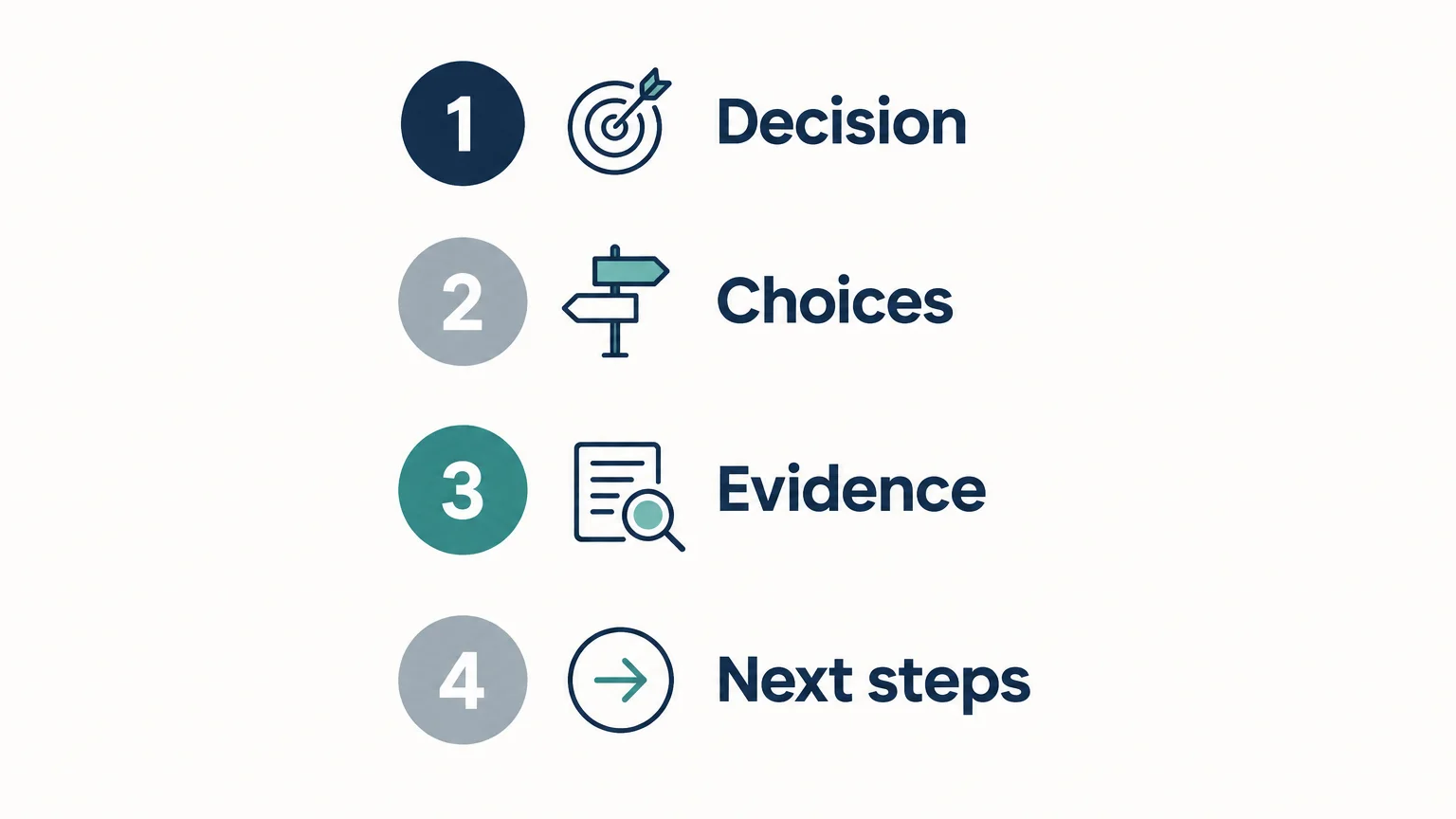
Before selecting a framework, define what the board needs to do with the information. A risk review needs clear indicators and ownership. An investment request needs alternatives, assumptions, and a specific approval. A recurring strategy update needs a consistent way to compare progress against priorities.
Then build a board presentation structure that carries the chosen framework into a readable story: decision context, recommendation or question, key supporting evidence, trade-offs and risks, and next steps. Use action titles to state each slide’s main point. If you need a reusable visual approach, our presentation slide systems for 2026 relate to organizing strategic ideas into presentation materials.
A 2026 study of more than 100 directors, discussed in a Harvard corporate governance article, highlights constructive dissent and the use of pre-read materials as ways to make room for board discussion. When directors are expected to review detailed background in advance, the live presentation can focus on the decision, the evidence that matters most, and questions that need deliberation. See the 2026 director study.
For execution reviews, a strategy map or balanced scorecard can connect priorities to outcomes and measures. Separate leading indicators, which can signal whether a plan is on track, from lagging results that show what has already happened. Give each measure an owner and a review point, and keep the set limited to indicators that could change the board’s understanding or action.
Choose the framework that sharpens the decision
The right board presentation framework depends on the agenda: use a decision brief for approvals, a strategic choice map for direction, diagnostics for context, and scenarios or scorecards for uncertainty and execution. Make one framework the organizing lens, show evidence and trade-offs clearly, and end with an explicit decision or next step. That keeps the board discussion focused without sacrificing the reasoning directors need.
Build a Clearer Board Narrative
When the board decision is clear but the analysis is difficult to organize, a consistent visual structure can help your team present the reasoning with greater clarity. Our library brings together strategic-thinking templates, board-ready frameworks, narrative structures, and presentation systems for executives, founders, consultants, and business leaders.

Our strategy guide covers more than 15 frameworks and includes a framework selection guide. Our presentation materials are built for PowerPoint, Keynote, Figma, and more. Explore our visual strategic-thinking assets as you develop board materials that connect strategic choices, evidence, and action.
Frequently Asked Questions
Which framework should you use for a board strategy discussion?
Use a strategic choice map to organize where the organization will compete, how it expects to create value, and what capabilities the direction requires. Add a diagnostic tool only when it answers a specific question in the discussion.
How many frameworks should one board presentation use?
Usually, one primary framework is enough to organize the main story. Add another only when it addresses a distinct need, such as testing external conditions or monitoring execution.
Should a board presentation begin with the recommendation?
For an approval request, state the recommendation and decision required near the beginning. Then provide the evidence, alternatives, assumptions, and risks directors need to assess it.
How are SWOT and PESTEL different in a board deck?
SWOT organizes internal strengths and weaknesses alongside external opportunities and threats. PESTEL focuses on political, economic, social, technological, environmental, and legal forces in the wider operating environment.
How can Deckadence support board presentation planning?
Our strategy guide covers more than 15 frameworks and includes a framework selection guide. Our presentation assets include board-ready frameworks, narrative structures, and slide systems built for PowerPoint, Keynote, Figma, and more.