Many B2B teams describe their customers as companies, industries, or account tiers. That is useful for market analysis, but it can hide the people who determine whether a purchase happens. A more useful approach starts with the company context, then separates the roles inside the buying and usage process. Our business model canvas can help you connect those customer groups to the wider logic of your business model.
Unbundling B2B customer segments is therefore not simply a more detailed form of firmographic segmentation. It is a shift from asking which companies you serve to asking which people are involved, what each person is trying to accomplish, and how their needs affect the decision.
What does unbundling mean in B2B segmentation?
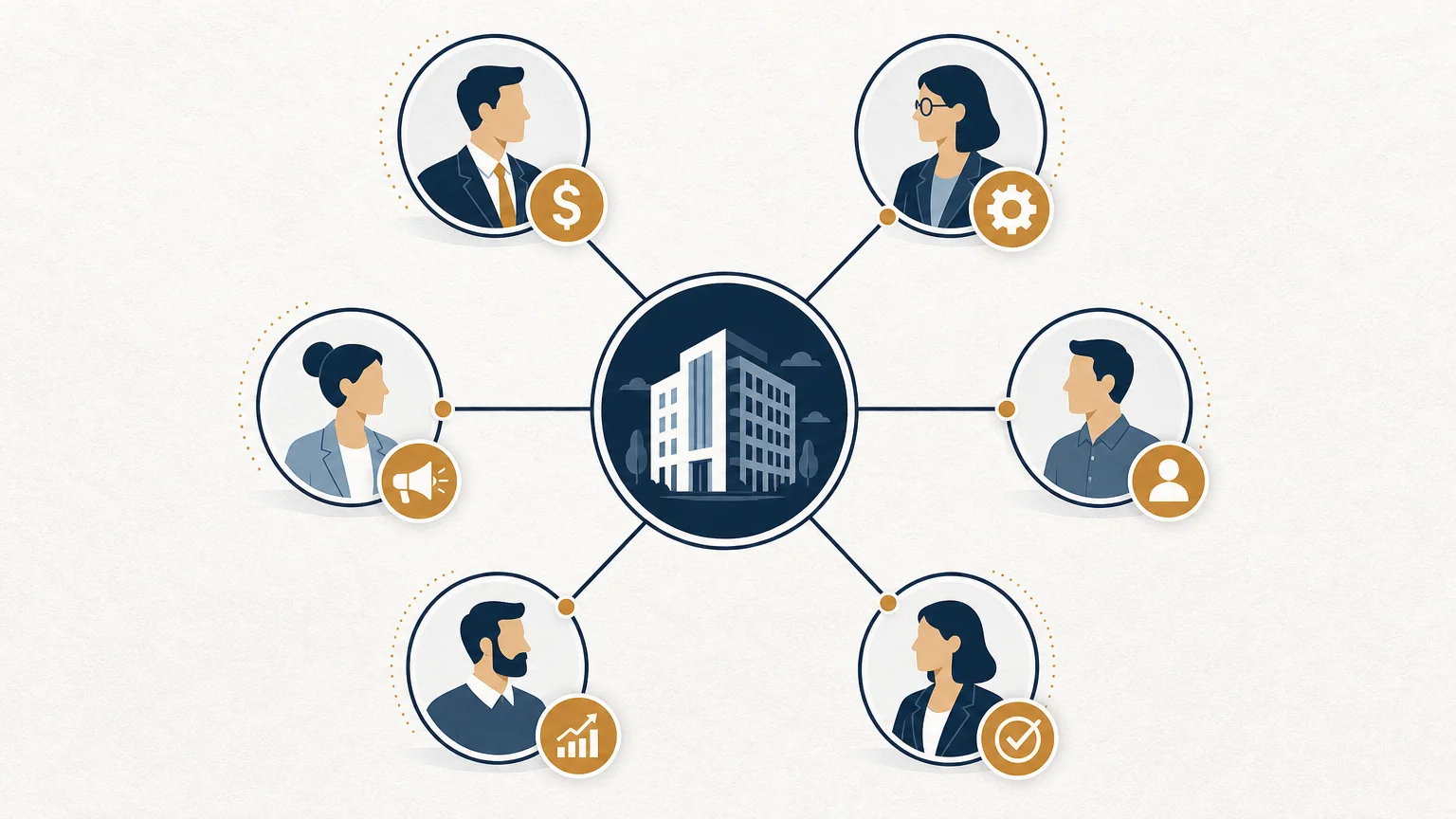
In a conventional B2B model, the customer is often represented as an account record. The record may include industry, revenue, employee count, location, technology, and purchasing history. These attributes help you identify suitable organizations, but they do not explain how value is experienced inside those organizations.
Unbundling adds a second layer. It separates the people involved in the search, evaluation, purchase, decision, recommendation, influence, implementation, and daily use of a product or service. Each role may have different priorities, objections, success measures, and sources of evidence.
For example, a finance leader may focus on budget control and measurable return. A technical evaluator may examine security, integration, and implementation risk. An end user may care about simplicity and workflow fit. A recommender may want a solution that supports the team’s credibility. These people may work for the same company, yet they do not represent the same customer profile.
A 2024 SEC-filed annual report from Turkcell illustrates this distinction at company level. Its corporate category includes both small and medium businesses and enterprise customers, while the company also describes tailored solutions for each segment. The example shows why an account category can remain broad while the needs within it still require more precise analysis through the Turkcell filing.
Why are company-level segments not enough?
Consider an enterprise account evaluating a strategy platform, professional service, or presentation system. The company may appear to be one segment, but the buying process can involve several customer types:
| Customer type | Primary responsibility | Typical jobs, pains, and gains |
|---|---|---|
| Economic buyer | Controls or approves the budget | Justify investment, reduce financial risk, and demonstrate business value |
| Decision maker | Has final authority or decisive influence | Choose a suitable option, protect strategic priorities, and secure internal alignment |
| Technical evaluator | Assesses operational or technical fit | Check compatibility, integration, security, implementation effort, and reliability |
| End user | Uses the product or service in daily work | Complete tasks efficiently, avoid friction, and achieve practical results |
| Recommender | Shapes the shortlist or internal preference | Find credible options, explain their relevance, and reduce uncertainty for others |
| Influencer | Affects perception or urgency | Frame the problem, introduce alternatives, and create confidence in a direction |
These roles can overlap, particularly in smaller organizations. In a startup, the founder may be the economic buyer, decision maker, recommender, and user. In a global enterprise, these responsibilities may be distributed across departments and seniority levels.
The important point is not to create a rigid taxonomy. It is to avoid treating one contact, or one account record, as a complete representation of the customer. A segment is useful only when it explains a meaningful difference in needs, behavior, value perception, or response to your offer.
How do you map jobs, pains, and gains by customer type?
Once you have identified the roles, map each one separately. The same product feature can support different outcomes for different people, so a single generic value proposition will often be too broad.
Start with the job each person must complete
A job is the practical, strategic, or social outcome a person is trying to achieve. The economic buyer may need to approve an investment with confidence. The user may need to complete work faster. The decision maker may need to select a solution that supports a wider transformation.
Describe the job in outcome terms rather than product language. “Create a presentation” is a task. “Align senior stakeholders around a strategic decision” is a more useful job because it reveals the result that matters.
Identify the pains that block progress
Pains include risks, frustrations, delays, trade-offs, objections, and consequences. A technical evaluator may fear implementation complexity. A user may worry that a tool will add work rather than remove it. An executive may be concerned that a recommendation will remain unclear to the board.
Prioritize pains by severity and relevance. Not every inconvenience deserves a separate segment. A pain becomes strategically important when it changes the buying decision, the perceived value of the offer, or the resources required to serve the customer type.
Define the gains that make the job successful
Gains describe the outcomes people want beyond the minimum acceptable result. These may include speed, confidence, clarity, recognition, risk reduction, status, control, or a stronger relationship with an internal stakeholder.
To structure this work, use our Value Proposition Canvas model as a practical way to connect customer jobs, pains, and gains to the value your offer is expected to create. The goal is not to produce six disconnected personas. It is to understand how the roles interact around one buying and usage situation.
Which criteria make unbundled segments actionable?
Unbundling becomes useful when it leads to decisions. Role labels alone are not enough. You need criteria that explain how each customer type should be reached, supported, persuaded, and measured.
Five criteria are particularly useful:
- Role in the journey: Identify whether the person searches, evaluates, recommends, approves, buys, implements, or uses the offer.
- Primary outcome: Define what success means for that person and how it differs from the outcomes of other roles.
- Decision influence: Estimate whether the person controls budget, shapes preference, blocks progress, or validates adoption.
- Buying stage: Distinguish between people who are identifying a problem, comparing solutions, building a business case, or preparing for implementation.
- Service expectation: Clarify whether the person needs education, technical support, customization, executive reassurance, or ongoing partnership.
These criteria help you avoid a common mistake: dividing the market into too many small groups that cannot support different actions. If two customer types respond to the same message, require the same evidence, and receive the same experience, they may belong in one operational segment.
Needs-based segmentation should complement, not replace, firmographics. Industry, company size, location, revenue, and technology remain useful for finding accounts. Customer-type analysis explains what happens inside those accounts once a relevant opportunity exists.
A 2026 market report on digital marketing services makes a related observation, noting that customer sophistication can affect preferences for bundled services and pricing models. This supports a practical distinction between customers who need education and customers who already understand the category, as described in the 2026 market report.
How can you build an unbundled B2B segmentation workflow?
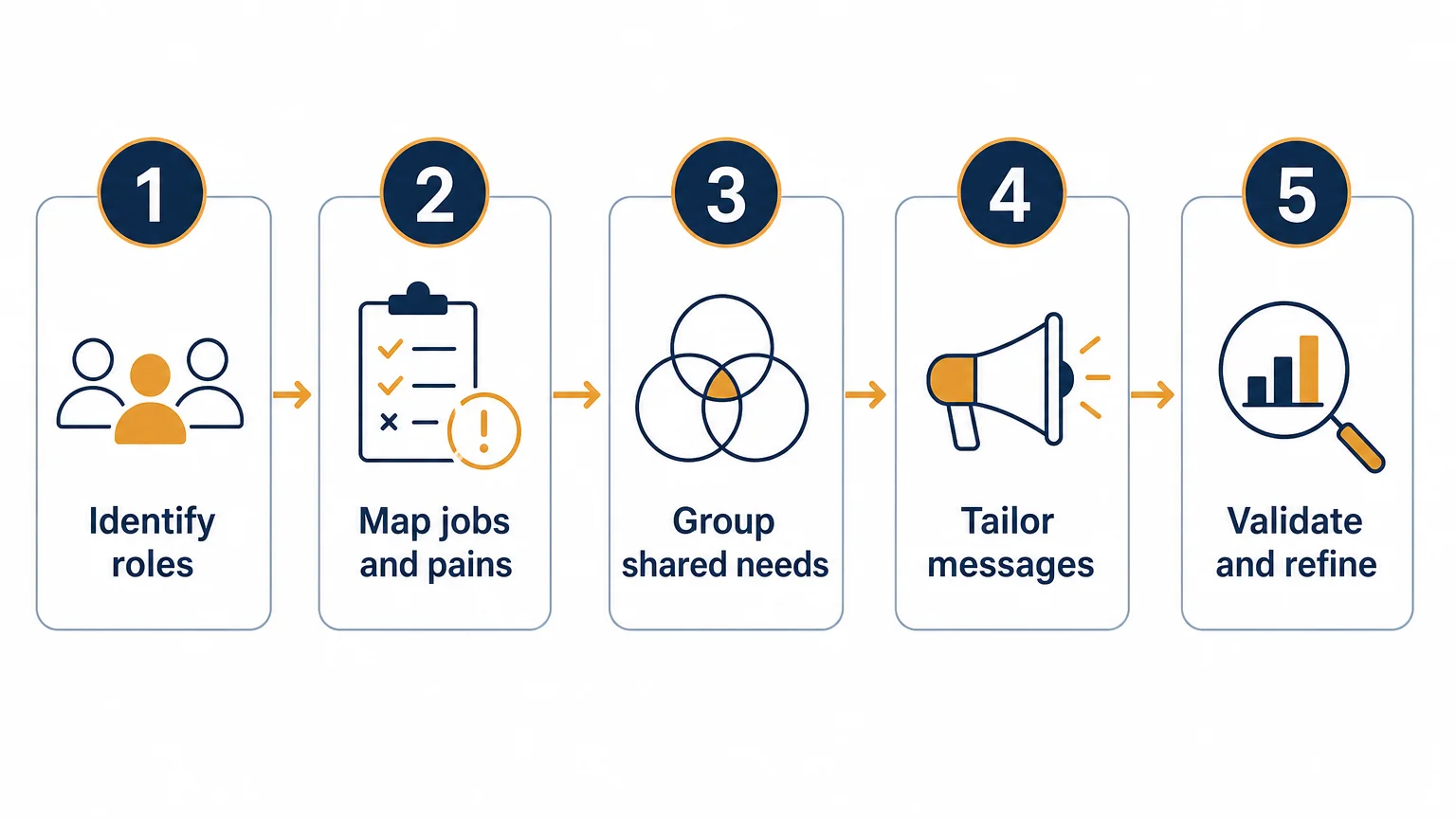
A workable process can be organized into six stages. Each stage should produce an output that another team can use.
- Define the account context. Start with the company attributes that determine relevance, such as industry, size, geography, technology, growth stage, and strategic importance.
- Map the buying and usage system. Identify everyone involved before, during, and after the purchase. Include people who can delay, accelerate, recommend, approve, or reject the decision.
- Interview across roles. Ask what each person was trying to accomplish, what created concern, which evidence mattered, and what nearly stopped the purchase.
- Cluster shared needs. Group customer types that have similar jobs, pains, gains, decision criteria, and service expectations. Keep role differences visible when they affect the message or offer.
- Connect segments to action. Define the message, channel, proof point, sales motion, content asset, and product experience for each priority segment.
- Measure and refine. Track response, progression, conversion, adoption, expansion, retention, and feedback by account segment and customer type.
For a broad market view, you can also connect the workflow to our TAM, SAM, and SOM examples. This helps separate the total market opportunity from the accounts you can serve and the customer types you can realistically reach with your current capabilities.
Within the workflow, maintain two connected views. The first is the account view, which explains whether an organization fits your target market. The second is the human view, which explains how value is evaluated and how the purchase progresses inside that organization.
How do unbundled segments improve communication and offers?
The immediate benefit is sharper communication. Instead of presenting one general message to an entire account, you can give each role the evidence it needs to move forward.
An economic buyer may need a concise business case. A technical evaluator may need implementation details. A user may need a demonstration of workflow improvement. An executive sponsor may need a clear narrative that connects the purchase to strategic priorities.
This does not mean producing unrelated messages. The messages should share a common value proposition while emphasizing different outcomes. Consistency protects the overall position. Relevance makes the position credible to each participant.
Unbundling can also improve offer design. If one segment values speed and self-service while another values guidance and customization, a single package may force both groups into the same buying experience. You may then explore different levels of support, implementation, education, access, or service without changing the underlying product.
An annual report on Orange Belgium published in 2026 provides a useful example of why operational context matters. Its B2B and wholesale discussion includes equipment lifecycle considerations and a planned shift toward circular business models from 2026. The broader lesson is that customer needs can be shaped by operational responsibilities, not just company size, as shown in the Orange Belgium report.
For internal alignment, our business model portfolio can help teams compare customer opportunities, value propositions, and strategic choices in a structured visual format. That is especially useful when several customer types compete for limited product, marketing, sales, or service resources.
What mistakes weaken unbundled customer segments?
The first mistake is confusing a job title with a customer profile. A chief financial officer is not automatically one segment. Two finance leaders may have different priorities because they operate in different industries, buying stages, or business contexts.
The second mistake is mapping only the buyer. The person who signs the contract may not be the person who uses the product, recommends it, or determines whether adoption succeeds. Ignoring those roles can create a message that wins approval but fails in implementation.
The third mistake is treating every stakeholder as equally important. Some people influence the decision directly. Others provide useful context but do not justify a separate segment. Prioritize the roles that materially change the buying process, the offer, or the customer experience.
The fourth mistake is creating static segments. People change roles, companies change priorities, and buying committees evolve during long sales cycles. Review segment assumptions when win rates, objections, adoption patterns, or customer feedback change.
The final mistake is stopping at description. A segment should lead to an action. If the team cannot explain how the segment changes the message, channel, proof, offer, or service model, the analysis has not yet become operational.
Conclusion
Unbundling B2B customer segments gives you a more realistic view of how business purchases happen. Companies provide the account context, but people create the jobs, experience the pains, evaluate the gains, influence the decision, and determine whether value is realized. Start with the account, map the customer types inside it, group people by meaningful differences, and connect every priority segment to a practical action. The result is clearer positioning, better stakeholder alignment, and more disciplined resource allocation.
Make complex B2B strategy easier to present
Once your customer types are mapped, the next challenge is making the logic clear to colleagues, clients, executives, or board members. A strong structure should show how the segments differ, why their needs matter, and which strategic choices follow.
We create premium slide decks, strategic-thinking templates, narrative structures, board-ready frameworks, and presentation systems for consultants, agencies, founders, executives, and business leaders. Our materials combine proven strategic frameworks, structured storytelling, concise messaging, action titles, and evidence-driven visual communication for PowerPoint, Keynote, Figma, and more. Explore our visual strategy presentation assets to turn complex B2B thinking into a clearer, more persuasive story.
Frequently Asked Questions
What does unbundling B2B customer segments mean?
It means separating the people involved in a B2B purchase or usage process instead of treating the company as one customer profile. Each customer type is analyzed through its role, jobs, pains, gains, influence, and buying stage.
How is unbundling different from firmographic segmentation?
Firmographic segmentation groups accounts by attributes such as industry, size, revenue, or location. Unbundling examines the people inside those accounts and explains how their different needs affect the buying and usage process.
Which customer types should be mapped first?
Start with the economic buyer, decision maker, technical evaluator, end user, recommender, and influencer when those roles exist. Prioritize the roles that control budget, shape preference, create objections, or determine adoption.
Can a single person belong to several customer types?
Yes. In smaller organizations, one person may approve the budget, make the decision, recommend the solution, and use it. Record the distinct responsibilities separately, even when the responsibilities belong to the same individual.
How can Deckadence support this work?
Our premium slide decks, strategic-thinking templates, narrative structures, and board-ready frameworks can help you communicate customer segments, value propositions, and strategic choices clearly. They are designed for professional presentation workflows across PowerPoint, Keynote, Figma, and more.